

To improve your communication when joining a new soccer team, observe what each teammate needs to know, use brief cues before they have to decide and confirm what the team's instructions mean. Support your words with a clear position or gesture. When you receive feedback, identify which action you need to change and check that you have understood.
Joining a new team also means learning how the group shares information. You may know a word, but the team uses it to trigger a different pressing action; you may ask for the ball with a gesture the passer cannot see. Sharing a language helps, but you still need to understand the cues and reference points used by your coach and teammates. You develop that understanding in specific situations by observing, asking questions and applying what you learn.
Why Does Communication Matter in a New Team?
During your first training sessions, you may focus so much on executing well that you warn a teammate about an opponent too late or struggle to offer support. The priority is to recognize which information is missing in each situation: where pressure is coming from, which teammate has space or who needs to provide cover when a defender steps out. A cue is useful when it arrives in time and describes something you can actually observe.
Communication helps coordinate actions and make intentions clear. If you identify a nearby defender, the receiver can assess how to protect or release the ball; if you call that you are providing cover, your teammate can understand who is protecting the space behind them. This information complements their reading of the game and needs updating as the ball, opponents or available options change.
You also need to understand how your coach communicates. FIFA Training Centre explains that direct instructions and questions can be used at different moments to support learning. For a player, this means listening to which detail is being corrected, asking for clarification when needed and demonstrating understanding in the next action.
Four Functions of Communication on the Pitch
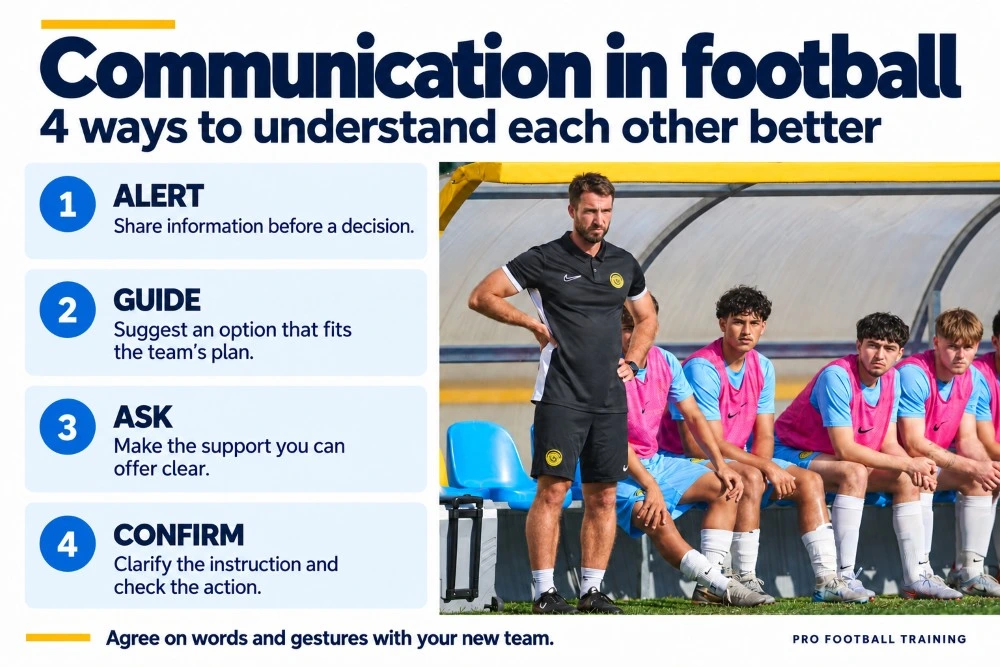
- Alert: communicate pressure, an unmarked opponent or the time available before your teammate has to act.
- Guide: share information about space, cover or a movement that affects the play.
- Ask: show that you are offering support, request a passing option or ask for an instruction to be repeated.
- Confirm: explain what you have understood and check it by making the adjustment, as well as listening to the instruction.
When you join, ask which calls and signals the team uses in your position. Start with a few common situations and expand your vocabulary as you understand each cue's purpose. Speak loudly enough for the intended teammate to hear you, using a message they can recognize without having to interpret a long sentence.
On-Pitch Situations: What to Communicate and When
Before Receiving
Before a teammate receives, you can warn them that a defender is approaching or let them know they have time. Check the situation again while the pass is traveling: space that was open may close. Use the call agreed by your team and avoid saying “turn” unless you can see that there is an available option. Give the receiver information they can use to decide.
A Teammate Under Pressure
If a teammate receives with their back to play or close to an opponent, identify how you can help: warn them about the pressure, offer a lay-off option or indicate an open passing lane. Calling “here” while you remain screened by a defender offers little help. Make sure your words and position describe the same option, and adjust again if that passing lane closes.
Cover and the Defensive Line
When a player steps out to press, the responsibilities of nearby teammates change. Before calling “covering” or “I'm going,” understand which area each player protects and who needs to close the space left behind. If you tell a teammate you are covering, make the movement needed to provide that cover. Your call must match your role in the team's defensive plan.
Transition After Losing Possession
After losing the ball, prioritize the team's instruction: press, drop back, close a passing lane or track an opponent, according to the agreed plan. A brief cue can guide the reaction of nearby teammates. Review the mistake once the action has ended; during the transition, you need to stay involved and adjust your position.
Set Pieces
Confirm your responsibility for corners and free kicks in advance: which zone or player you are responsible for, who organizes the team and how to respond to the second ball. If something has not been agreed, clarify it before play restarts. The taker's signals and planned movements need to be shared with the group; bringing a code from your previous team does not mean everyone will understand it.
Feedback During a Drill
Turn the instruction into a specific action. If you are asked to get “wider,” clarify your reference point and when you should move. You can ask, “Do you want me to receive closer to the touchline?” or “When the full-back steps out to press, should I close the inside passing lane?” Then try the adjustment and ask for a brief confirmation if you are still unsure.
Non-Verbal Communication: What Your Body and Movement Convey
Your position also communicates information. Offering support within the passer's field of vision, pointing toward an available option or preparing your body to receive can help your teammate recognize your intention. For a signal to be useful, they need to see it and connect it with a real option in play.
- Body orientation: lets a teammate see how you are prepared to receive or continue the action, alongside the pressure near you.
- Eye contact: can help you connect with the passer, although a glance alone does not confirm that you have both chosen the same option.
- Gesture: indicates space or a passing option. Confirm what it means within the team and avoid pointing to an option that is blocked.
- Distance: affects whether your support is recognizable and usable, both when keeping possession and when protecting space.
- Movement: a run to get free, a pause or a change of direction can show when and where you want to receive.
Check whether the intended teammate can see your signal. Raising your arm behind the passer does not provide the same information as offering support within their field of vision. Agree on gestures too: pointing to an area may mean “pass there” or “move into that space,” and the distinction changes the action.
How to Ask Your Coach for Clarification
Frame your question around the task and the moment when it happens. A specific question can clarify one detail without requiring the whole explanation to be repeated. When possible, use a pause between repetitions; then demonstrate what you have understood through an action or a brief explanation.
- Ask about the action: “Do you want me to tuck inside or stay wide?”
- Clarify the target: “When you say ‘step out,’ which opponent should I press?”
- Confirm the sequence: “When the ball goes to the full-back, I close the inside passing lane. Is that right?”
- Check the adjustment: “Is that the position you wanted, or should I move closer?”
If you are not yet confident in the language, ask someone to point out the position or demonstrate the sequence. You can repeat what you have understood in your own words and ask a teammate after the task. Learning an expression alongside the action it describes makes it easier to use meaningfully than memorizing it out of context.
Short Soccer Cues: Examples and What to Confirm
This table offers examples of cues that can help you ask about the group's shared codes. Their meaning varies between countries, coaches and teams. Confirm who the cue is directed at, which area it refers to and what responsibility it implies before using it in your play.
| Situation | Example cue | What to confirm with your team |
|---|---|---|
| A teammate is about to receive under pressure | “Pressure”, “man on”, or the agreed warning | Which cue the group uses and which opponent you can identify from your position. |
| The receiver has space | “Time” | How much time the receiver has to act and whether the space is still available when the ball arrives. |
| You offer a passing option | “Here”, “support”, or a name and gesture | That the passer can identify you and that the passing lane is open. |
| A teammate steps out to challenge | “Covering”, “I’m going” | Who challenges, who covers behind them and which movement each player is responsible for. |
| A coordinated press is triggered | “Press”, “step out”, or the team’s agreed cue | Which opponent to press, what triggers the movement and who provides cover. |
| The team reacts after losing possession | “Recover”, “close the space”, or the agreed cue | Whether the plan is to press or drop back and which space you need to protect. |
| Before a set piece | A teammate’s name and their agreed responsibility | The assigned player or zone, planned signals and the response to the second ball. |
These cues are examples. Confirm their meaning and the responsibilities with your team.
Use the table to connect a word with a situation. A call such as “time” becomes less useful if it arrives late; “covering” needs a matching movement; “here” requires a recognizable passing option. Assess the quality of communication by the information it provides and how your teammate responds.
Three Ways to Practice Soccer Communication
You can work on these aspects with teammates and guidance from your coach. Adjust the space, opposition and instructions to the group's level. The following tasks help you observe a specific behavior and discuss what happened afterwards.
1. Passing and Support With a Useful Cue
Set up a sequence in which one player passes, another receives and a third offers the next option. The supporting player needs to be visible and use an agreed cue before the receiver decides. After several actions, review whether the message arrived in time and whether the supporting player's position made the option usable. If you add a defender, adjust the difficulty with your coach and avoid calling for an option that is already blocked.
2. A Small-Sided Game Focused on Signals
A small-sided game can focus attention on how players show their support and intentions. As part of its grassroots resources, FIFA Training Centre presents a silent task for observing communication without words. Any adaptation should be agreed with the coach to suit the group. Review which looks, gestures or movements were visible and which situations needed a verbal cue.
3. One Correction and One Check
Choose a recurring instruction for your position with your coach. Explain what you think it means, identify when it applies in play and try the adjustment in the next repetition. Then check whether your action matched what was requested. If the reference is still unclear, change your question: instead of repeating the same word, ask for a demonstration or an example.
How to Check Whether Your Communication Is Useful
After training, choose a specific situation and review what you saw, what you communicated and when your teammate reacted. Ask whether the message was understandable, arrived before the decision and described an option that was still available. If you have video, limit your conclusion to what the recording allows you to see and hear.
You can keep a brief record with three fields: the situation, the call or gesture used, and an adjustment for your next session. Discuss it with the teammate involved or your coach; completing a pass does not, by itself, show that communication was clear. The same action can depend on your teammate's observation, technical execution and pressure from opponents.
Common Mistakes When Communicating on the Pitch
- Shouting without useful information: adjust your volume so you can be heard and check that the cue identifies something useful.
- Using long sentences: choose a message your teammate can recognize while focusing on play.
- Bringing codes from your previous team: confirm their meaning before assuming everyone shares the same reference.
- Speaking only when asking for the ball: you can also warn about pressure, coordinate cover or help after possession is lost.
- Switching off after a mistake: keep carrying out your responsibility in the next action and review the previous one during a pause.
- Assuming you have understood feedback: check which action is being requested and explain your interpretation if you are still unsure.
- Giving instructions that contradict the team's plan: share information and respect the responsibilities set by the coach.
For Families: Supporting the Learning of Team Cues
Families can help by asking which instruction was new, how the player understood it and what they want to clarify at the next training session. Listen to the situation before interpreting feedback as a judgment of the player's level. If a player is under 18 and the language barrier prevents them from understanding important instructions or expressing a need, agree on a clear communication channel with the staff responsible.
Communication is part of a broader adjustment to the team and its environment. To review routines, feedback and your response to training as well, read how to adapt to football during your first 30 days in Spain. This communication guide focuses on the calls, gestures and clarification that help you take part in on-pitch actions.
Developing Communication as Part of Your Training Process
When joining a new team, first observe how the group shares information and choose a few cues to work on. Use calls that match what you see, offer clear support and turn feedback into actions you can review. Learning requires practice and feedback, as well as knowing the words.
Pro Football Training, a platform within Siello Academy, is part of Siello Football Group, an ecosystem dedicated to the long-term development of footballers in Europe.
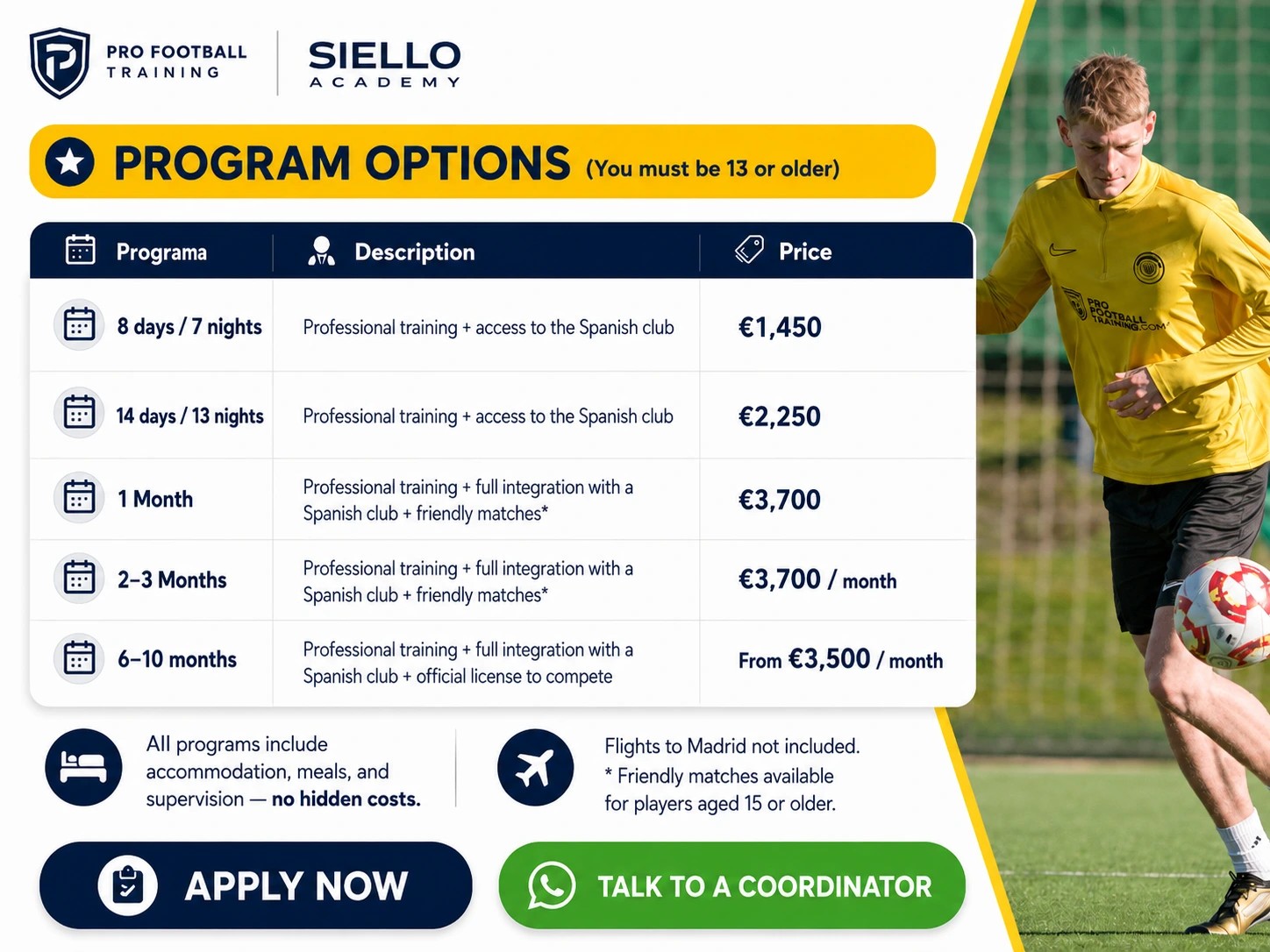
To learn about immersion and training options in Madrid, explore our programs and review which format may suit your age, level and goals. Your choice should start with your profile and the continuity of training you can sustain.

Frequently Asked Questions About Soccer Communication
Are There Universal Words in Soccer?
Some expressions are common, but their practical meaning can vary between teams. Before using a word, confirm who it is directed at, which situation it describes and what action is expected. Sharing a language does not guarantee that you share every reference used in play.
What Should I Do If I Do Not Understand My Coach's Feedback?
Ask about the specific action: where you should position yourself, which opponent you should press or when you should move. You can explain what you have understood and ask for confirmation. Then check the instruction in the next repetition.
Does Talking a Lot Always Help on the Pitch?
No. A cue needs to arrive in time and provide recognizable information. Repeating instructions or speaking without a clear reference can be distracting. Check whether the intended teammate could hear you and use the message.
How Can I Communicate If I Am Not Yet Confident in the Language?
Start with the common calls used in your position and learn each word alongside the situation it describes. Ask for a sequence to be demonstrated, explain your interpretation and confirm what gestures mean. If an important instruction is still unclear, ask your coach or the staff responsible for help.
Can Non-Verbal Communication Be Trained?
Yes. You can observe and practice how you make support visible, where you point and when you make eye contact with the passer. FIFA Training Centre includes a silent task within a grassroots session. The choice and adaptation of tasks should suit the group and the coach's objective.
Does Communication Guarantee Better Adaptation or More Playing Time?
No. Understanding team cues and giving useful information can help coordinate actions, but adaptation and competitive participation also depend on your level, performance, the coach's decisions and the team's context.