
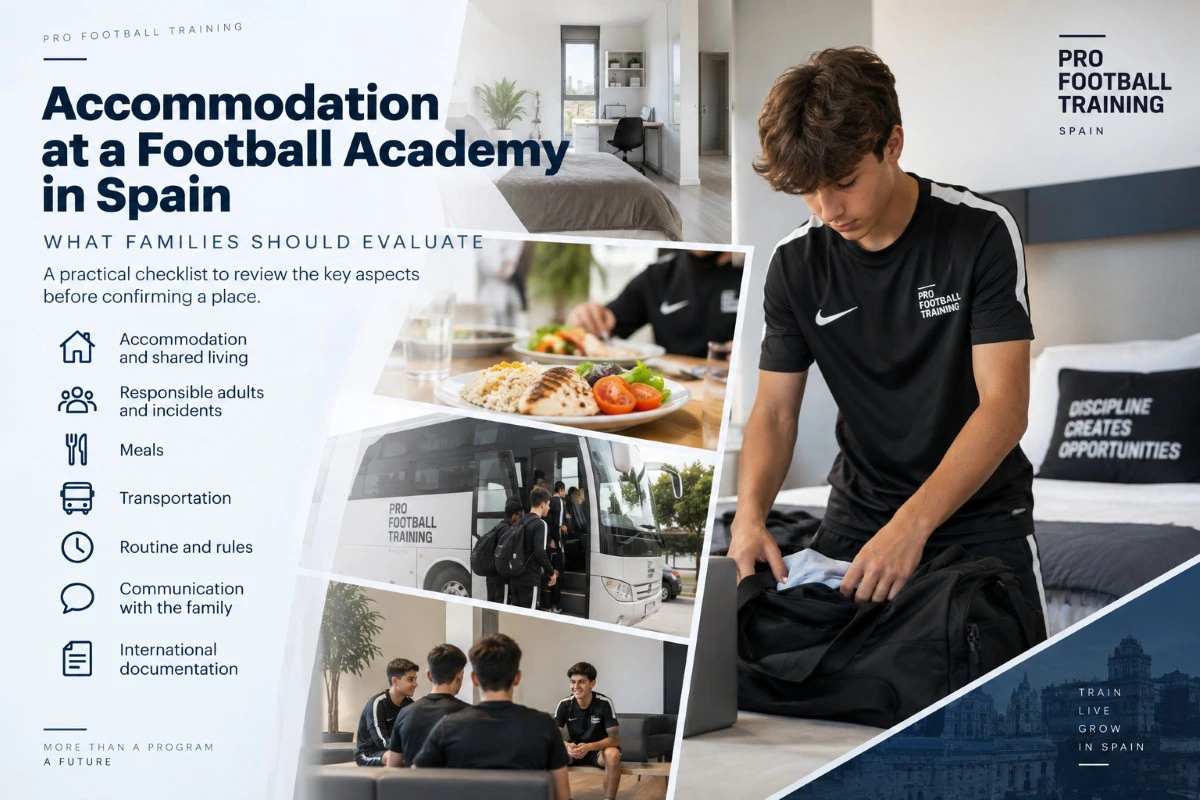
Before choosing soccer academy accommodation in Spain, review seven areas: the accommodation and shared-living setup, responsible adults and incident procedures, meals, transportation, routines and rules, family communication and international documentation. Ask for specific answers in writing and distinguish confirmed inclusions from conditions that depend on program length, age or the player’s individual situation.
Choosing accommodation is not simply about knowing where the player will sleep. The decision affects the player’s daily routine, rest, shared living, meals, transportation and ability to adapt to a new environment.
For a family, the useful question is not simply “is accommodation included?” but what structure supports the player’s life away from the field and who is responsible when a need or incident arises.
This guide is designed to help families compare specific conditions before confirming a program. It does not present a residence, shared apartment or any other accommodation format as inherently better. Its purpose is to distinguish between what is confirmed, what can vary and what should not be assumed.
How to Use This Checklist Before Deciding
Compare each option using the same criteria: program length, player age, accommodation format, room type when applicable and individual needs.
Ask for specific answers, preferably in writing, and keep that information together with the proposal, budget or program terms.
It is not enough to read that “accommodation,” “full board,” “transportation” or “supervision” are included. Families need to understand how each element works in the specific program format they are considering.
Before moving forward:
- separate confirmed inclusions from anything subject to program length, age, format or individual confirmation;
- ask who is responsible for each part of the stay, not only which services are advertised;
- ask how schedule changes, illness, conflicts or rule violations are handled;
- clarify what is covered by the price and what may require additional arrangements or costs;
- and compare how the arrangement actually works, not only labels such as “residence,” “full board” or “support.”
Core Checklist: What to Verify Before Confirming Accommodation
| Area | What to verify | Questions the family should ask | What to request |
| Accommodation and shared living | Housing setup, room arrangement, roommates, common areas and rules | Where will the player live? Will the room be shared? How is shared living organized? | Current accommodation description and applicable house rules |
| Responsible adults and incidents | Responsible contact, coverage and escalation process | Who responds in case of illness, conflict or an emergency? When is the family informed? | Responsible contact or role and incident-response procedure |
| Meals | Meals provided and management of individual needs | Which meals are included? How are allergies, intolerances or dietary restrictions handled? | Practical meal details and specific confirmation when required |
| Transportation | Regular routes, coordination and schedule changes | Which journeys are covered by the program? What happens if a schedule changes? | Clear scope of the transportation provided and its limits |
| Routine and rules | Rest, phone use, organization, study where applicable and discipline | How much independence is expected? What rules apply, and how are repeated violations handled? | House rules or a clear summary of shared-living expectations |
| Communication with the family | Communication channel, responsible contact and emergency procedure | Who communicates with parents or guardians? How is a significant incident reported? | Official communication channel and contact procedure |
| International documentation | Travel, required medical coverage, visa matters and emergency contacts | Which documents should we review based on nationality, residence and length of stay? | List of outstanding documents for the player’s specific case |
The value of this table is that it turns broad concepts into specific, verifiable questions.
1. Accommodation and Shared-Living Conditions
The word “residence” does not explain what daily life will actually be like. Families should confirm which accommodation format the player will use, how the room is organized, which spaces are shared and what basic shared-living rules apply.
It is also important to understand how roommates are assigned, how much privacy the player will have and how everyday matters such as noise, tidiness, cleaning, laundry and use of common areas are handled. If any of these services are listed as included, ask for confirmation for the specific program format.
A residence is not automatically more suitable than a shared apartment unless it is specifically structured around the player’s needs, as is the case with the Siello Academy Residence.
The right fit depends on the player’s age, maturity and independence, as well as the structure in place, the responsible adults and the clarity of the rules.
For a family, the right question is not which label sounds better, but which environment is appropriate for that specific player.
2. Responsible Adults and Incident Procedures
It is not enough to ask whether supervision exists. Families should understand who holds operational responsibility, how time outside training is covered, what counts as an incident and when the family is expected to become involved.
A logistics question, a conflict between players, an illness and an emergency are not the same type of situation and should not be handled through the same procedure.
If a program includes 24/7 supervision and support, families should ask what that means operationally for the selected format: who the contact person is, which communication channel is used and how an issue is escalated.
For a broader look at wellbeing, independence, health, routines and support while living away from home, see our parent guide to safety, accommodation and support for young players.
This article has a more specific purpose: what a family should verify before confirming accommodation.
3. Meals and Individual Needs
The concept of full board also needs to be translated into practical information.
Families should know which meals are provided, how they fit into the daily routine and what happens when a player has allergies, intolerances, medical restrictions or specific dietary needs.
The fact that a program includes meals does not mean every individual dietary need can automatically be accommodated. If the player has a specific requirement, communicate it before booking and ask how it can be managed.
It is also worth asking what happens when normal meal times change because of training, travel or scheduled activities.
4. Transportation and Daily Logistics
Daily logistics directly affect punctuality, rest and independence. Before confirming accommodation, families should understand how regular trips between the residence, training, the club environment and scheduled activities are organized, who coordinates them and what happens when a schedule changes.
The fact that a program includes local transportation does not necessarily mean every personal trip is covered. Ask which routes are part of the program’s organization and which are outside its scope.
This is particularly important for international families because it prevents expectations from being built around an overly broad interpretation of the word “transportation.”
5. Routine, Rest and Shared-Living Rules
A large part of adaptation happens outside training. Being on time, getting enough rest, organizing personal belongings, respecting shared spaces, using a phone responsibly and asking for help when needed are all part of living away from home.
A clear structure does not guarantee immediate adaptation, but it helps both the player and family understand the level of independence expected.
Before traveling, families should understand any rest schedules or guidelines, rules for leaving and returning, punctuality expectations, use of common areas and how house rules are communicated and enforced.
If the program overlaps with education requirements, families should also confirm how those responsibilities fit into the player’s routine. Academic tutoring or other education services should not be assumed unless they have been explicitly confirmed.
6. Communication With Parents and Guardians
A good communication structure does not mean constant contact.
The family needs to know who to contact and in which situations, while the player develops a level of independence appropriate to their age and circumstances.
Before confirming the stay, identify the official communication channel, the person responsible for logistics, the emergency procedure and which types of situations are communicated directly to parents or guardians.
It is also useful to clarify which issues the player is expected to handle first and which require intervention from a responsible adult.
This reduces two common problems: families not knowing who to contact when something happens, and several people trying to resolve the same issue through different channels.
7. Additional Checks for International Families
For families from Mexico, Argentina, the United States and other international markets, accommodation cannot be evaluated separately from the travel arrangements.
In addition to accommodation conditions, families should review the player’s passport, entry or stay requirements, emergency contacts, any medical coverage required for travel, the language used for communication and any authorizations that may apply to a minor.
The requirements are not the same for every family. They may vary according to nationality, usual country of residence, itinerary, length and purpose of the stay, age and family circumstances.
The travel authorization published by Spain’s National Police has a specific scope: it refers to the procedure that applies to certain Spanish minors residing in Spain who leave the country. It should not be interpreted as a universal authorization for every foreign player traveling to Spain.
International families should therefore verify their situation with the relevant authorities, the countries involved and the airline before traveling.
If you are also organizing dates, documentation and preparation time, see our guide on when to start preparing for a soccer academy in Spain.
15 Questions to Ask Before Confirming a Place
Use these questions as the basis for a call, email or comparison between programs. If an answer depends on the selected format, ask for that condition to be clearly identified.
- Which accommodation format will the player use?
- Will the room be private or shared?
- How many people will the player share a room or common areas with?
- Which shared-living rules should the player know before arrival?
- Who is the operational contact responsible for the accommodation?
- How are illness, injury or shared-living conflicts handled?
- In which situations are parents or guardians informed directly?
- Which meals are included?
- How are allergies, intolerances or specific dietary needs confirmed?
- Which transportation routes are included?
- What happens if a training session or activity schedule changes?
- What rules apply to rest, phone use and punctuality?
- What is the official communication channel for the family?
- Which documents should we review based on our nationality and circumstances?
- Which elements may change depending on program length, age or format?
Before Paying: What Should Be Clear
Before making a reservation or taking on a significant financial commitment, the family should be able to identify clearly which accommodation format applies to the player, what the price includes and which elements are still subject to confirmation.
The responsible adults, general meal and transportation arrangements, relevant rules, incident procedures and any conditions that may change according to age or program length should also be clear.
Not every point needs to become a separate document, but important conditions should not depend only on an informal conversation or an interpretation of the website.
When a need is particularly important for the player—for example, a dietary restriction, medical situation or specific accommodation requirement—it is advisable to obtain specific confirmation before moving forward.
How the Siello Academy Residence Works Within Our Programs
At Pro Football Training, accommodation is not treated as a separate service from the sporting process. Our programs include a structured stay in Madrid designed to support training, rest, shared living and adaptation within an organized environment.
The residence is part of daily life at Siello Academy: it supports much of the player’s routine away from the field, including rest, meals, shared living, independence, schedules and personal organization.
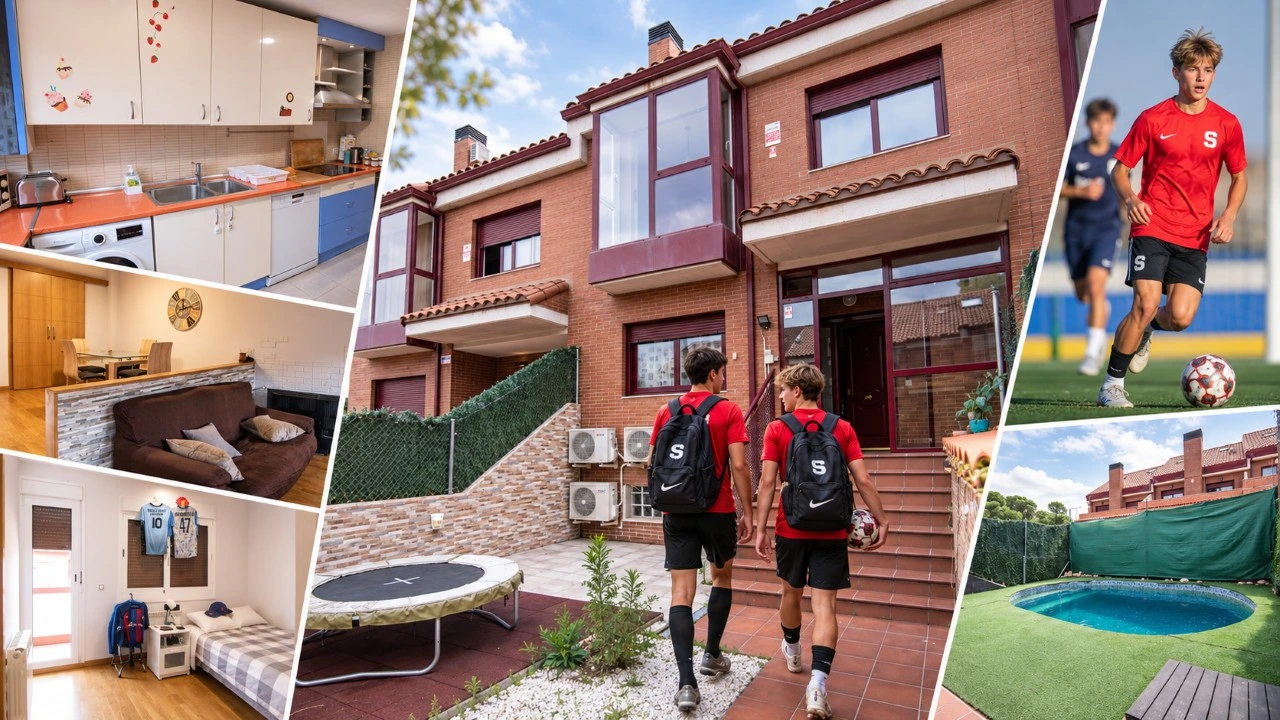
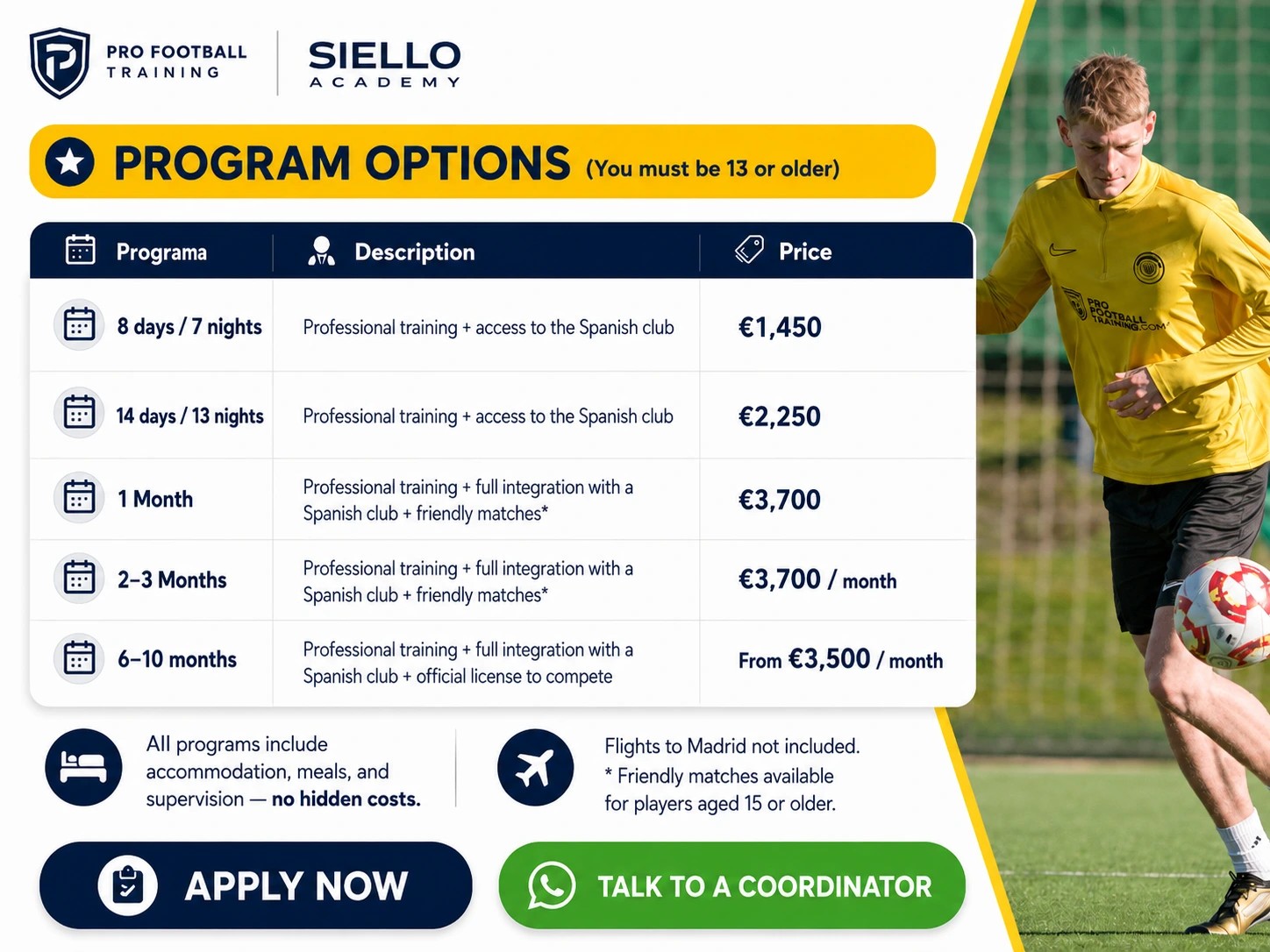
Our current residential structure includes single, double and triple rooms, as well as three meals per day, transportation to academy and club sessions, 24/7 staff supervision, laundry and cleaning of common areas. Families also have access to a dedicated communication channel with the team during the stay.
Airport pickup, local transportation, full board and assistance with documentation and visa matters when applicable are also part of the general structure of our programs in Madrid.
This does not mean families should stop asking questions before confirming a stay. Some details need to be reviewed according to the player and selected program, including the specific room configuration, individual dietary needs, documentation, length of stay, age, level of independence and any personal circumstances that may require specific arrangements.
That is why this checklist remains useful even when accommodation is included: the goal is not to confirm that a residence exists, but to understand how that structure will work for the specific player.
If you want to explore the residential setup in more detail, see our football boarding school and residence in Madrid, where we explain why accommodation is part of the player’s adaptation, rest and daily structure.
You can also review what a football program in Madrid actually includes—and what you should not assume to distinguish general inclusions, elements that depend on program length and details that require individual confirmation.
If you are still comparing the overall decision, also review how to choose a soccer academy in Spain for an international player and how much a football academy in Spain costs.
La residencia también forma parte del proceso
Accommodation is not simply where the player sleeps after training. During an international stay, the residence is part of the structure supporting the process: rest, meals, shared living, transportation, daily discipline, supervision and adaptation all happen away from the field as well.
For a family, that means the decision should not be limited to comparing facilities or room types. What matters is whether the environment provides a structure appropriate to the player’s age, independence and needs.
A well-structured residence does not guarantee immediate adaptation or better performance on its own. What it can do is reduce friction, organize the routine and provide a more stable environment so the player can focus on training, shared living and responding to the demands of the program.
If you are already evaluating a stay, use this checklist to bring the decision down to your specific case: age, program length, individual needs, documentation and level of independence.
Talk to an advisor to confirm how the program and residence will work for your specific case.

FAQs
What Should a Family Evaluate in Soccer Academy Accommodation?
Families should review how rooms and shared living are organized, who is responsible during the stay, how meals and transportation work, which rules apply, how communication with the family is handled and which documents are required. Rather than comparing facilities alone, the key is to understand how the player’s daily life works within that structure.
Is a Residence Always Better Than a Shared Apartment?
Not by definition. What matters is the structure behind each accommodation format: responsible adults, supervision, rules, shared living, meals, transportation and suitability for the player’s age and independence. In our programs, we work with a sports residence in Madrid that is integrated into the daily structure of Siello Academy and the player’s routine.
What Are the Rooms in the Residence Like?
Our current residential setup includes single, double and triple rooms. The specific room configuration for each player should be confirmed when organizing the stay.
Which Meals Are Included?
Our programs include full board, and the current residential setup for families includes three meals per day prepared by our chef. If a player has allergies, intolerances, medical restrictions or specific dietary needs, it is important to communicate them in advance and confirm how they can be managed.
How Does Transportation Work During the Stay?
The structure includes airport pickup and local transportation, as well as daily travel connected to academy and club sessions. Families should communicate any additional transportation needs so the team can determine whether they are part of the planned arrangements or require a different solution.
What Does 24/7 Supervision and Support Mean?
It means that during the stay there is a structure of supervision and support from staff in Madrid, including outside training sessions. The residential setup for families specifically includes 24/7 supervision. For individual situations, families can confirm before traveling who their contact will be and how communications or incidents will be handled.
How Does the Family Communicate With the Team During the Stay?
Our residential structure includes a dedicated communication channel for parents, giving families a clear way to contact the team during the program. The aim is to keep communication organized while allowing the player to progressively develop the independence required by this type of experience.
How Can You Tell Whether a Player Is Ready to Live Away From Home?
Beyond the player’s sporting level, families should consider whether they can follow schedules, live with other players, respect rules, organize their belongings, communicate a problem and ask for help when needed. The residence provides structure and support, but adaptation also depends on the player’s maturity, attitude and ability to respond to the environment.
Do the Conditions Change Depending on Program Length?
Program length changes the depth of immersion, sporting integration and some operational aspects of the program. Families should therefore confirm the specific conditions of the selected stay rather than assuming that a short format and a multi-month program work in exactly the same way.
Are the Travel Requirements for Spain the Same for Every Minor?
No. Documentation can vary according to nationality, residence, length of stay, itinerary and family circumstances. The country of departure, transit countries or the airline may also have specific requirements. These details should therefore be checked for each player before travel.