
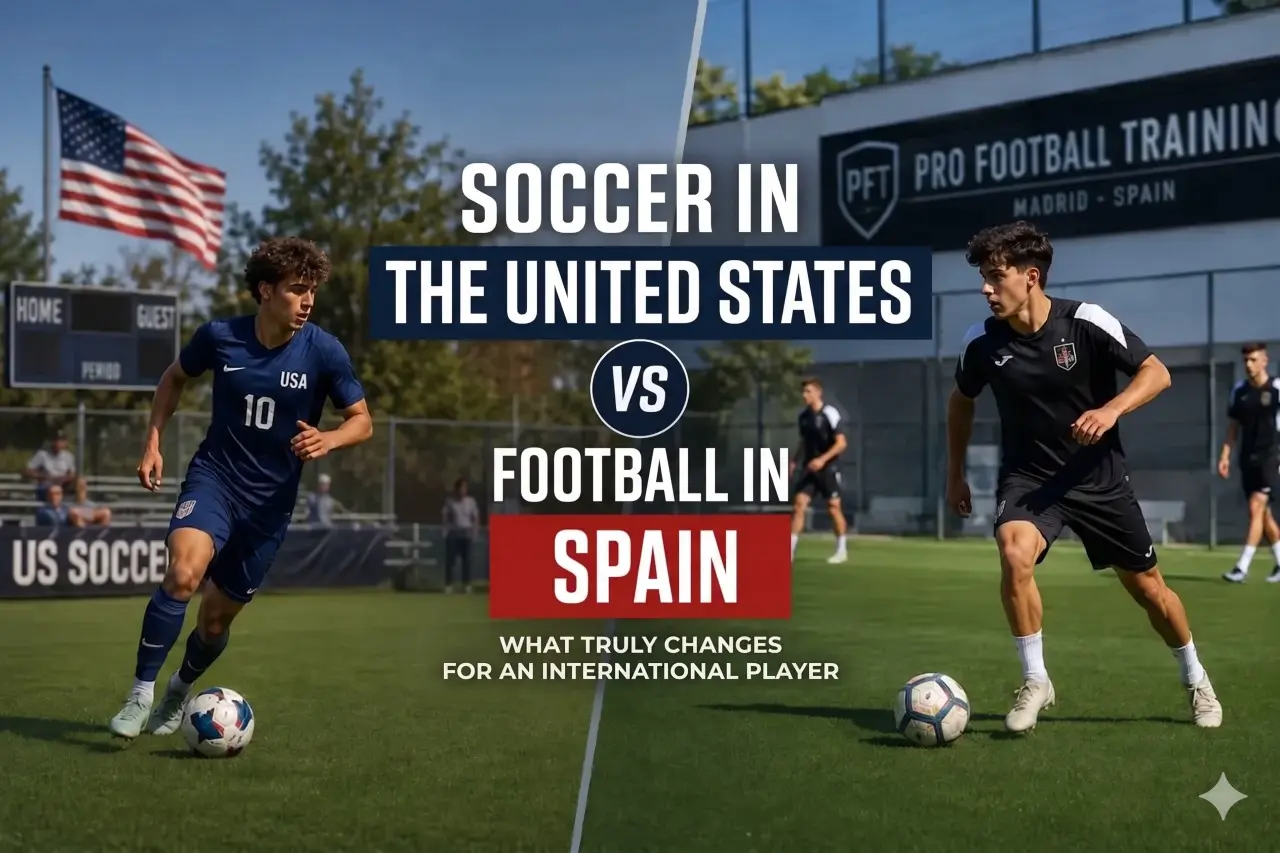
When families compare soccer in the United States with football in Spain, they often do it through shortcuts. Some sound familiar: Europe is more tactical, the United States is more physical, Spain is more technical, U.S. soccer is more tied to school and college pathways.
The problem is not that these statements contain no truth at all. The problem is that, on their own, they are not useful enough to support a serious decision.
For an international player, the real comparison is not about which country “wins.” It is about what actually changes in the type of process, the rhythm of the environment, the tactical demands, the competitive context, and the way daily development is sustained.
At Pro Football Training, a platform within Siello Academy and part of Siello Football Group, we do not sell an empty fantasy of Europe. We work inside an ecosystem focused on the long-term development of footballers in Europe. From that perspective, the right question is not whether Spain sounds more attractive than the United States, but whether the Spanish environment truly fits the player’s stage, profile, and real needs.
The first mistake is comparing labels when the real issue is the process
Many players and parents begin this conversation by comparing visible outputs: club prestige, country reputation, academy names, or the overall history of football in each market. Those things may influence perception, but they do not explain the most important layer: how players are trained, how they compete, and how their development is read on a daily basis.
The U.S. soccer environment can include very different structures: school soccer, club soccer, private academies, showcases, college-oriented routes, and highly competitive youth settings. Spain also contains its own internal differences. But when an international player enters a serious structure in Madrid, what changes is not only the badge or the language. What changes is the training logic, the tactical reading of the game, and the way the process is lived every day.
In the United States, the player often moves through a visible system; in Spain, the context often tests the player earlier
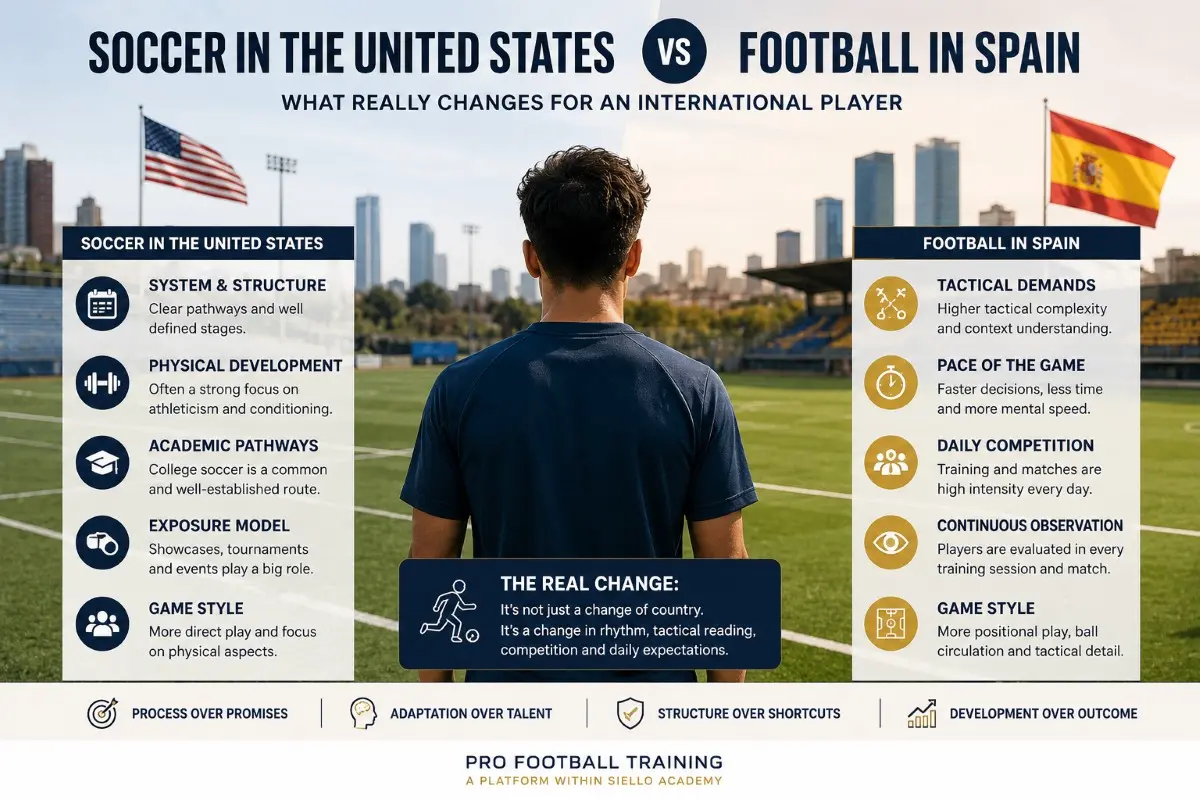
In many U.S. soccer pathways, the family moves through recognizable stages: club, tournament calendar, showcases, school soccer, and sometimes college planning depending on age and objective. Not every case is identical, but there is usually a stronger sense of a visible system guiding the player from one step to the next.
In Spain, international players often feel the pressure of the context before they feel the comfort of the system. The environment quickly pushes more difficult questions to the surface: how fast do you decide, how do you read space, how do you position yourself, how well do you respond to the training rhythm, and how consistent are you once the novelty disappears?
That difference does not automatically make one environment superior to the other. What it does is change the way the player is evaluated. In a Spanish football context, integration depends not only on what the player arrives with, but on how he responds inside a structure where tactical reading, adaptation, and daily consistency carry significant weight.
The tempo changes, but not only in physical terms
When people hear the word tempo, they often think first about running speed or physical intensity. But the biggest shift is not always there. It is often mental.
In Spain, tempo is frequently experienced through decision-making speed, the need to interpret spaces earlier, the pressure to play with less time, and the obligation to understand the situation before the action fully develops. That does not mean serious intensity does not exist in the United States. It means that the Spanish environment often pushes tactical understanding and contextual decision-making more visibly to the front of the process.
For some players, that shift is productive and clarifying. They find a football culture that organizes their reading of the game more effectively. For others, the same shift reveals very quickly that general athletic ability is not enough without tactical structure, detail, and the discipline to hold a demanding routine.
Competition is also integrated differently
Another common mistake is assuming that competing in Spain automatically means being “closer to professional football.” That is too simplistic. The real difference is found elsewhere: in the way competition is linked to training and to the player’s continuous observation inside the process.
In a serious environment, competition is not only about official matches. Training sessions themselves already belong to the evaluation, the adaptation phase, and the integration process. That is why international families should not think of Spain only as a place where a player can “be seen,” but as a place where the entire environment may require more precision, more tactical clarity, and a stronger daily response.
This also connects with one of our most important principles: training, competing, getting exposure, and signing are not the same thing. A more demanding environment does not justify automatic promises. It does justify a more realistic explanation of what kind of context can help evaluate a player more seriously.
Daily adaptation matters more than most families expect
When a family compares the United States with Spain, it is easy to focus only on what happens on the field. But a serious immersion is never defined only by training sessions. It also depends on routine, discipline, logistics, emotional balance, daily supervision, and the player’s ability to live inside the process rather than just visit it.
That is where our structure becomes especially relevant. The program is not built around isolated sessions or a one-off event. It includes accommodation in Madrid, full board, airport pickup, local transportation, daily training, integration into a Spanish club environment, 24/7 supervision and support, and local logistical guidance.
None of that should be framed as luxury or as a shortcut to results. It should be understood as part of the structure that allows the player to actually live the process instead of only observing it from the outside.
For players coming from the U.S. soccer ecosystem, that point matters even more. What they need is not a football-themed trip. What they need is a setting where adaptation can be tested seriously.
So what should U.S. families actually compare?
The useful comparison is not who has stronger branding or which country sounds more prestigious. What matters is what type of development the player really needs right now.
Families should look at questions like these: does the player need a serious first immersion or a deeper integration? Does his level and competitive maturity justify a change of context? Does he respond better in highly scheduled systems, or does he need an environment that pushes his tactical reading and adaptation more aggressively? Is he truly ready to sustain daily life inside a serious structure away from home?
When those questions are answered honestly, the comparison between the United States and Spain stops being ideological. It becomes practical. The point is not to choose between two labels. It is to understand which environment helps the player move forward.

The right country never replaces the right process
Soccer in the United States and football in Spain are not impossible to compare, but they should not be reduced to clichés either. What really changes is the way the process is organized, the type of demands that carry the most weight, and the way the player is read inside the environment.
For many international profiles, Spain can offer a very valuable setting for adaptation, competition, and development. But that only matters when the decision is made with criteria, not fantasy. The right country never replaces the right process.
If a family wants to bring this comparison down to its real case, the next step is not to repeat general statements about Europe or the United States. It is to evaluate what the player truly needs and which type of program actually fits his current stage.