

Arriving from Mexico or Argentina to train in Spain can create a very specific feeling: you know how to play, you have spent years training and competing, yet during the first few sessions some situations seem to happen half a second earlier than you expected.
That does not necessarily mean your level has dropped. It may simply mean the context has changed.
The speed of the ball, how players occupy space, the way a coach gives instructions, the distances between teammates or the amount of information you need before receiving can all be different from what you are used to. That is where adaptation begins.
For an international player, adapting to Spanish football does not mean abandoning your identity or trying to become a different kind of footballer overnight. It means understanding what the new environment demands and learning how to use the qualities you already have more effectively within that structure.
The first 30 days are particularly valuable for this. One month is rarely enough for complete adaptation, but it can reveal something important: how you respond when the tempo, methodology, competition, communication and daily routine change.
What should happen during your first month?
A successful initial adaptation should not be measured only through goals, assists or one outstanding training session.
By the end of your first month, you should have a clearer understanding of what the coach expects from your position, need less time to interpret feedback, respond more naturally to the rhythm of training and have a more realistic picture of both your strengths and the areas you need to improve.
That progress is not always spectacular from the outside. Sometimes it appears in small details: scanning before receiving, improving your body orientation, arriving earlier to provide cover, choosing a simpler pass or reacting immediately after losing possession.
Those actions say a great deal about a player’s ability to learn and adapt.
Before travelling: arrive ready to train, not to solve avoidable problems
Adaptation begins before you land in Madrid. You do not need to anticipate every possible situation, but you should arrive with the basics organized: know exactly which program you are joining, how long it lasts, what its sporting scope is, where you will stay and which documentation applies to your particular situation.
It is also useful to record your starting point: your main position, recent competitive minutes, physical condition, significant injuries and two or three areas of your game that you specifically want to monitor during the stay.
This helps avoid a common mistake: judging the whole experience based on the first training session. If you are tired after travelling or have a poor session, that does not define your level. Likewise, one outstanding training session does not prove that your adaptation is complete.
Documentation: Keep it clear and separate from the sporting promise
The documentation required depends on factors such as nationality, age, length of stay and the legal purpose of the trip.
Official Spanish consular information for Mexico and Buenos Aires sets out specific requirements for study visas for stays longer than 90 days. That does not mean that every football program automatically qualifies as an activity that can support this type of authorization. Players and families should confirm the immigration route that applies to their specific case directly with the relevant Spanish authorities.
This distinction matters: an academy may provide documentation or support connected with its program, but it cannot guarantee an immigration outcome.
The practical rule is simple: For immigration and documentation, use official government sources. For the football program, ask the academy exactly what is and is not included.
Days 1 to 7: understand the environment first
Your first few days are not the best time to decide whether you are “good enough for Spain.” They are the time to observe.
How is the session structured? When does the coach stop the exercise? Which mistakes are corrected? What is specifically expected from your position? How do teammates react after losing the ball? What happens after a pass?
You will also begin to understand football terminology that, even when the language itself is familiar, may not carry exactly the same meaning in your previous environment.
Instructions such as open your body, pin the defender, step out, delay, play back to goal or close inside are not simply vocabulary. They describe specific tactical behaviors.
Sharing Spanish as a language gives players from Mexico and Argentina an advantage, but it does not eliminate the need to understand the coach’s football culture and communication style. International coaching experience highlighted by the FIFA Training Centre reinforces precisely this point: communication needs to adapt to the cultural context, and verbal language is only one part of the process.
So if you do not understand an instruction, ask. It is far more useful to clarify a concept than to pretend you understood it and repeat the same mistake for three sessions.
During this first week, there is also a less glamorous but equally important task: building a routine.
Sleep, meals, transportation, preparing your equipment and arriving on time stop being secondary details when they begin to affect training quality. Evidence summarized by the FIFA Training Centre shows that sleep restriction can negatively affect both physical and cognitive aspects of performance, while better sleep opportunities can support them.
You do not need to turn your daily life into a laboratory. You need a routine stable enough that fatigue, poor organization or arriving late do not hide your actual football level.
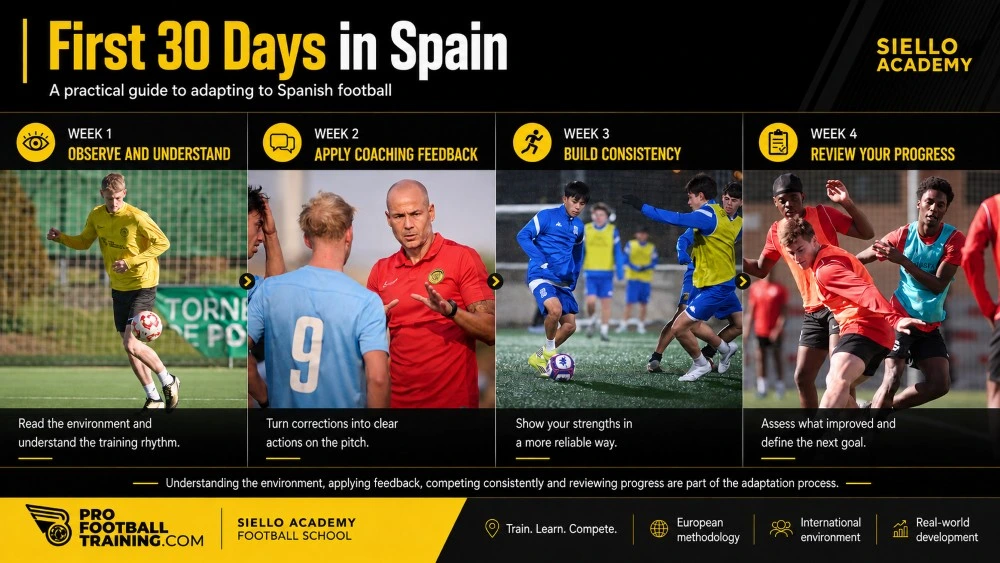
Week 2: Turn coaching feedback into actions
During the second week, something important usually begins to happen: you start hearing the same corrections repeatedly.
Perhaps the coach wants you to use fewer touches. Receive with a different body shape. Maintain width. Step into the press earlier. Close a passing lane. Move again after releasing the ball.
The difference between hearing feedback and learning from it lies in what you do next. Suppose you are a winger and the coach repeatedly tells you not to move toward the ball every time. The correction is not simply “stay wide.”
You need to understand why. Perhaps moving too close allows one defender to cover two spaces, while remaining wide forces the opposition to spread out and opens an interior lane for a teammate.
Once you understand the intention, feedback stops being an isolated command and becomes part of your understanding of the game.
A simple question to ask yourself after training is: What was I corrected on, when does that situation happen, and what specific behavior can I try tomorrow? That is much more useful than collecting ten different corrections and trying to change everything at once.
Week 3: stop trying to impress and start showing consistency
When a player arrives from another country, it is normal to feel there is limited time to prove yourself. Problems begin when that feeling turns every possession into an audition.
The winger tries to dribble every time. The midfielder attempts the most difficult pass. The striker shoots from every position. The center-back tries to intercept every ball.
One spectacular action may attract attention, but a coaching staff also watches what happens between those actions.
Do you arrive prepared? Do you understand the task? Do you recover after a mistake? Do you offer yourself again after losing the ball? Do you perform your role when you are not directly involved?
By the third week, your strengths should begin to appear in a more integrated way. If your main quality is one-versus-one ability, the objective is not to stop dribbling. It is to understand where to receive so that the skill creates a real advantage.
If passing is your main strength, technical ability alone is not enough. You also need to occupy useful passing lanes, gather information before receiving and understand when to release the ball.
And if you are a defender who excels in duels, that strength becomes more valuable when combined with positioning, communication and spatial awareness.
Adaptation does not mean hiding what makes you different. It means making that quality more useful to the team.

Week 4: stop asking “Did I do well?” and look for better information
At the end of the first month, it is time to evaluate the process, But broad questions usually produce broad answers. “How did I do?” may not tell you very much.
It is more useful to ask which behavior improved, what your biggest current limitation is, how the staff sees your position and what would need to change over the following weeks for them to recognize genuine progress.
You should also compare that feedback with your starting point. Maybe you are not physically faster, but you are arriving earlier because you read situations better. Perhaps your first touch has not changed technically, but you lose possession less often because your body orientation is better. Or perhaps the biggest improvement happened outside the pitch, in your ability to manage the routine and respond after making mistakes.
Research on youth athlete development presented by Jean Côté through the FIFA Training Centre emphasizes that development is influenced not only by training itself, but also by the environment, activities and social dynamics surrounding the player.
That is why evaluating the first month only through statistics leaves out an important part of the process.
How to know whether you are actually adapting to spanish football?
There is no universal metric, but there are useful signs.
| Area | At the beginning | Sign of adaptation |
| Tactical understanding | You need several explanations | You recognize situations earlier and ask more precise questions |
| Decision-making | You receive first and then look for options | You gather information before receiving |
| Coaching feedback | The same corrections are repeated often | Some corrections become stable behaviors |
| Off-the-ball play | You disconnect when the action is far away | You adjust your position and role more naturally |
| Response to mistakes | One error affects several following actions | You recover your role quickly |
| Routine | Your whole day revolves chaotically around training | Sleep, meals, transport and recovery become more organized |
You do not need to improve every area at the same speed. Adaptation is not a race against the calendar. What matters is whether a positive trend starts to appear.

What changes for a player arriving from Mexico or Argentina?
There is one common mistake worth avoiding: speaking about “the Argentine player,” “the Mexican player” or “Latin American football” as though every player from each country had the same profile. They do not.
A youth player from Buenos Aires may have received completely different training from another player in Córdoba. The same is true across Mexico City, Guadalajara, Monterrey and other football environments.
What can change when arriving in Spain is the context: the speed of certain actions, the way training exercises are organized, how much time and space you have to make decisions, how coaches communicate corrections or how much independence is expected from the player.
And that creates an important opportunity. The player is not arriving empty-handed. They may bring creativity, power, competitive aggression, technical quality, strong duel ability or a way of interpreting the game built through years of experience in another environment.
The goal is not to replace those qualities. It is to expand the player’s range.
This connects with the principles we have already explored when looking at Spanish player development after the 2026 World Cup: a strong collective structure does not need to produce identical players. It needs footballers who understand the game and can use different profiles within a common football language.
For families: Support the process without turning every session into an exam
When the player is a minor, adaptation also affects the family. Sending a child to another country naturally raises questions about safety, routine, accommodation, documentation and sporting development.
But supporting the process does not mean evaluating every day whether the player “performed well.”
After each training session, constantly asking “Did they notice you?”, “Did you score?” or “What did the coach say?” can create the feeling that every session is deciding the player’s future. A much more useful question is: What did you understand today that you did not understand yesterday? That type of conversation provides support without preventing the player from developing independence.
Training, club integration and official competition are different stages
This should be clear before travelling. Training means participating in sessions and entering a development methodology.
Integration into a Spanish club environment means experiencing a football structure closer to the daily reality of a team, depending on the conditions and duration of the program.
Official competition involves another layer: eligibility, registration, documentation, age category, calendar and federation rules. Longer programs can provide deeper competitive integration and, depending on the format, an official competition license. That should not be assumed for a short-term stay.
For international minors, FIFA also maintains strict restrictions on the international transfer of players under the age of 18. The February 2026 edition of FIFA’s guide identifies six specific exceptions and also addresses certain first-registration procedures, all of which are subject to the relevant conditions and approvals.
For that reason, training in Spain does not automatically mean that a minor can compete officially in Spain. And competition does not automatically mean representation or a club signing. Maintaining these distinctions is part of communicating international football programs responsibly.
What role does Siello play during that first month?
Pro Football Training, a platform within Siello Academy, is part of Siello Football Group, an ecosystem dedicated to the long-term development of footballers in Europe.
Programs in Madrid range from short 8-day and 14-day formats to one-to-three-month options and long-stay programs lasting six to ten months. The depth of the process changes with duration. A short stay provides an initial immersion. A one-month program allows more time to observe adaptation and consistency. A full-season pathway creates a considerably deeper level of integration.
Siello Academy represents the training and methodology layer. Siello FC provides an official competitive structure and currently competes in Tercera RFEF. Representation, when applicable, belongs to Siello Football Agency and is a separate stage of the process.
Not every player moves through every layer of the ecosystem, and not every program provides the same level of access.
For an article about the first 30 days, the important point is simpler: players enter an environment where they can train, receive feedback, adapt and begin to understand how their profile responds within Spanish football.

Your first 30 days do not need to provide every answer
It may show that your tactical understanding needs to evolve. That your technique still works under greater pressure. That you need more time. That another position suits you better. Or that your main strength remains valuable in Spain but needs to be used differently.
All of those answers are useful. What a player should avoid is turning the first month into a desperate search for immediate confirmation.
Serious adaptation requires curiosity, discipline and the ability to continue learning even when there is no visible result yet.
Arriving from Mexico or Argentina does not mean starting from zero. It means taking everything you have already built into a new environment and discovering what happens when the demands change. The objective is not to stop being the player you were. It is to finish the first month with a clearer understanding of the player you could become within a more demanding context.
Explore which program fits your level, age and goals
A short stay, a one-to-three-month program and a full-season pathway do not offer the same depth.
Before choosing based only on price or calendar, it is worth understanding what you actually want to assess and how much time that objective realistically requires.
Explore Pro Football Training programs in Madrid and see which format makes the most sense for your current stage of development.
FAQs
How long does it take a footballer to adapt to Spanish football?
There is no universal timeframe. The first 30 days can help a player understand the environment, establish a routine and identify the main demands, but deeper technical, tactical and personal adaptation may take several months.
Does a Mexican or Argentine player need to completely change the way they play?
No. Adaptation does not mean removing the qualities developed in the player’s home country. It means understanding what the new environment requires and using those qualities effectively within a different structure.
Is one month enough to know whether I have the level to play in Spain?
One month can provide considerably more information than a few isolated sessions because coaches can observe consistency, response to feedback and adaptation to the routine. However, it is still a snapshot of one stage of development, not a final verdict on the player’s future.
Can I compete officially during my first month?
This should not be assumed. Official competition depends on the program, age, category, eligibility, documentation, registration, calendar and applicable regulations. International minors are also subject to specific FIFA rules.
Does training at Siello Academy mean I automatically join Siello FC?
No. They are different layers of the ecosystem. Competitive integration depends on the program format, the player’s profile, applicable conditions and sporting decisions. Training, official competition, representation and club signing are not equivalent.
What should I ask the coach at the end of my first month?
Instead of asking for a general assessment, ask which behavior has improved, what your main current limitation is and what specific change the staff would expect to see over the next few weeks to consider that you are progressing.