

Receiving a message from someone who says they represent footballers, work with European clubs or can connect you with a football trial can create expectations very quickly. But before sending a passport, booking a flight, signing a document or making a payment, there is a more important question:
Can you independently verify who is contacting you and what they are actually offering?
The safest place to start is by searching the agent’s full name in the official FIFA Football Agent Directory. The platform allows you to check licensed agents, and FIFA also provides a digital licence validation system that can show whether the licence is active and whether the holder is authorised to work on transactions involving minors.
- However, finding a real name does not automatically validate the message you received.
A scammer can copy the identity, photographs and even professional information of a legitimate football agent. FIFPRO has documented cases in which the identities of real representatives were used to collect money for non-existent trials and fake professional contracts.
That is why a proper verification process should check three things separately: the agent’s identity, the authenticity of the opportunity and the conditions of the agreement or payment.
How to verify a FIFA football agent in five steps
| Step | What to check | Why it matters |
| 1 | Identity and professional details | You need to know who is actually offering the service |
| 2 | FIFA licence | Confirms whether the individual is licensed to act as a football agent |
| 3 | Identity through a second channel | Helps protect against impersonation |
| 4 | Club, trial or programme | Confirms whether the opportunity really exists |
| 5 | Agreement and payment | Helps you understand what you are committing to before signing or paying |
The key is to complete the entire process. A licence screenshot or a convincing conversation does not replace the other checks.
Step 1: Ask for the agent’s full legal name
Do not start with their Instagram profile. Start with their identity. Ask for their full legal name, FIFA licence number when provided, the agency or company they work with and a professional contact channel.
- FIFA define al agente de fútbol como una persona física con licencia para prestar servicios de representación destinados a formalizar una transacción futbolística. La licencia pertenece al individuo, no a la agencia como empresa.
This distinction matters because an organisation may employ several staff members, advisers or collaborators, but the person actually providing regulated representation services must be properly licensed to do so.
You can also ask for the agent’s FIFA digital licence. FIFA’s agent platform allows licensed agents to download a digital card with a QR code that can be validated through the official system. That is useful evidence, but it should not be your only check. La propia plataforma de agentes permite descargar una tarjeta digital con código QR cuya validación dirige al sistema oficial de FIFA. Ese recurso ayuda, pero tampoco debería ser la única comprobación.

Step 2: Search for the agent yourself in FIFA
Go directly to the official directory. Do not rely only on a link or screenshot sent by the person who contacted you. Search their name and check whether the information matches the person they claim to be.
If you have a verifiable digital licence, you can also use FIFA’s platform to check its status. The validation system may show details such as the licence identifier, whether the licence is active and whether the agent has the required authorisation to work on transactions involving minors.
If the name does not appear, the licence details do not match or there is another significant inconsistency, that does not automatically prove fraud. It does mean that you should not move forward until the discrepancy has been explained.
“FIFA agent” and “FIFA-licensed football agent” are not exactly the same expression
Searches often use phrases such as “FIFA agent”. The more precise term is FIFA-licensed football agent.
Not everyone who helps a player develop needs this licence. A footballer may legitimately work with coaches, scouts, academies, strength and conditioning staff, educational advisers, video specialists or companies organising football programmes.
The key question is what service that person is actually providing.
If they intend to represent you in a negotiation, intervene to conclude a football transaction or perform other activities FIFA classifies as football agent services, they need to operate within the appropriate regulatory framework.
Step 3: Confirm that the person messaging you is actually that agent
This may be the step players overlook most often. Imagine that you search the name received through WhatsApp and discover that the agent genuinely exists. There is still another question: Supongamos que buscas el nombre recibido por WhatsApp y descubres que el agente existe, todavía queda una pregunta:
Is the person messaging you from that number actually the agent?
Do not verify this only through the information contained in the original message. Find a second channel. That could be an email published by the agent’s organisation, an institutional website, another independently verified professional contact or a video call arranged through a separate source.
- This is precisely the risk highlighted in cases documented by FIFPRO: scammers do not always invent a fictional agent. Sometimes they use the name and photographs of somebody who genuinely works in football representation. So the fact that the agent exists does not necessarily mean that the account contacting you belongs to that agent.

Step 4: Verify the trial, club or programme separately
Now imagine that the agent is real and you have confirmed their identity. You still need to verify the opportunity. comprobar la oportunidad.
If you are offered a trial with a club, find the club’s official website yourself and use a telephone number, contact form or email obtained through an independent source.
Do not ask only: “Do you know this agent?” Ask about the specific activity.
Does the trial actually exist? Will it take place on those dates? Is the player genuinely invited? Who is organising the assessment? Is there a cost? What does it include? Who makes the sporting decision?
This also helps distinguish between several situations that are often grouped together under the word “trial”.
Not every football opportunity works in the same way
| Type of activity | What it means |
| Direct club trial | The club confirms the activity and observes the player |
| Tryout or assessment | Players take part to be evaluated, without guaranteed selection |
| Development programme | The player trains over a period of time and may receive ongoing assessment |
| Showcase | An event designed to create exposure to invited football professionals |
| Camp or sporting experience | May provide development value without being a professional club trial |
Paying for an academy, accommodation, training or a player-development programme does not automatically make the proposal a scam. What must be clear is what service you are purchasing.
A fee for training is one thing; a payment presented as a guarantee that you will sign with a club is something very different. Understanding that distinction also helps clarify what a football tryout actually involves and why participating in an assessment is not the same as receiving a contract.
Step 5: Understand the agreement and payment before moving forward
Once you have verified both the person and the opportunity, you need to understand the contractual relationship you are accepting.
Under FIFA’s current framework, a football agent may only provide football agent services to a client after entering into a written representation agreement. That agreement must contain minimum information including the identity of the parties, duration where applicable, fees, the nature of the services and signatures.
For representation agreements between a player or coach and an agent, FIFA currently establishes a general maximum duration of two years. Before signing, the agent must also inform the client in writing that they should consider obtaining independent legal advice and obtain written confirmation that the client either received that advice or decided not to.
You do not need to become a contract specialist.
But you should be able to answer these questions clearly: Who is representing whom? What services will be provided? For how long? What will they cost? How can the agreement end?
Details can depend on national regulations, the type of football transaction and the applicable legal framework. For that reason, an online article should not replace legal review when an agreement carries significant contractual or financial consequences.
What should you check before making a payment?
Legitimate football services can have a price. Training programmes, accommodation, transport, private assessments and certain professional services may all involve fees.
The important question is not: “Are they charging me?”.
It is: “What am I paying for, who is receiving the money and what outcome have I been promised?”
Before transferring money, confirm that the payment recipient has a clear connection with the agreement, invoice or organisation involved. There should also be a clear explanation of the payment concept, cancellation conditions and services included.
A payment request deserves additional verification when you see situations such as an unexpected change of bank account, a recipient with no obvious connection to the organisation, extreme pressure to pay immediately or payment methods that are particularly difficult to reverse.
None of these signs proves fraud on its own. But each of them is a good reason to pause until you understand what is happening.
Warning signs that deserve a second check
There is an important difference between being cautious and assuming that every opportunity is fraudulent. Instead of trying to memorise dozens of “red flags”, it is more useful to look for a broader pattern of transparency.
| More verifiable process | Requires further verification |
| The agent provides their identity | They avoid giving basic personal or professional details |
| You can check the licence yourself | They only send screenshots or credentials |
| They accept a second contact channel | They insist on communicating exclusively through private messages |
| The club confirms the activity | The club has no record of the trial |
| Services are explained in writing | Everything depends on verbal promises |
| The fee has a clear purpose | Unexplained payments appear later |
| You have time to review before signing | You are pressured to decide immediately |
| They explain what depends on assessment | They guarantee a contract, playing time or club signing |
Transparency does not guarantee that the sporting opportunity will produce the outcome you want. It guarantees something different: that the player can understand what they are accepting.
If the player is a minor, verification needs to be stricter
FIFA published a handbook specifically for parents of young footballers in March 2026 because the relationship between agents, minors and families requires additional safeguards. Parents or legal guardians should be involved from the beginning.
FIFA’s current rules establish that a football agent may not approach a minor — or their legal guardian — for the purpose of entering into a representation agreement until six months before the player reaches the age at which they may sign their first professional contract under the applicable national law. Prior written consent from the legal guardian is also required.
Agents working on transactions involving minors must also complete the relevant education and accreditation requirements.
That is why there is no universally correct statement such as: “Football agents can contact players from the age of 15.” The permitted timing depends on the age at which the player is legally allowed to sign their first professional contract in the relevant jurisdiction.
For families, one practical rule is especially useful: a minor should not manage a contractual proposal, payment or the transfer of sensitive personal documents alone.
What should you do if you have already sent money or documents?
If inconsistencies appear after you have already moved forward, avoid making any additional payments while you investigate.
Keep messages, emails, agreements, profile information and payment receipts. If you have already transferred money, contact your bank or payment provider as soon as possible and ask what options may exist to trace, stop or dispute the transaction.
It can also be useful to contact the real agent or club whose identity may have been used and report the accounts involved. Where there are reasonable signs of fraud, financial loss or misuse of personal documentation, contact the police, cybercrime authorities or appropriate legal services in your country.
If you shared passwords, change them immediately. And if you sent identity documents or banking information, check which identity-protection measures are available in your jurisdiction.

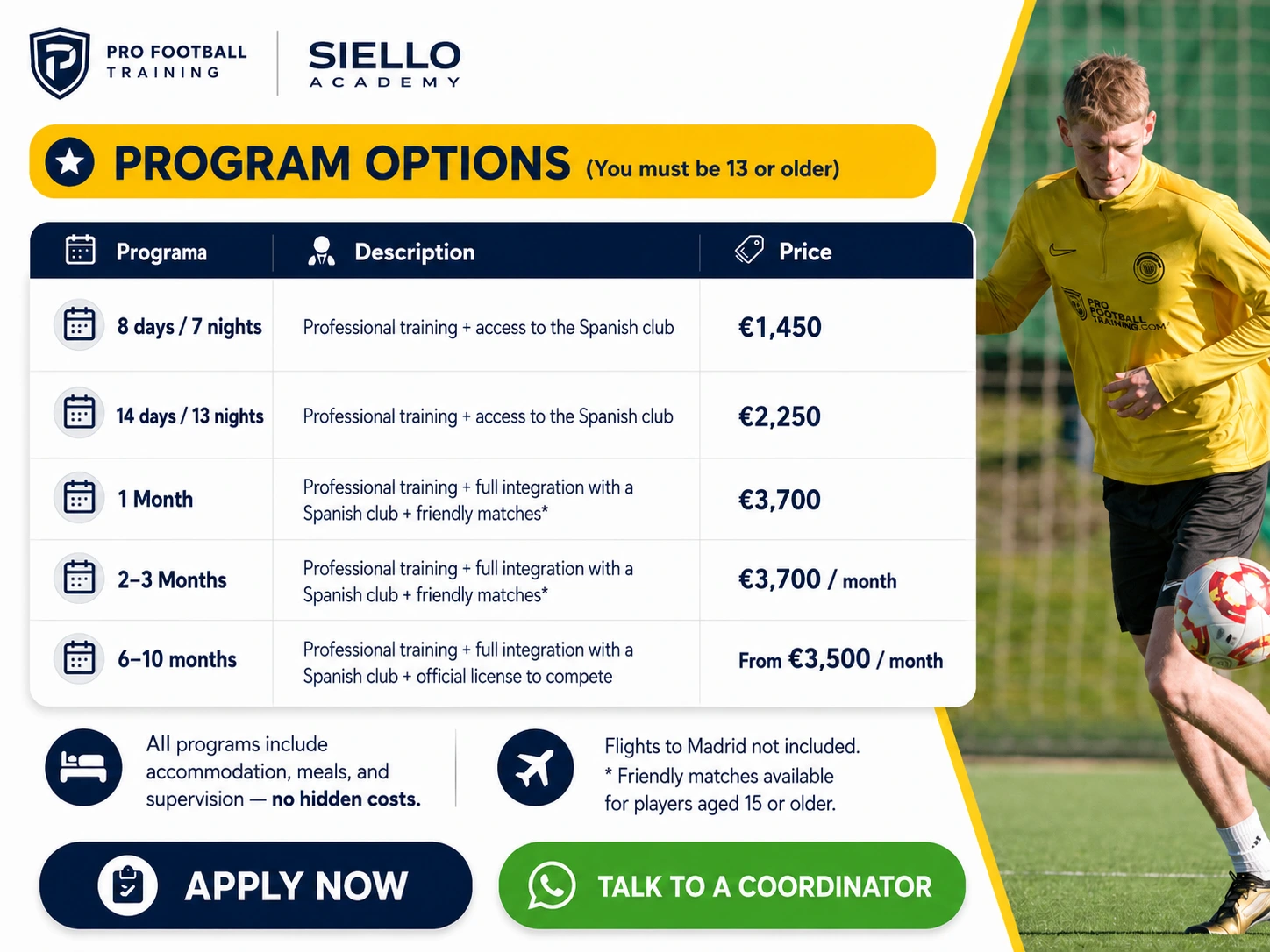
What transparency means within the Siello ecosystem
Estas mismas diferencias deben aplicarse cuando un jugador evalúa nuestros propios programas.
- Pro Football Training is the visible platform through which we present our international programmes.
- Siello Academy is the training, methodology and immersion environment.
- Siello FC is the club within the ecosystem and currently competes in Tercera RFEF.
- And Siello Football Agency is the representation layer.
Although they are part of the same ecosystem, they are not the same stage. Training at Siello Academy does not automatically mean competing for Siello FC. Being assessed does not mean signing with Siello Football Agency. And representation does not mean signing for a club.
Longer programmes may allow for more continuous observation and, where applicable, deeper integration into the football environment. However, any progression towards official competition or representation depends on the player’s profile, technical decisions and the conditions applicable in each individual case.
That is exactly the type of separation you should also expect when assessing any other football opportunity.
Quick checklist before signing, travelling or paying
Before moving forward, you should ideally be able to answer yes to the following questions:
- Do I know the full legal name of the person who contacted me?
- Have I personally verified their licence if they are acting as a football agent?
- Have I confirmed their identity through a second channel?
- Have I independently confirmed with the club or organiser that the activity exists?
- Do I understand exactly what service I am purchasing?
- Do I know which outcomes depend on an assessment?
- Do I have the relevant conditions in writing?
- Do I know who is receiving the money and why?
- Have I had enough time to review everything before deciding?
- If I am a minor, are my parents or legal guardians involved in the process?
If several of these questions are still unanswered, you do not yet have enough information to make an informed decision.
Verifying the licence is only the beginning
Knowing how to verify a FIFA football agent is useful because it allows you to eliminate one important source of risk, but a genuine licence does not automatically make every account, message, trial or payment request using that person’s name legitimate.
The complete process is easier to remember: verify the person, verify the opportunity and verify the agreement.
A professional football opportunity can involve sporting uncertainty. What it should not involve is unnecessary uncertainty about who is contacting you, what you are purchasing or where your money is going.
The strongest signal is not an extraordinary promise, it is a process that can be explained, independently verified and reviewed before you need to make a decision.
Learn how assessment works within a structured development process
At Pro Football Training and Siello Academy, we distinguish between training, assessment, competition and representation so players and families understand what is included in the programme and what requires a separate decision later in the process.
Explore our programmes and review what each format includes before applying.
FAQs
How can I check whether a football agent is licensed by FIFA?
Search the agent’s full legal name directly in the official FIFA Football Agent Directory. The agent may also provide a digital licence whose QR code can be validated through FIFA’s official platform. You should then use a second communication channel to confirm that the person contacting you is genuinely that agent.
Does appearing in the FIFA Football Agent Directory mean the offer is real?
No. The directory confirms that a licensed agent with that identity exists. It does not confirm that the WhatsApp number, Instagram account or email address contacting you belongs to that person, nor that the proposed trial actually exists. Impersonation of genuine football agents has been documented.
Is a football academy that charges fees a scam?
No. Training programmes, accommodation, assessments and other football services can legitimately involve fees. The provider should clearly explain what the price includes and should not present enrolment as an automatic guarantee of a club signing, professional contract or playing time.
Can a football agent guarantee me a professional contract?
A football agent cannot independently guarantee a decision that ultimately depends on a club and other sporting and contractual conditions. A guaranteed professional contract offered in exchange for payment deserves particularly careful verification.
What should an agreement with a football agent include?
FIFA establishes minimum information including the identity of the parties, duration where applicable, service fees, the nature of the services and signatures. Representation agreements between players or coaches and football agents currently have a general maximum duration of two years under FIFA regulations.
How can I verify a football trial with a club?
Find the club’s official communication channels yourself and confirm the activity independently. Ask about the dates, location, responsible staff member, assessment format and authenticity of the invitation.
What changes when the player is a minor?
The player’s legal guardian should be involved throughout the process. FIFA establishes specific rules covering when an approach for representation can take place, guardian consent and the accreditation required for agents working on transactions involving minors.
Does training at Siello Academy guarantee playing for Siello FC?
No. Training and competition are separate stages. Any possible integration depends on the player’s level, technical assessment, age, category, availability, eligibility and the other relevant sporting and administrative conditions.
Does training within the Siello ecosystem guarantee representation?
No. Representation is handled through Siello Football Agency and requires a separate assessment. Training, competition, representation and signing for a club are different processes.