

Many players hear the word “tryout” and understand it as a decisive opportunity: one day, one trial, someone watching, and a chance to be selected. But in serious football, one isolated trial is rarely enough to understand a player’s real level, tactical adaptation, decision-making, competitive behaviour and ability to sustain performance.
One trial can show something, but it rarely tells the full story of a player. In football, a strong action, a good training session or a solid match can attract attention, but it is not always enough to assess level, adaptation, competitive maturity and the ability to sustain performance.
That is why, before looking for a football tryout,, players should understand what it really means, what is evaluated and why one isolated trial should not be sold as a magic solution.
- A football tryout is an assessment opportunity where a player shows his level in front of coaches, clubs or scouts. It can help observe technical, physical, tactical and competitive qualities, but one trial does not define a full player profile. In serious environments, performance should be assessed within a broader process of training, adaptation and follow-up.
The problem is not the tryout itself. A trial can be useful. The problem begins when it is presented as a shortcut: come, get seen and sign. Serious football does not work that way. Being seen is not the same as being evaluated. Being evaluated is not the same as being signed. And signing with a club is a different layer of the process.
What does “football tryout” mean?
A football tryout is a situation where a player takes part in a session, match, training environment or specific evaluation dynamic to be observed. It can happen within an academy, a club, a showcase, an open trial or a more structured assessment process.
In English, the words tryout and trial are often used in different ways depending on the market.
- A test typically refers to a specific instance where a player seeks to demonstrate their skill level.
- The term tryout is widely used in international contexts—particularly in markets like the United States—to describe an evaluation opportunity.
- Trial is a more common term in European and British settings, referring to an assessment with a club or sports organization.
- A visoría is usually associated with scouting or talent identification, although in practice, the term can also be used more broadly.
The name matters less than the structure behind it. Players and families should understand what kind of evaluation is involved, who is watching, how long it lasts and what may realistically happen afterwards.
A serious tryout or trial should explain:
- who evaluates the player;
- what type of session or match takes place;
- how long the observation lasts;
- what level of players will be involved;
- what is expected from the player;
- what may happen next;
- what is not guaranteed.
If a proposal does not explain these points and only promises that “scouts will see you,” the player should be careful.
What is actually evaluated during a football tryout?
Many players arrive at a trial thinking they need one standout action: a goal, an assist, a dribble, a powerful run or a moment that attracts attention. Those things can help, but they are not enough.
A serious coach does not only look at whether a player has talent. He looks at how that talent behaves inside the game.
Technique and on-ball resources
Technique matters, but it is not evaluated as an isolated exhibition. A coach does not only watch whether the player controls, passes or finishes well. He watches whether the player can do it under pressure, with limited time, with the right body orientation and in response to what the game demands.
A first touch can say a lot. Not only because of the quality of contact, but because of direction, preparation for the next action and previous scanning. A simple pass at the right moment can be more valuable than an unnecessary dribble.
In a tryout, technique is observed in context: how the player receives, protects, accelerates, switches play, finishes and makes technical decisions when the opponent applies pressure.
Decision-making
Decision-making often separates a player who has tools from a player who understands the game.
During a trial, the coach can observe whether the player knows when to play simple, when to carry, when to accelerate, when to pause, when to take risk and when to secure the play. He also watches whether the player recognizes overloads, spaces, support angles, cover and pressure moments.
A common mistake is trying to impress in every action. That can lead to turnovers, poor choices and a less reliable reading of the player. In competitive football, playing simple when the moment demands it is also a sign of intelligence.
Physical and competitive rhythm
Physical rhythm is not only speed or power. It also includes the ability to repeat efforts, sustain intensity, press, recover, change direction, compete in duels and maintain concentration under fatigue.
A player may produce one explosive action and still fail to sustain the rhythm of the session. Another player may not be the fastest, but may compete with consistency, intensity and strong game reading.
In European environments, the competitive rhythm often leaves less mental pause. The player must respond quickly, correct quickly and return to the next action after making a mistake.
Tactical reading
Tactical reading is one of the hardest things to show in a short trial, but it is also one of the most important elements.
A coach may observe:
- how the player positions himself without the ball;
- whether he offers passing lanes;
- how he occupies space;
- how he presses;
- whether he knows when to jump, delay or close;
- how he reacts in transition;
- whether he respects the team structure;
- how he communicates with teammates;
- whether he understands tactical instructions during the session.
A player who stands out individually but constantly breaks the team structure may raise doubts. A less flashy but more reliable, organized and adaptable player may create a stronger impression.
Attitude, discipline and response under pressure
A tryout also assesses behaviour. Not from a moral angle, but from a competitive one: a player who does not listen, does not correct, complains constantly or disconnects after a mistake can be difficult to integrate into a demanding environment.
Attitude appears in concrete details: punctuality, body language, concentration, respect, response to feedback, communication, off-ball effort and the ability to keep competing after failure.
Coaches do not look for perfection. They look for signs that the player can learn, adapt and sustain himself inside a serious dynamic.
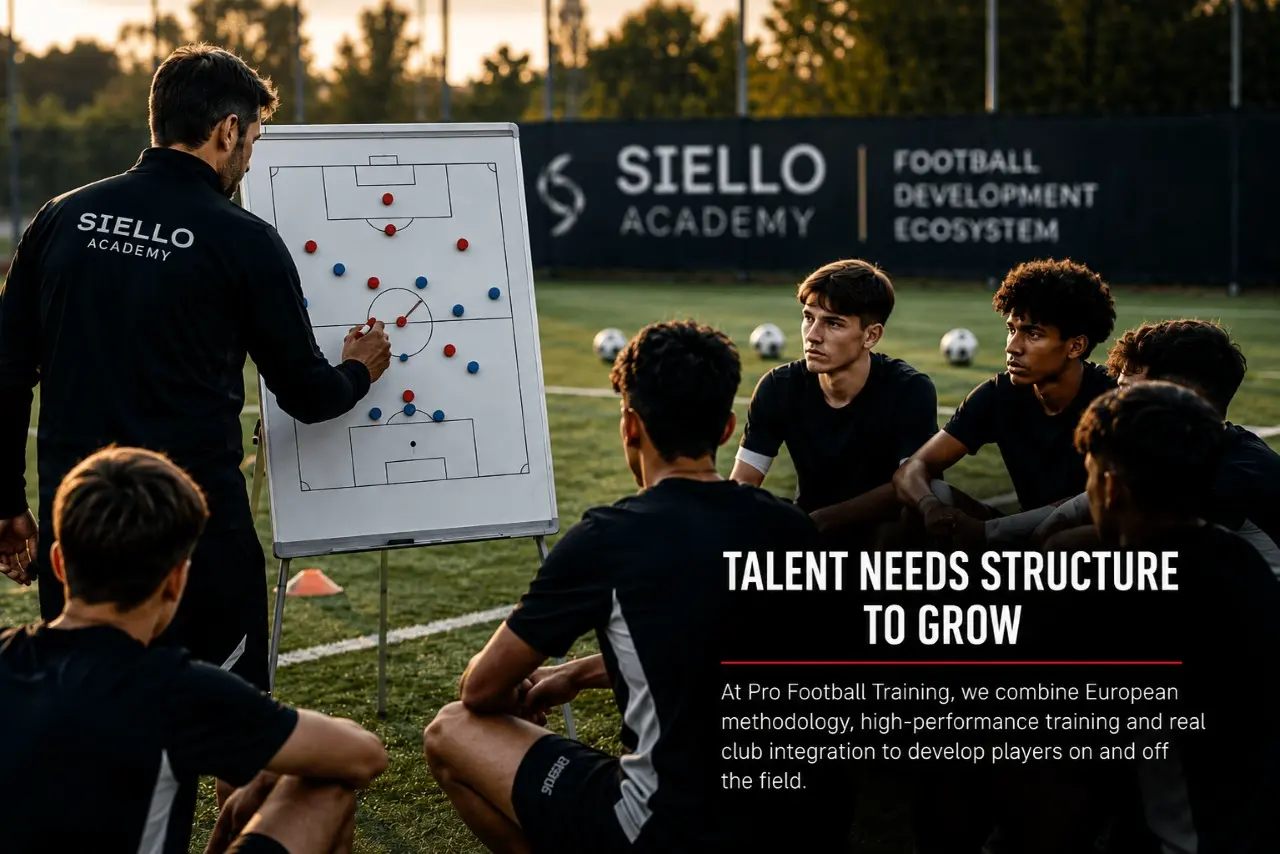
Why one isolated trial does not show the full player profile
An isolated trial has a clear limit: it gives a snapshot, not the full picture.
It can show qualities, but it does not always reveal continuity. A player can have a great day, a poor day, arrive tired, feel nervous, be unfamiliar with the playing style, struggle with the football language or fail to adapt immediately to the group’s tempo.
The opposite can also happen: a player may stand out in one action and still fail to sustain performance, discipline or tactical reading in a longer process.
That is why a complete assessment needs context and repetition. It needs to observe how the player trains, corrects, responds to different teammates, competes after mistakes, processes instructions and sustains habits on and off the pitch.
This is especially relevant for international players. Arriving from another country and going straight into a trial can be useful, but it can also be limited if there is not enough time for adaptation, communication and understanding the environment.
That is why one trial may not be enough when assessing:
- adaptation to another country or city;
- response to the European football rhythm;
- daily discipline;
- tactical understanding;
- consistency;
- competitive maturity;
- autonomy;
- development after feedback.
This is especially important for international players. Coming to Spain or Europe and going straight into a trial can be useful, but it may not be enough to show the full profile. Often, the player needs to train first, adapt to the rhythm, understand the environment and arrive better prepared for any assessment opportunity.
Tryout, trial, scouting and assessment: important differences
One of the most common mistakes is confusing three different moments: being seen, being evaluated and being signed.
Ser visto Being seen means someone watches the player. That can happen in a training session, match, showcase or video. But being seen does not mean there is real interest or continuity.
Being evaluated means there is a more structured observation. There are criteria, context, comparison, profile analysis and performance assessment. Evaluation can lead to feedback or further conversations, but it is not the same as a signing.
Being signed means a club decides to bring the player in under specific conditions. That depends on many factors: level, age, position, documents, club needs, competitive context, performance and feasibility.
There is also representation, which is another concept. Signing with an agency is not the same as signing with a club. Representation can support the process, but it should not be confused with an automatic football contract.
This distinction matters because it protects players from empty promises. A tryout may help you be seen. A serious process may help you be evaluated with more context. But no serious trial should be sold as a guaranteed signing.
| Concept | What it means | What it does not guarantee |
| Tryout / trial | A situation where the player shows his level in an observed setting | It does not guarantee signing, contract or continuity |
| Soccer tryout | The US-oriented term for a football evaluation opportunity | It does not mean automatic selection |
| Scouting | A broader process of observing and analyzing players | It does not always involve direct contact or selection |
| Player assessment | A more structured reading of level, profile, adaptation and potential fit | It does not guarantee representation or signing |
| Exposure | The possibility of being seen in the right environment | It is not the same as being selected |
| Club signing | A formal decision by a club to incorporate the player | It depends on many sporting, legal and contextual factors |
Common mistakes players make before a tryout
One of the most common mistakes is arriving with the idea that one brilliant action is enough. The player becomes anxious, forces plays, keeps the ball too long and ends up showing a less reliable version of himself.
Another mistake is preparing only highlights. A video can open a conversation, but full-game behaviour shows much more: decisions, turnovers, transitions, repeated efforts, off-ball movement and collective understanding.
Players also often underestimate the rhythm of the environment. A player may come from a context where he has more time to decide and then face sessions where pressure, speed and correction are more constant.
Some players overperform to impress. They try to show everything in ten minutes: dribbling, shooting, long passing, pressing, leadership. But in serious football, impressing is not always the same as playing well. Sometimes the strongest message is solving the game clearly.
Another delicate mistake is not listening to corrections. During a trial, the coach watches what you do before feedback and what you do after it. If you correct quickly, that says something. If you repeat the same error without processing the instruction, that also says something.
The most dangerous mistake is confusing exposure with signing. A tryout can open an observation, but it does not buy a decision. A real opportunity is sustained through performance, adaptation and context.
Isolated tryout vs ongoing evaluation process
| Aspect | Isolated tryout | Ongoing evaluation process |
| Duration | One session, day or event | Several sessions, days or weeks |
| Player reading | Partial, affected by the moment | More complete, with context and repetition |
| Adaptation | Hard to measure deeply | Easier to observe over time |
| Decision-making | Seen in specific moments | Assessed across different scenarios |
| Response to mistakes | May appear only briefly | Observed more clearly |
| Preparation | Often limited | Allows rhythm and habits to be adjusted |
| Correct expectation | Show qualities | Measure performance, adaptation and development |
| Main risk | Overvaluing one trial | Understanding the real profile more accurately |
This does not mean a tryout has no value. It means a tryout is more valuable when it is part of a process, not when it is sold as a single opportunity that will “solve” a player’s career.
What training before a trial can provide
Before a trial, many players focus only on being physically fit or preparing a highlight video. Those things help, but they are not enough.
A training process before evaluation can provide something more important: contextual preparation.
For international players, this can make a real difference. It is not the same to arrive directly at a trial without understanding the local rhythm as it is to train first, adapt, receive feedback and understand how football is played in that environment.
At Siello Academy, within the Pro Football Training ecosystem, we understand evaluation as part of a process, not as an isolated promise. Pro Football Training, a platform within Siello Academy, is part of Siello Football Group, an ecosystem dedicated to the long-term development of footballers in Europe. The goal is not to sell a magic trial. The goal is for the player to enter a real training environment, adapt, be observed with more context and understand what next steps may make sense according to his profile.
How to prepare for a serious football assessment
Preparing for a football tryout does not mean training as hard as possible during the previous week. It means arriving with clarity, rhythm and an honest reading of your own profile.
Before an assessment, the player should review his main position, secondary positions, competitive background, current level, physical condition, recent videos, language or communication capacity, basic documentation, goals and availability to continue a process if an opportunity appears.
He should also prepare the way he competes. is not about playing with fear. It is about playing with intelligence. In a trial, the player must show what he can do without breaking the game just to attract attention.
Good preparation includes:
- arriving with competitive rhythm;
- sleeping and eating well before the trial;
- understanding your role by position;
- reviewing your own video honestly;
- preparing a simple and credible player CV;
- understanding the type of environment you will face;
- knowing how to listen and correct;
- competing with intensity without losing clarity.
Si estás pensando en buscar una prueba o entrenar en España, el primer paso no debería ser perseguir cualquier tryout, sino entender si tu perfil, edad, nivel y timing encajan con una ruta seria de evaluación.
What changes when the trial takes place in a European environment
For an international player, a trial in Europe does not only assess football. It assesses adaptation.
- The player changes rhythm, language, teammates, coaching style, tactical intensity, routine, food, rest and emotional pressure. All of that shapes how he performs.
In a European environment, a coach may give significant weight to details that can be overlooked elsewhere: body orientation, speed of release, reaction after loss, coordinated pressure, off-ball behaviour, positional discipline and the ability to understand instructions quickly.
This does not mean European football is “better” in a generic sense or that every environment is the same. It means the player must adapt to a different logic. And that adaptation is rarely measured well in one day.
For some players, training first within a structured environment can be more useful than arriving directly to a trial. Previous training allows the player to understand rhythm, receive feedback and show a more realistic version of his profile.
What to question when someone promises a magic trial
There are warning signs every player should recognize.
Be careful if someone promises that a tryout guarantees a club. Be careful if someone assures a contract before watching you compete. Be careful if the whole message is based on “scouts will see you” without explaining context, level, duration or process. Be careful if they do not separate trial, representation, exposure and signing.
Players should also question any proposal that:
- does not explain who evaluates;
- does not explain what happens next;
- promises automatic sporting outcomes;
- talks about signing before assessing level;
- uses artificial urgency;
- does not clarify what is included;
- does not ask about the player’s profile;
- does not differentiate between a short stay and a long-term process.
A serious trial does not need fantasy. It needs clarity about the environment, limits and the player’s role.

Why the process matters more than one opportunity
A tryout can be useful. It can open a door, provide an initial reading or show qualities. But it does not replace a process.
A process allows coaches to observe what one isolated trial may not show: development, discipline, correction, adaptation, relationship with teammates, response to demands and ability to sustain performance.
Serious football is not decided only by being seen. It is decided by how the player responds when demands increase, how he understands the game, how he competes without the ball, how he adapts to the group and how he sustains habits when the initial excitement fades.
A one-day opportunity can start a conversation. The process shows whether that conversation makes sense.
When a training immersion in Spain can make sense
A training immersion in Spain can make sense when the player needs more than a trial: he needs context.
At Pro Football Training, programs in Madrid focus on training, adaptation and integration within an academy and club environment. Depending on the length of the program and the player’s performance, that experience can open real opportunities for exposure, competition and progression within the process.
That must be understood precisely. Exposure does not mean signing. Competition does not mean contract. Being observed does not mean being selected. The structure creates the right environment; performance still depends on the player.
For some profiles, a short stay can work as a first immersion. For others, a one to three-month stay can allow a deeper assessment. And for players with more serious objectives, a full-season pathway may provide more continuity, always with the right limits around age, duration, documentation and performance.
The important point is not to choose out of anxiety. One trial may look more direct, but it is not always fairer for the player.
Where Pro Football Training fits into this process
In our programs in Madrid, the focus is on immersion, adaptation and evaluation within a real training and club environment. Depending on the length of the program and the player’s performance, that experience can open real opportunities for exposure, competition and progression within the process.
That statement must be understood precisely. Exposure does not mean signing. Competition does not mean contract. Being observed does not mean being selected. Performance remains decisive.
For some players, a short stay may work as a first immersion. For others, a longer duration may allow for a deeper assessment. The important thing is not to confuse the format with a guarantee.
For some players, a short stay may work as a first immersion. For others, a longer duration may allow for a deeper assessment. The important thing is not to confuse the format with a guarantee.
A tryout can open a door, but it does not replace the process
A football tryout can be useful. It can help you show qualities, receive an initial reading or enter a more demanding environment. But one isolated trial does not replace training, adaptation, consistency or a well-contextualized evaluation.
Football is not decided only by being seen. It is decided by how you respond to demands, how you understand the game, how you correct yourself, how you compete and how you sustain performance.
If you want to move forward with more clarity, the next step is to understandl the difference between training, competing, getting exposure and signing. And if you are evaluating a more serious pathway, it makes sense to review your profile before chasing a trial without context.
FAQs
What is a football tryout?
A football tryout is an evaluation opportunity where a player takes part in a training session, match or assessment environment observed by coaches, clubs or technical staff. It can help a player show his qualities, but it does not guarantee a signing or contract.
Does a football tryout guarantee a club signing?
No. A football tryout does not guarantee a club signing, professional contract, representation or continuity. It can help a player be seen or evaluated, but the outcome depends on level, context, club needs, documents and performance.
What do coaches look for during a tryout?
Coaches may look at technique, decision-making, tactical understanding, intensity, off-ball movement, response to mistakes, communication, discipline, competitive attitude and ability to adapt to the group’s rhythm.
How should a player prepare for a serious evaluation?
A player should prepare physically, tactically and mentally. It helps to have recent video, clarity on position, competitive background, communication skills, strong habits and realistic objectives. A serious evaluation looks at the complete player, not only one action.
What is the difference between a tryout and a trial?
“Tryout” is more common in US soccer contexts, while “trial” is more common in European and UK football. Both can refer to an evaluation opportunity. The important point is not the word, but who evaluates, how the session works and what is realistically possible afterward.