

One of the most common sources of confusion in international soccer has less to do with a player’s talent and more to do with the language used to sell an opportunity. Many families hear words like training, competition, exposure, representation, or signing and end up treating them as if they were automatic steps in one single path. They are not.
In fact, understanding the difference is one of the fastest ways to separate a serious program from an inflated promise.
Because a player can train without competing officially. He can compete without receiving useful exposure. He can receive exposure without reaching the representation stage. He can sign with an agency without signing with a club. And he can train inside a serious structure without that automatically turning his process into a professional career.
That distinction should not create fear. It should create clarity.
The problem is not only what is being offered. It is how it is being interpreted.
When a family looks at options in Spain, the starting expectation is often reasonable: to find a structure where the player can develop, test himself in a more demanding environment, and, if his profile justifies it, move closer to real opportunities. That expectation makes sense. The problem begins when the market blends different concepts together in order to sound more convincing.
That is where frustration usually starts.
Because being part of a serious training process is one thing. Entering real competition is another. Being exposed inside the right ecosystem is something else again. And reaching a representation or signing stage is an even more sensitive layer.
If those layers are not explained properly, the family is not evaluating a pathway. It is evaluating a badly translated illusion.
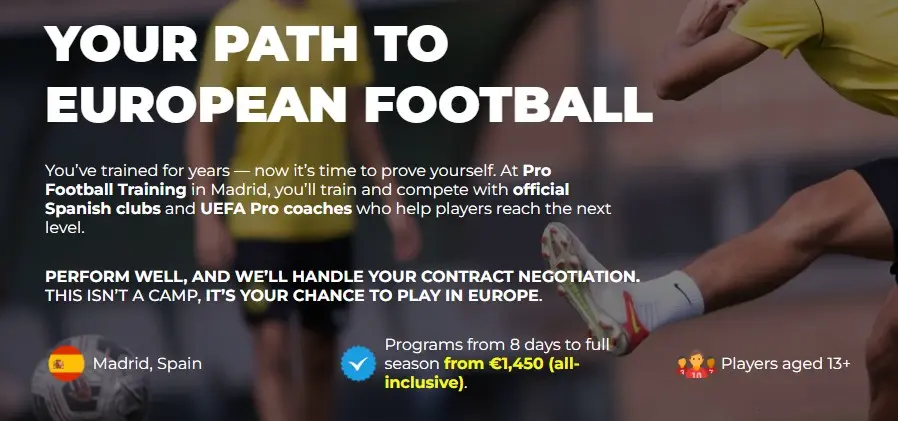
At Pro Football Training and Siello Academy, that distinction matters because the offer should not be framed as a fantasy of immediate access. It should be understood as a process of immersion, development, and exposure inside the Siello ecosystem.
The structure exists precisely to organize the journey: Pro Football Training is the visible platform and point of entry; Siello Academy is the training and daily high-demand layer; Siello Football Agency belongs to the representation layer; and Siello FC belongs to the official competitive side of the ecosystem. Understanding what each entity does helps families understand what each step actually means.
Training is not the same as competing
Training means working inside a method. It means entering a routine, being held to a certain level of demand, adapting to a different intensity, absorbing corrections, sustaining discipline, and beginning to measure yourself in a different way. All of that matters. But it does not automatically mean official competition.
Competing belongs to another layer. It means entering an environment where there is a real match context, genuine opposition, sustained collective dynamics, applied tactical reading, and clearer sporting consequences. Not every format offers that same depth, and short, medium, and long programs should not communicate it in the same way.
That difference matters a great deal. Families often hear that a player will train in an academy-and-club structure and, without realizing it, interpret that as full competitive integration. But the depth of competition depends on the format, the duration of the process, and how the player is actually inserted into the environment.
That is why a serious program should not use “training” and “competing” as if they were interchangeable. They overlap. They connect. But they are not exactly the same thing.
Competing is not the same as getting exposure
Even when a player is already competing inside a more serious environment, another question still remains: is that competition creating useful exposure?
Not every competitive setting generates relevant visibility. Sometimes it serves first to measure adaptation, rhythm, game understanding, and response inside the process. That already has value. But it should not be sold as if any competitive presence automatically triggered an outside opportunity.
Exposure, in a serious sense, means that the player is being seen inside the right context, by the right people, at the right time in the process. It does not simply mean “being there.” It is not a photo. It is not a permanent tryout narrative. It is a real possibility that can emerge from being inside the right structure, but it is not an automatic result of every training session or match.
This matters especially when a program talks about access to clubs, scouts, or ecosystem-level opportunities. That access can be real as part of the value of the structure, but communicating it correctly requires a distinction: creating an exposure environment is one thing; promising that the player will be discovered is something entirely different.
A serious brand does not need to erase that difference. It explains it.
Exposure is not the same as signing
This is probably the point where the conversation gets distorted the most.
A player can be in the right environment, training, competing, and showing himself, and still not be at a signing stage. That does not mean the process failed. It means that each layer has its own timing, logic, and conditions. And even signing does not always mean the same thing.
Signing with an agency is not the same as signing with a club. The first belongs to a layer of guidance, follow-up, and representation management inside the player’s broader pathway. The second belongs to a different contractual and competitive dimension. Confusing the two creates a false sense of progress and, even worse, a misleading interpretation of the real value of each step.
That is why when a project like Pro Football Training or the Siello ecosystem speaks about representation, contract discussions, or signing, it has to do so with discipline. The structure may open opportunities and place the player in the right environment, but the player’s performance remains decisive, and no layer should be presented as an automatic promise.
Saying that clearly does not weaken the offer. It makes it more credible.
Why this distinction protects families better
For many families, the hardest part is not understanding soccer. It is understanding the market.
From the outside, many offers look similar: training, club environment, Europe, visibility, methodology, high performance. But what actually changes the quality of the decision is the ability to separate which stage of the process is really being offered.
When a family understands the difference, it can ask much better questions:
- does this format offer only training, or also deeper competitive integration?
- is what is being communicated as exposure a real possibility inside the ecosystem, or just a commercial hook?
- when signing is mentioned, are we talking about agency representation or a club contract?
- which parts depend on the format and which parts still depend on performance?
- what should we not assume automatically?
Those questions change the conversation completely. They also reduce the anxiety that comes from interpreting every word as a hidden promise.
An informed family usually makes better decisions not because it becomes cynical, but because it learns to read the offer with greater precision.
What a serious program should actually offer
A serious program does not need to say that everything is guaranteed. It needs to demonstrate structure.
That means, among other things:
- clarity about the duration and depth of each format
- a clear distinction between what is included and what is conditional
- honest explanations about what depends on age, duration, or performance
- a clean separation between academy, agency, and club
- a process-based logic rather than a shortcut-based one
- proof of real structure, track record, and ecosystem depth
In that sense, Pro Football Training can safely communicate a serious immersion offer in Madrid where the player trains, integrates into a club environment, and enters a real structure inside the Siello ecosystem. Depending on the length of the program and the player’s performance, that experience can open real opportunities for exposure, competition, and progression within the process. What it should not do is turn those possibilities into a universal guarantee.

Choosing well starts with naming each stage correctly
When everything gets blended together, any program can seem to promise more than it really offers. When each stage is named precisely, the family can evaluate much more clearly whether a format makes sense for its case.
Training has value. Competing has value. Getting exposure inside the right environment has value. Signing, when it truly becomes relevant, belongs to an even more sensitive layer. None of these stages cancels out the others. But they should not be merged together in order to speed up a decision.
In soccer, as in any serious process, words matter because they organize expectations.
And for a family evaluating a major investment, that is not a side issue. It is central to the decision.
Before choosing, it makes sense to bring the conversation down to your real case
Not every pathway fits every player. Not every stage of development asks for the same thing. And not every profile needs the same depth of process.
That is why, before making a decision, the most useful move is not to compare slogans. It is to understand precisely which stage of the journey you are evaluating and what kind of structure makes sense for that player right now.
If you want to bring that distinction down to your real case, the most logical next step is to request a profile assessment and speak with the team about the player’s level, objective, and timing. That conversation is usually far more useful than any generic promise.