Choosing a football academy in Europe can look simple from the outside. Many families begin with a common assumption: if the destination is in Europe, the process must already be serious by definition. The problem is that Europe does not work as one single, uniform category.
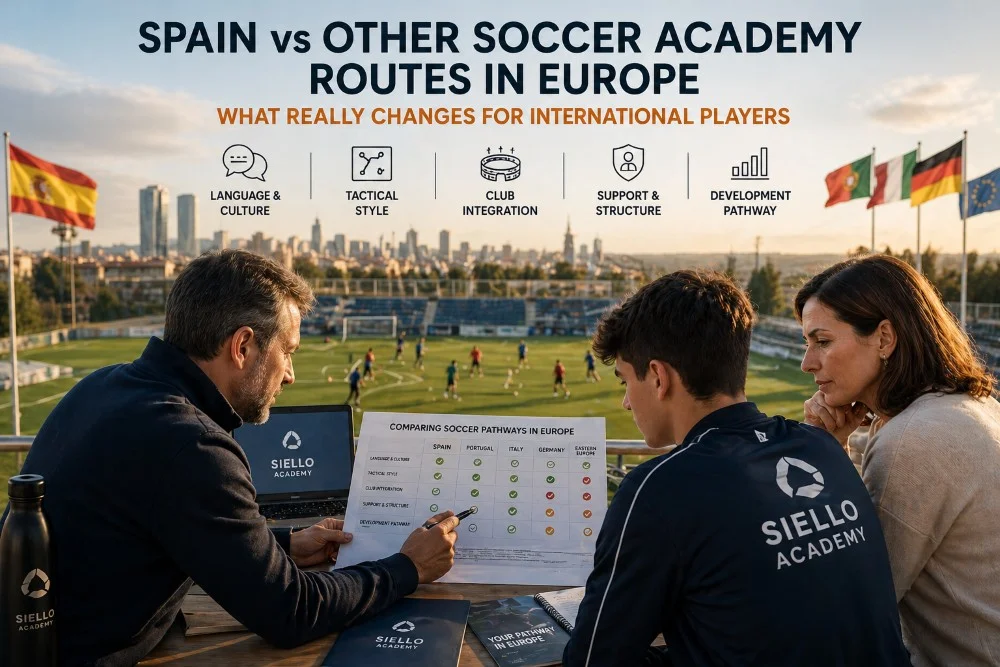
It is not only the country that changes. The football culture changes. The language changes. The training logic changes. The level of support changes. The depth of club integration changes. And most importantly, the player pathway changes.
That is why, when a family compares Spain with other European options the real question should not be which country sounds stronger on paper. It should be which environment makes more sense for the player’s profile, timing, and actual goal.
Europe is not one single pathway
One of the most damaging simplifications in this market is the idea of “playing in Europe” as if Spain, Portugal, Italy, Germany, or Eastern Europe all offered the same kind of experience. They do not.
For an international player, what matters is not only the abstract prestige of the continent. What matters is how the process is actually lived inside that environment: how much room there is to adapt, how clear the structure is, how much of the day is supported in a real way, how training connects to a club context, and what type of tactical understanding that system demands.
This matters because many families choose by geographic aspiration rather than by process fit. When that happens, the issue is rarely the country itself. The issue is that the environment never matched the type of player they were trying to develop.
What often makes Spain stand out within the European map
Spain holds a particular place in the international conversation for several reasons. Not only because of football tradition, but because for many international players and especially many Spanish-speaking families, the process can feel more understandable and more sustainable in an environment where the language and the daily culture reduce part of the initial friction.
That does not mean Spain is automatically superior to every other route. It means it can offer very concrete advantages for certain profiles.
The first is cultural and linguistic readability. For a family from Latin America, or for a player who needs to reduce anxiety away from the field, being able to understand the day-to-day environment is not a minor detail. Adaptation does not happen only during training. It also happens in the residence, in the routine, in the relationship with staff, and in the ability to sustain daily life without feeling overwhelmed from the first week.
The second is tactical culture. Spain is often associated with a more structured reading of the game, with emphasis on decision-making, ball circulation, positional understanding, and methodological detail. That does not mean other European countries do not offer high-level development. It means the type of football education can be different, and for some players the Spanish environment can be especially valuable.
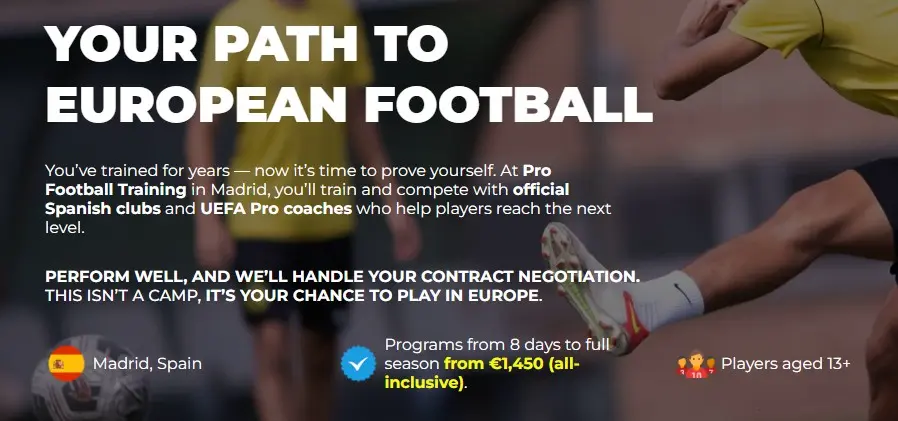
The third is the clarity of the ecosystem when it is properly built. In Pro Football Training, we do not sell “Europe” as an abstract dream. We present it as concrete programs in Madrid inside an ecosystem with a visible platform, academy structure, training environment, club integration, and support. That clarity reduces one of the biggest errors in this market: assuming that every European experience means the same thing.

What can change significantly from one European country to another
When a family compares Spain with other soccer academy routes in Europe, several factors should be part of the decision.
1. Language and adaptation off the field
In some countries, the language barrier is much harder from day one. That does not automatically make the experience worse. But it can create more friction for certain profiles. A very autonomous player may adapt well to a harder context in that sense. Another player, with less time away from home or a more fragile transition stage, may need an environment where the first weeks are more stable.
2. Training culture
Some environments work with very high physical intensity from the beginning. Others place more emphasis on tactics, structure, and decision-making. The relationship with error can change. The staff’s demands can change. Group dynamics can change. The way the international player is integrated can change too.
That is why, when an academy promises “high performance” without explaining how training actually works and what kind of game culture exists in that environment, the family still understands very little. The important idea is not simply training hard. It is training inside a football logic that actually serves the player’s development.
3. The real depth of integration
Not every academy in Europe offers the same kind of relationship with a club environment. Some operate closer to showcase models, short stays, or isolated exposure opportunities. Others allow deeper integration through daily training, residential structure, and continuity. For an international player, that difference is structural.
Choosing one route over another should not depend on which one sounds more “professional.” It should depend on what is actually organized and what can be sustained with clarity.
4. The way the offer is communicated
This may sound commercial, but it is actually technical. Some academies communicate everything as if it were one single promise: train, compete, get exposure, sign, progress. When that happens, the issue is not only the copy. It often means the structure behind it may also be unclear.
A serious pathway needs to separate with precision:
- what is included
- what depends on duration
- what depends on age
- what depends on performance
- and what simply cannot be promised in advance
Spain, as a destination, does not guarantee anything by itself. But when the structure is clearly communicated, it can become a more legible and more stable route for many families than other European options that are harder to understand.
What a family should compare instead of comparing countries in the abstract
The most useful comparison is not “Spain vs Germany” or “Spain vs Italy” in the abstract. The right comparison is between process models.
For example:
- Is the program short, medium, or long?
- Is there a real residential structure and supervision?
- Is club integration explained with precision?
- Does the environment support adaptation, or does it make the transition much harder without a clear reason?
- Does the academy clearly separate exposure, competition, and later outcomes?
- Does the proposal seem built around the player’s profile, or just around selling an idea of Europe?
When families change the comparison framework, the decision improves. They stop looking for the most famous country. They start looking for the most suitable structure.
Which profiles often find a strong fit in Spain
Spain often fits especially well in several concrete cases.
First, for Spanish-speaking families who want a demanding environment but with less cultural and linguistic friction. Second, for players who need a pathway where tactics, game understanding, and adaptation to the European context carry real weight. Third, for profiles that are not looking for a fast promise, but for a serious immersion inside a structure they can actually understand.
That does not mean Spain is “the best academy in Europe” or anything close to that. Claims like that would not only be exaggerated; they would also be strategically weak. What matters is that Spain can offer a very strong combination of football culture, clarity, adaptation, and process depth when the offer is properly designed and properly explained.
Choosing Europe with criteria means choosing a route, not a slogan
The best decision rarely comes from a big word like “elite,” “Europe,” or “once-in-a-lifetime opportunity.” It comes from a more grounded evaluation: what kind of player is this, what kind of adaptation can he sustain, and what kind of structure does he need for the process to make sense?
Europe is not one single thing. And that is exactly why it needs to be compared more carefully.
For some profiles, Spain can be an especially solid route because it combines football culture, immersion, tactical demand, and a structure that is easier for families to understand. For others, another route may make sense. The key is not to fall in love with the continent. It is to understand which environment offers the right kind of process.
If you want to bring that comparison down to your real case, the next step is not to collect more slogans. It is to evaluate which route fits your profile, your goals, and your moment more clearly.
FAQs about Football Academies in Spain vs. other football academies in Europe
Is Spain always the best option in Europe for an international player?
Not necessarily. Spain can be a very strong route because of its football culture, tactical emphasis, and language fit for many Spanish-speaking families, but the best option still depends on the player’s profile, goals, and adaptation needs.
Do all soccer academies in Europe offer the same level of club integration?
No. Some programs are closer to short experiences or showcase models, while others offer deeper daily training, residential structure, and more consistent integration with a club environment.
What advantage can Spain offer compared with other European routes?
For many international players, Spain offers a strong mix of football culture, tactical development, and a more understandable environment for families when the program is clearly structured and communicated.
Does choosing Europe mean choosing one single development model?
No. Europe includes very different environments. Language, tactical demands, training culture, and the way academies connect training, residence, club, and support can vary a lot
How can a family know which country or environment fits best?
he smartest approach is to evaluate the player’s real profile, age, level, goals, available time, and adaptation capacity before comparing destinations only by prestige.