
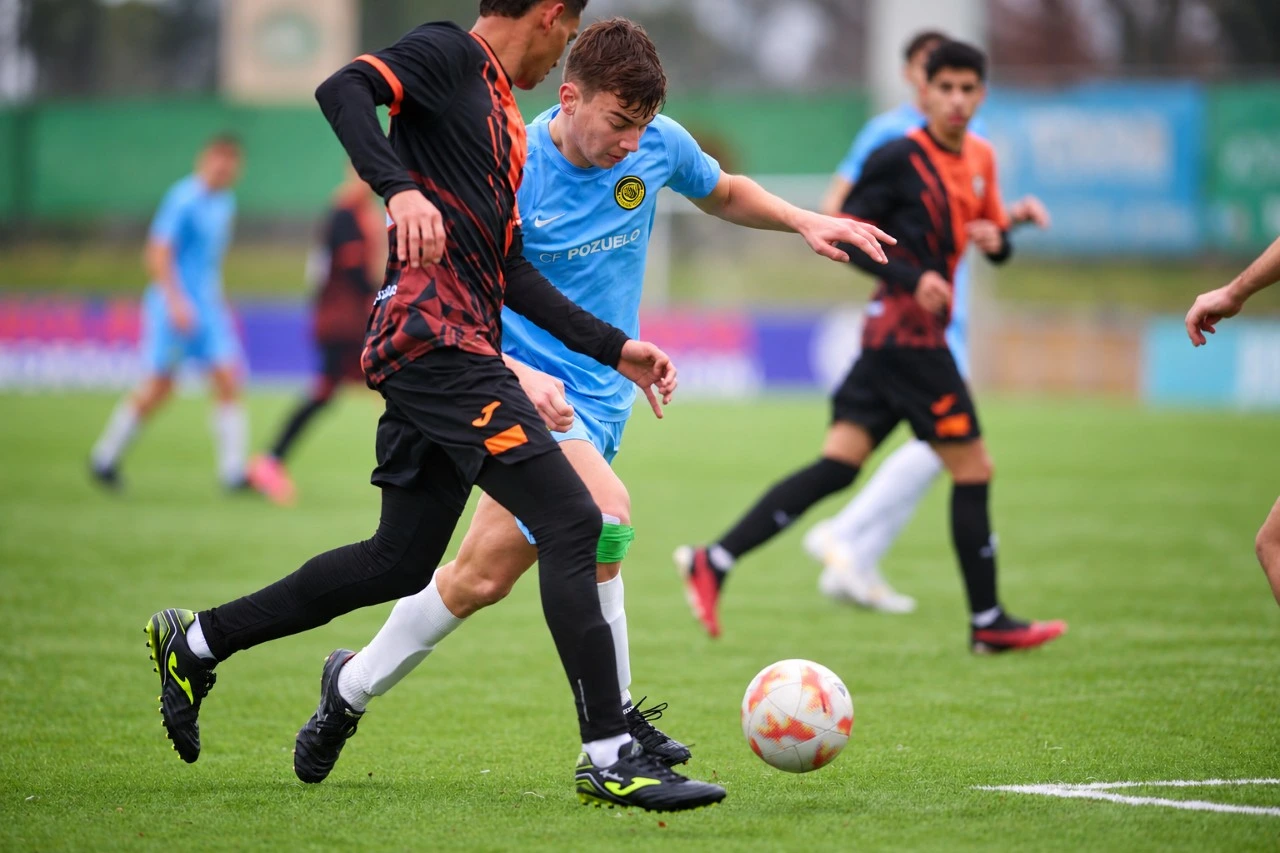
To improve your first touch in soccer, scan before receiving, prepare your body position and direct the ball toward your next action. The pass trajectory, opposition pressure and available space determine how to receive. A useful touch can set up a pass, a dribble, a turn, a shield or a finish.
A ball that stays close to your foot may look well controlled yet still force you to adjust your position before continuing. Another touch may move the ball slightly farther away while taking it beyond the defender and opening a way out. To assess a reception, consider both the execution and what it allows you to do next.
That is why first-touch training needs a variety of situations. Repeated touches help develop technique; changing the pass angle, the pressure and the available options helps you learn when to use it.
What Is a First Touch, and How Does It Differ From Playing One Touch?
Your first touch when receiving secures or directs the ball so you can continue the play. It can cushion a pass, move the ball into another space or position it where you can shield it. You do not need to stop the ball: you need to make it available for the action you have chosen.
Here, we distinguish receiving with a controlling touch from playing the ball first time. If you return a pass directly without controlling it first, you are playing one touch. That contact also requires body preparation, awareness of space and accuracy, but it completes the action without a separate receiving touch.
This distinction helps you make better decisions. In some situations, you will have time to receive and turn; in others, a one-touch pass can preserve an advantage that an extra touch would remove. Receiving better also means recognizing when to play without taking a controlling touch.
How Should You Prepare Your Body Before Receiving?
Preparation starts while another player has the ball. Scan for nearby opponents, teammates offering support and space you could use. Keep updating that information as the play changes: an option that looked open may close before the pass arrives.
Next, adjust your foot position and body orientation. A partly open stance can help you see both the passer and space to move into; with a defender close by, you may need a position that lets you shield the ball. Your stance should respond to the pass angle and pressure rather than stay identical for every reception.
The foot farther from the passer can help you direct certain receiving touches when your body is already positioned for them. The nearer foot can be useful for securing the ball, laying it off or shielding it. Practice and compare these options in different situations.
How to Direct Your First Touch Based on Pressure and Space
Before choosing the direction of your touch, identify what the situation requires. If you can move forward, direct the ball toward an option that remains open. If there is no room to turn, shielding the ball or finding a supporting teammate may be more useful.
The distance of your first touch changes too. Near an opponent, you need to keep the ball within reach; in open space, you can push it farther ahead to start a dribble. The key is being able to complete your next action before the defender reaches the ball.
| Situation | What to Check Before Receiving | What May Help |
| Pressure from behind | The opponent’s distance, room to turn and the supporting teammate’s position | Shield and lay the ball off; turn only if there is enough space |
| An opponent in front of you | The side under less pressure and available passing lanes | Direct your touch to the side or play one touch |
| Open space ahead | The defender’s distance and the available route forward | Set up a dribble or a forward pass |
| Receiving near the sideline | The space between the sideline, the ball and the opponent | Avoid getting trapped; find a route inside or a supporting teammate |
| Receiving with your back to goal | The marking defender’s position and nearby support | Secure and shield the ball, then choose whether to turn, retain possession or lay it off |
| A high or bouncing ball | Height, speed and trajectory | Cushion it with a suitable contact surface and prepare the next touch |
Use these situations to guide observation and decisions. The specific solution also depends on your position, your teammates’ movements and the team’s instructions.

Which Contact Surface Should You Use to Receive the Ball?
Your contact surface should help you handle the reception. The inside of the foot offers options for securing and directing many passes along the ground; the outside can help you move to the side; the sole lets you adjust or shield the ball in tight spaces. For high balls, your thigh or chest can help cushion the drop.
The choice also depends on the speed and trajectory of the pass. Practicing different contact surfaces gives you more options, but their value becomes clear when you connect the receiving touch with what happens next.
| Contact Surface | When It May Help | What to Watch For |
| Inside of the foot | Cushioning and directing a pass along the ground | Whether the touch sets up your chosen next action |
| Outside of the foot | Changing direction to the side | The weight of the touch and the available space |
| Sole of the foot | Adjusting, stopping or shielding the ball in tight spaces | Whether it adds an unnecessary pause |
| Thigh or chest | Cushioning high balls | Where the ball drops and how you prepare the next touch |
In UEFA’s technical analysis of Paris Saint-Germain’s movement, Phil Church connects receiving with body position, different foot surfaces and observation of the ball, players and space. These elements work together: your touch responds to the information you have gathered.
Five Drills to Improve Your First Touch in Soccer
These activities progress from technical execution to decisions against opposition. Adjust the distance, pass speed and difficulty to the player’s level. Each activity should raise a clear question: is the first touch helping the player solve the situation?
1. Partner Passing With Exit Zones
Mark an exit zone on each side of the receiver. A teammate passes the ball, and the receiver directs it toward one of those zones before passing it back. Start with an agreed direction to work on the contact, then change the angle or speed of the pass.
Check whether the ball is ready for the next action or whether you need to reposition your feet. If you train alone, use a wall and keep the reference zones. This variation lets you work on part of the execution, although a teammate’s response adds more variety.
2. Three-Player Receiving and Passing
Set up a triangle: one player passes, another receives and the third provides the next passing option. The receiver must use body orientation and the first touch to prepare a pass to the third teammate. Reverse the direction of play to work on both sides.
Once the activity feels comfortable, change the supporting player’s position before the ball is received. The receiver then has to scan for the next option instead of repeating a memorized sequence. Look for the ability to connect the actions with balance and accuracy.
3. Receiving With a Defender Blocking One Side
Add a defender who occupies a nearby space without actively challenging for the ball. The defender’s position limits one exit and requires the receiver to recognize which option is still available. The receiver can direct the touch, shield the ball or return the pass.
Change the side the pressure comes from. The receiver should adjust body position and the touch to the new situation rather than always making the same turn. This activity introduces information about an opponent before moving to full opposition.
4. Live Opposition With More Than One Option
Keep two supporting players or exit zones and allow the defender to challenge for the ball. The receiver must decide whether to direct the touch into space, shield, lay the ball off or play one touch. Turning can help, but it should not become the only solution rewarded.
Review the information available before the pass and whether the execution matched the choice. If the activity becomes too difficult to maintain, adjust the space or pressure so the player can recognize and practice different options.
5. A Small-Sided Game Focused on Receiving
Take the work into a small-sided game with supporting teammates, opponents and changes of possession. The focus can be on scanning before receiving or directing the first touch into open space when it is available.
Avoid requiring every receiving touch to go forward. That rule can cause turnovers or turns the situation does not need. Observe whether the player recognizes when to progress and when to retain possession, and use short breaks to review specific situations.

Common Mistakes in First-Touch Training
- Watching only the ball. You can make clean contact without recognizing the pressure around you. Include scanning before receiving and check which information you can use.
- Trying to turn every time you receive. If the opponent is close and no route is open, turning can increase the risk of losing possession. Shielding or laying the ball off can also solve the situation.
- Always leaving the ball at the same distance. A touch that is too short can slow a dribble; one that is too long can give the ball to the defender. Adjust the distance to the space and your next action.
- Automatically choosing your dominant foot. This can force you to close your body or move the ball toward pressure. Work on both feet and compare which touch supports each option.
- Always practicing the same pass. A predictable activity can improve a movement but limits decision-making. Introduce changes in direction, speed, support and opposition when you can maintain quality.
- Correcting the touch without checking the cause. Losing possession may begin with late scanning or an unsuitable decision. Identify the problem before choosing what to train.
How Can You Review Your First Touch in a Match?
Select several receptions and watch the full sequence, including the moments before the pass. Review the available space, where the pressure came from and the options your teammates offered. Then assess the direction and distance of your touch in relation to the action you intended to take.
Separate information, decision and execution. You may choose a suitable option and miscontrol the ball, or execute a touch accurately after making a choice that leaves you with no options. Consider the difficulty of the incoming pass too: not every turnover can be attributed to the receiver.
Use these questions to structure your review:
- What could I see before receiving?
- Where was the pressure coming from?
- Did my body orientation let me use the option I had chosen?
- Did the touch leave the ball at a useful distance?
- Was playing one touch a better option?
- What behavior repeats in similar situations?
When the video does not show a detail, leave that question open. Discuss the action with your coach and use the method for analyzing your own soccer match to turn a recurring pattern into a training priority.
Receive Better to Keep the Play Moving
Improving your first touch means preparing the next action with better information and greater accuracy. Work on scanning, adjust your body and practice different touches in situations where the pressure and available options change. Assess progress by what you can do after receiving: pass, dribble, shield or turn when the play allows it.
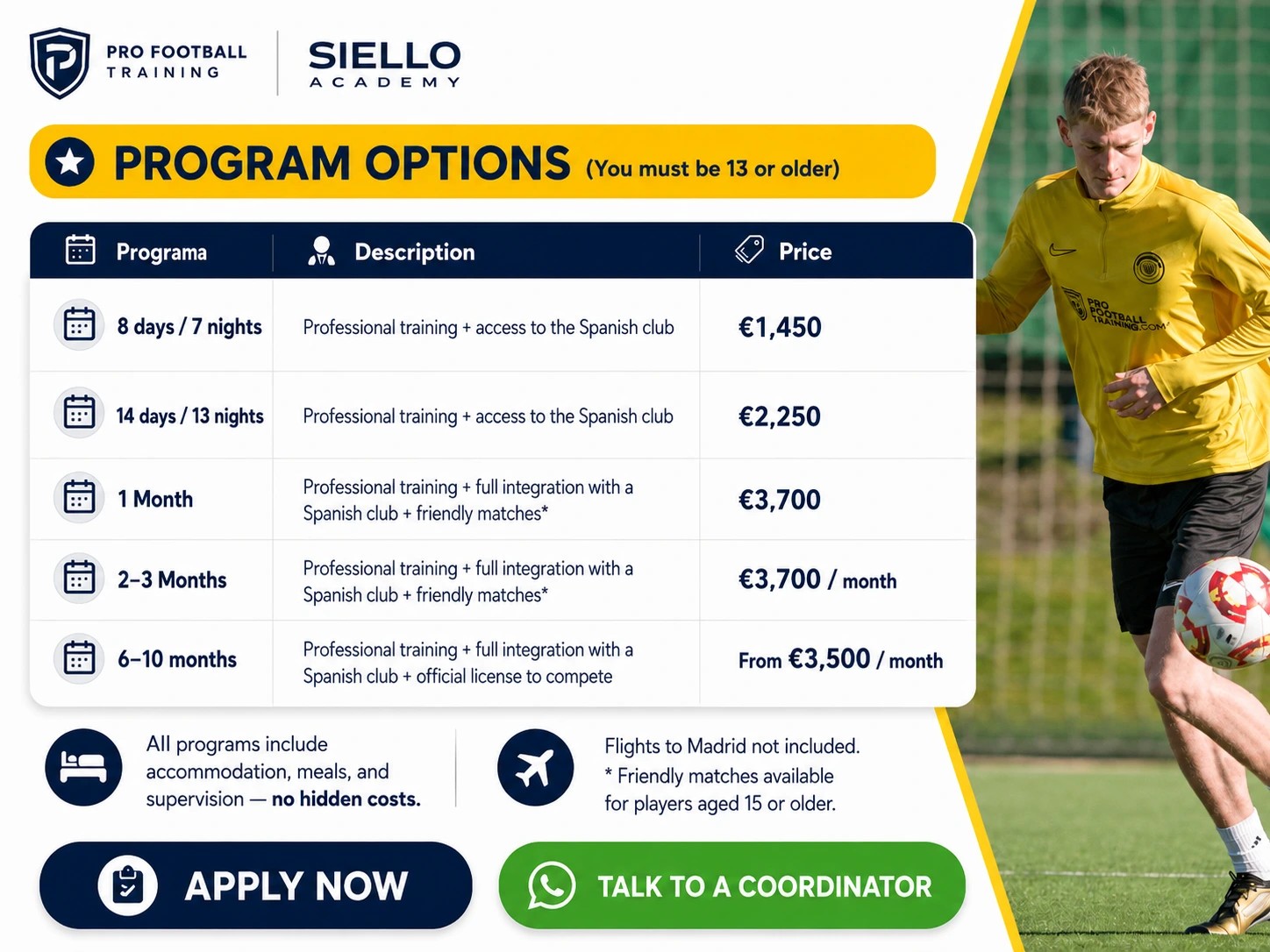
Pro Football Training, a platform within Siello Academy, is part of Siello Football Group, an ecosystem dedicated to the long-term development of footballers in Europe. To learn about immersion and training options in Madrid, explore our programs and consider which format may suit your age, level and goals.
Frequently Asked Questions About First Touch in Soccer
What Is the Difference Between a First Touch and a Directional First Touch?
A first touch when receiving secures or prepares the ball so you can continue the play. A directional first touch moves the ball toward a chosen space to make the next action easier. Not every receiving touch needs to move the ball a long distance.
Should Your First Touch Always Go Forward?
No. You may need to move sideways, shield the ball or prepare a pass to a supporting teammate. Directing your touch forward helps when there is space and you can continue the play while retaining control.
How Can I Practice My First Touch on My Own?
Use a wall and mark exit zones on both sides. Vary the distance, angle and weight of the pass, and alternate feet. This helps with execution; training with teammates and opponents adds pressure and options that a wall cannot reproduce.
When Should You Play One Touch?
When you have already identified a viable option and taking a controlling touch could close a passing lane or allow pressure to arrive. Playing one touch requires a decision in advance and accurate execution; doing it automatically does not guarantee faster or more effective play.
Is a Directional First Touch Only for Midfielders?
No. Center backs, fullbacks, wingers and forwards may also need to direct a receiving touch into space. What changes is the area of the field, the pressure they typically face and the action they want to prepare.
How Many Repetitions Do I Need to Improve?
There is no universal number. Adjust the work to your level and the activity’s objective. Check whether you can maintain quality and adapt your touch when the situation changes rather than judging the work only by the number of repetitions.