
To analyse your own football match, watch it all the way through first without pausing. Then review your on-ball actions by separating information, decision and execution; observe your off-the-ball movements across the four phases of the game; identify behaviours that repeat and turn one of those patterns into a training objective and a cue for your next match.
That order matters.
Starting only with your goals, best passes or most obvious mistakes can give you a very incomplete picture of the match. Much of what defines a player’s performance happens before touching the ball or while the action is taking place elsewhere on the pitch: where you position yourself, what information you gather, what space you create, how you react after losing possession and whether you understand what the team needs at that moment.
- The purpose of self-analysis is not to decide whether you played “well” or “badly.” It is to understand why things happened.
With a recording of the match and a notebook, you can build a useful analysis without professional software, advanced data models or statistics that the video cannot measure accurately.
The method: Five steps to analyse your own match
| Step | What you do | What you are looking for |
| 1. Understand the match | Watch the game without pausing | Context, tempo and role |
| 2. Review on-ball actions | Study receptions, passes, carries and turnovers | Information, decision and execution |
| 3. Analyse off-the-ball play | Review the four phases of the game | Positioning, reactions and team relationships |
| 4. Identify patterns | Compare similar situations | Behaviours that repeat |
| 5. Turn analysis into training | Choose one priority | A specific behaviour to improve |
The key is not to jump straight to the final step. Before deciding what you need to train, you need to understand the problem you are trying to solve.
Before you start: Reconstruct the context
An isolated action can be misleading. A backward pass may be exactly what the team needed to retain possession. A striker can go several minutes without touching the ball and still be creating space for others. A full-back may appear too deep or too high if you do not know the instruction they were given.
- Before watching the match, write down a few basic details: opponent, score, position, minutes played, role, team structure and any specific instruction from the coach. rival, resultado, posición, minutos jugados, función, sistema del equipo y alguna indicación específica del entrenador.
You do not need to write a report beforehand. Two or three lines are enough to remind yourself what was expected from you that day.
Full-match footage and highlights do not serve the same purpose
Whenever possible, use the full-match recording.
A highlight video can be very useful for presenting your profile to an academy, coach or club, but it selects specific actions. It usually does not show supporting runs where you never received the ball, reactions after losing possession, defensive movements or moments when your positioning influenced a play without appearing in the statistics.
To assess your performance, you also need to see those actions. When you only have a short section of footage, you can still analyse it. The important thing is to limit your conclusions to what actually appears in that material and not turn five minutes of video into an assessment of the entire match.
Step 1: Watch the full match without pausing
The first viewing is not for analysing every first touch. It is for understanding the match again.
Watch it as a continuous sequence and try to reconstruct its logic: which team controls different periods, where the game is concentrated, when the tempo changes and what your role appears to be within that structure.
When the match ends, write down only three things: One thing that worked. One difficulty. One question.
For example:
- I found more space when the opposition pushed higher.
- I rarely received facing forward.
- Was I moving too close to the winger during build-up?
These are not conclusions yet. They are hypotheses you will test during the following viewings.
This first pass helps you avoid a common problem: stopping the video from the first minute and judging every action as though it were disconnected from what happened before and after.
In football, every decision has context.
Step 2: Analyse your on-ball actions without reducing them to “good” or “bad”
When you return to the footage, you can now pause at your own involvements, but there is an important difference between counting actions and analysing them.
Instead of asking only whether you completed a pass or lost possession, reconstruct each situation through four questions.
1. What information did I have before receiving?
When the camera angle allows it, look at whether you checked your surroundings before controlling the ball: opponents, teammates, space and nearby pressure.
The FIFA Training Centre presents a three-stage cognitive model to explain many football decisions: assess the situation, select an action and execute the response. Scanning is one of the skills that helps a player gather information before deciding.
The video will not always show exactly where you were looking. Do not invent information you cannot see.
2. Which options were actually available?
Do not analyse the action with the advantage of already knowing the outcome. Try to return to the moment before your decision.
Could you have played first time? Was there space to turn? Would retaining possession have been better? Was a vertical pass genuinely available or already closed? Would carrying the ball have created an advantage?
You do not need to find ten alternatives. Recognising one or two realistic options is enough.
3. Did the decision make sense?
A completed pass is not automatically a good decision. You may have kept possession when there was a clear opportunity to progress. In the same way, an unsuccessful pass can come from the right reading if the idea was appropriate but the technical execution was not good enough.
That is why you should always separate decision quality from the outcome of the action.
4. How was the execution?
Once you have assessed the decision, look at the first touch, body orientation, accuracy, timing of the pass or the technique used.
If you chose a good solution but your first touch was too heavy, the main problem may be technical.
If you executed a clean pass towards an option that did not help the team, you probably need to work more on perception and decision-making.
This distinction turns a generic mistake into a much more trainable objective.
A simple action log is enough
| Time | Situation | Decision | Execution | What to review |
| 12:40 | Receive between the lines | Turn inside | Heavy touch | Scan for pressure earlier |
| 28:10 | Regain possession high | Vertical pass | Good | Repeat the reading |
| 51:25 | Receive near the touchline | Play backwards | Good | Check whether turning was available |
You do not need to record every touch. Select the actions that help explain a behaviour.

Step 3: Look at what you do off the ball across the four phases of the game
This is probably the biggest change when a player begins analysing their own matches with more tactical awareness: stop watching only where the ball is.
UEFA divides open play into four broad phases: attacking organisation, defensive transition, defensive organisation and attacking transition. In April 2026, its Game Insights unit used this same framework again to analyse Champions League teams.
You can use the same framework at an individual level.
| Phase | Question for your analysis |
| Attacking organisation | Does my position help the team when we have possession? |
| Defensive transition | What is my first reaction when we lose the ball? |
| Defensive organisation | Am I protecting the space I am responsible for? |
| Attacking transition | What do I do immediately after we regain possession? |
When your team has the ball
Do not limit your review to how many times you received the ball. Look at whether you are creating a passing lane, maintaining a useful distance, pinning an opponent or opening space for a teammate.
A movement can be useful even if the pass never arrives.
When your team loses possession
Focus on the first few seconds. Depending on your position, the area of the pitch and the team’s playing model, you may need to press, protect the centre, close a passing lane or recover your position quickly.
What matters is whether you react to the new situation or remain mentally stuck in the previous action.
When the opposition has established possession
This is where distances, cover, body orientation, communication and coordination with teammates become important. Many good defensive actions begin several seconds before a tackle or interception.
When your team regains possession
Ask yourself whether you recognise quickly what the situation offers. Sometimes there will be space to attack. At other times, the best decision will be to provide an initial supporting option and retain possession.
UEFA summarises this transition with a particularly useful principle: after regaining the ball, the team must recognise whether it can attack the goal or whether it should secure possession first.
What should you look at according to your position?
Your analysis should reflect your actual role, not a generic description of the position.
| Position | Main areas to review |
| Goalkeeper | Build-up, positioning, depth and communication |
| Centre-back | Progression, anticipation, cover and defensive-line management |
| Full-back | Height, width, supporting movements and defensive protection |
| Central midfielder | Scanning, body shape, tempo and passing lanes |
| Attacking midfielder | Receiving between lines, support and occupation of space |
| Winger | When to pin, attack, release the ball and work off the ball |
| Striker | Link-up play, runs, pinning defenders, pressing and finishing |
Your coach’s specific instructions always take priority over this table.
Step 4: Look for patterns, not blame
- One turnover does not prove that you have a decision-making problem.
- One poor defensive action does not automatically make positioning a weakness.
What you are looking for are behaviours that appear repeatedly in similar situations.
Perhaps you regularly receive without identifying pressure. Maybe you move too close to the teammate in possession. You might anticipate well, but when you fail to win the ball you take too long to recover your position.
You should also identify positive patterns. Perhaps every time you receive on the half-turn you find a progressive option. Or maybe you reorganise very quickly after losing possession.
As a practical guideline — not a scientific threshold — you can pay more attention to a behaviour when it appears around three times in similar contexts.
Once may be circumstantial; when it starts repeating, it is worth investigating.
Do not confuse the symptom with the cause
“I lost possession four times” is a piece of information, not yet a diagnosis.
Those four turnovers may have different causes: limited scanning, poor body orientation, receiving under too much pressure, taking a risky decision in the wrong area or simply poor technical execution.
That is why an objective such as “do not lose the ball” is not particularly useful.
Instead:
“Scan before receiving in central areas so I can identify pressure and direct my first touch” describes a behaviour you can actually train.
Step 5: Turn the video into an action you can train
The analysis is complete when it changes something on the pitch. After reviewing the match, choose one main priority, not five.
That priority should become two things:
- A training objective, specific enough to practise.
- A cue for your next match, short enough to remember while playing.
For example:
| Element | Example |
| Pattern | I receive without identifying pressure |
| Evidence | It happened in four central receptions |
| Possible cause | Late scanning |
| Training objective | Scan before receiving under pressure |
| Match cue | “Check first” |
| Progress indicator | More directional first touches and earlier decisions |
An objective such as “improve my decision-making” is too broad. An objective such as “check before receiving between the lines and direct my first touch into the available space” tells you much more clearly what you need to work on.
Which metrics can you track without professional software?
Some numbers can help, provided the footage allows you to observe them reasonably well. For example, you can track receptions preceded by a visible scan, first touches that allow progression, turnovers by area, line-breaking passes, quick reactions after losing possession or actions performed with your weaker foot.
Not every metric is relevant to every position. You should also avoid comparing two matches without considering the opponent, minutes played, role, scoreline or game plan.
A central midfielder may complete far fewer passes simply because the team had less possession. A striker may have very few shots while still performing important work by pinning centre-backs or creating space.
Data describes; context allows you to interpret it.
This distinction is especially important now that football analysis can produce huge amounts of information. In a FIFA Training Centre session published in May 2026, David Sumpter noted that the challenge is not simply having data, but turning it into actionable information; analytical tools should support professional judgement, not replace it.
How to analyse your match in 20 minutes
Not every match needs a one-hour review. To build a sustainable routine, you can use a shorter version:
- First 5 minutes: reconstruct the context by watching moments from the beginning, middle and end.
- Minutes 5–10: review a few on-ball actions and separate decision from execution.
- Minutes 10–15: find one off-the-ball situation from each of the four phases.
- Minutes 15–18: identify the most relevant pattern.
- Minutes 18–20: define one objective, one cue and one question for your coach.
This does not replace a detailed analysis, but doing it regularly can be far more useful than producing a huge report once every few months.
Talk to your coach: The video does not know the whole game plan
Self-analysis should not become a way of proving that you were right.
Your coach has information the camera does not always show: the collective instruction, the behaviour expected from your position, what the team worked on during the week or the specific adjustments for that opponent. A useful conversation can therefore begin with one or two clips and a specific question:
“In these two situations I end up too close to the winger and we occupy the same space. Should I stay more inside or delay my supporting movement?”
The goal is not to replace the coach’s assessment; it is to learn how to ask better questions.
Self-analysis, professional assessment and highlights are not the same thing
| Resource | Main purpose |
| Self-analysis | Understand your game and identify patterns |
| Professional assessment | Add the perspective of coaches or analysts and the playing-model context |
| Highlight video | Present selected actions from your profile |
| Full-match footage | Observe continuity, decision-making and off-the-ball behaviour |
A highlight video may encourage someone to review your profile, but it should not be used as a complete representation of your performance.
When the goal is to present your material to an academy or club, it is useful to combine this analysis with a football player CV template and understand how to combine your football CV with a video for European clubs. Those resources serve a different purpose within the process.
The most common mistakes when analysing your own match
The first is watching only what you do when you have the ball. The second is counting actions without understanding why they happened.
It is also common to confuse a successful outcome with a good decision, look only for mistakes, try to correct too many things at once or use one match to judge your entire level.
There is another less obvious mistake: using the video to criticise yourself. A useful analysis should not end with “I am bad at this.” It should end with something closer to:
“When this situation happens, I usually respond this way. In the next training session, I am going to work on this alternative.”
That completely changes the purpose of the video.

Analysis is useful when it changes what you do in the next match
You do not need to work like a professional analyst to learn from your own matches; you need to watch with a clear question.
Understand the context first. Then study what information you gather, which decisions you make and how you execute them. Look at what happens when you do not have the ball as well. Find patterns, speak with your coach and choose one priority you can train.
The quality of your self-analysis does not depend on how many statistics you manage to record. It depends on whether the video helps you understand a behaviour and change it. When, in the next match, you scan earlier, occupy a better space, choose an option more clearly or react faster after losing possession, the analysis has started to do its job.
Turn observation into development
Analysing your matches can help you understand your profile more clearly. An external assessment adds another layer: it allows you to compare those observations with the demands of your position, your current level and the environment where you want to develop.
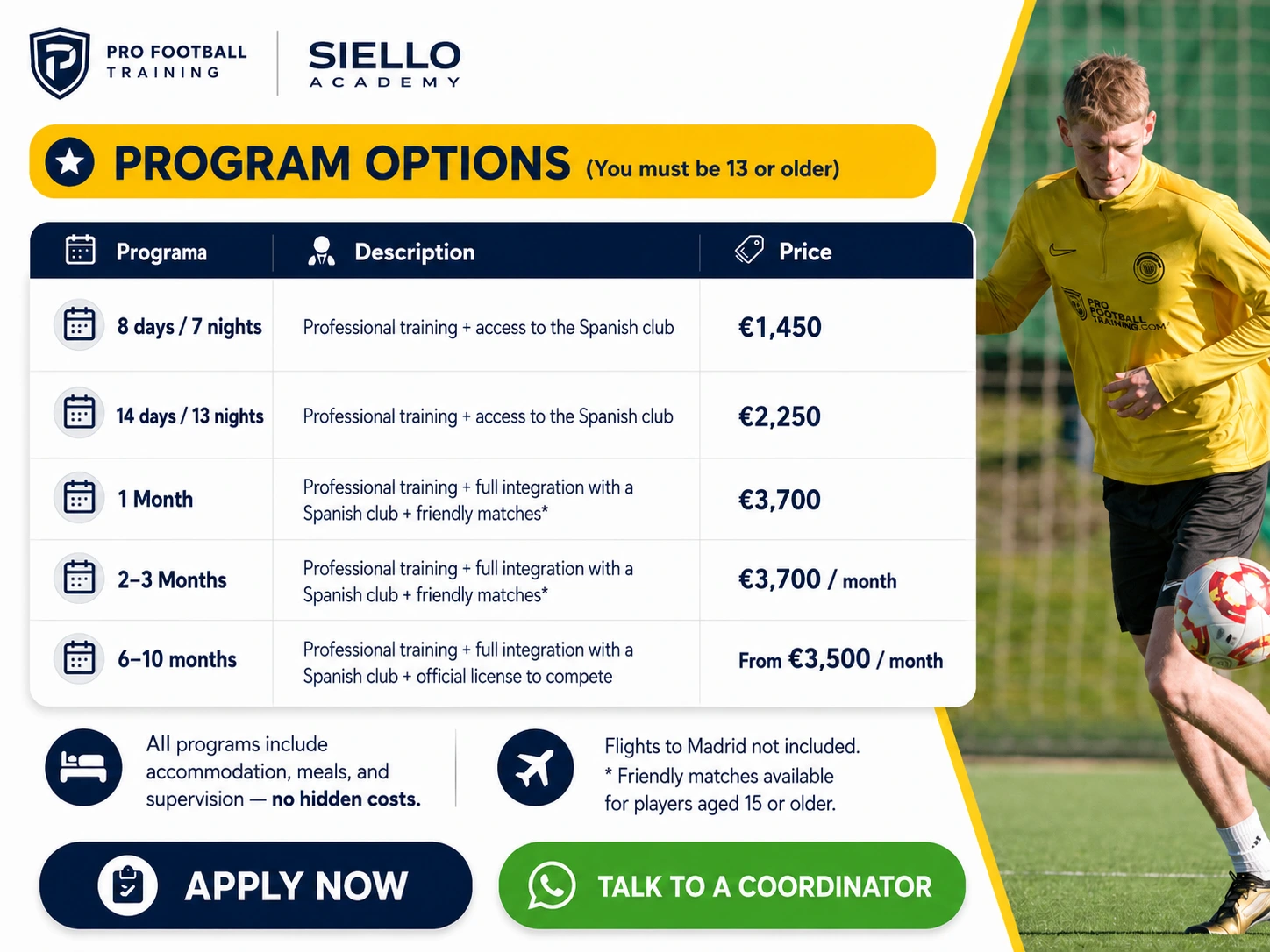
Learn how the assessment and development process works within Pro Football Training and Siello Academy.
Explore our programs.
FAQs
How long does it take to analyse your own football match?
A quick review can be organised in around 20 minutes. For a more detailed analysis, you may spend between 45 and 90 minutes depending on the length of the footage and the level of detail. You do not need to study every match exhaustively.
Should I analyse the entire match or only my own actions?
It is better to understand the full match first and then focus on your own actions. This allows you to interpret each decision within the team’s collective behaviour.
What should I do if I do not have a full-match recording?
Analyse the section you have, but limit your conclusions to that period. A highlight video or partial clip can provide information about specific actions, but it cannot assess your complete performance.
How do I know whether I made a poor decision or simply executed it badly?
First reconstruct the options that were available before the action. If the option you chose made sense but the technique failed, you are probably looking at an execution issue. If you executed a technically clean solution that was not very useful, perception and decision-making may need more attention. The cognitive model presented by FIFA specifically separates situation assessment, action selection and execution.
How many mistakes should I look for?
There is no correct number. Finding one relevant pattern is more useful than creating a long list of isolated mistakes. You should also identify positive behaviours that you want to repeat.
Do statistics tell me whether I played well?
Not by themselves. Numbers need context: position, role, opponent, possession, minutes played, scoreline and playing model all affect their meaning.
Can a highlight video be used to analyse my performance?
Only partially. Highlights allow you to review selected actions and are useful for presenting a profile, but they do not show everything you do off the ball or the continuity of the match.