
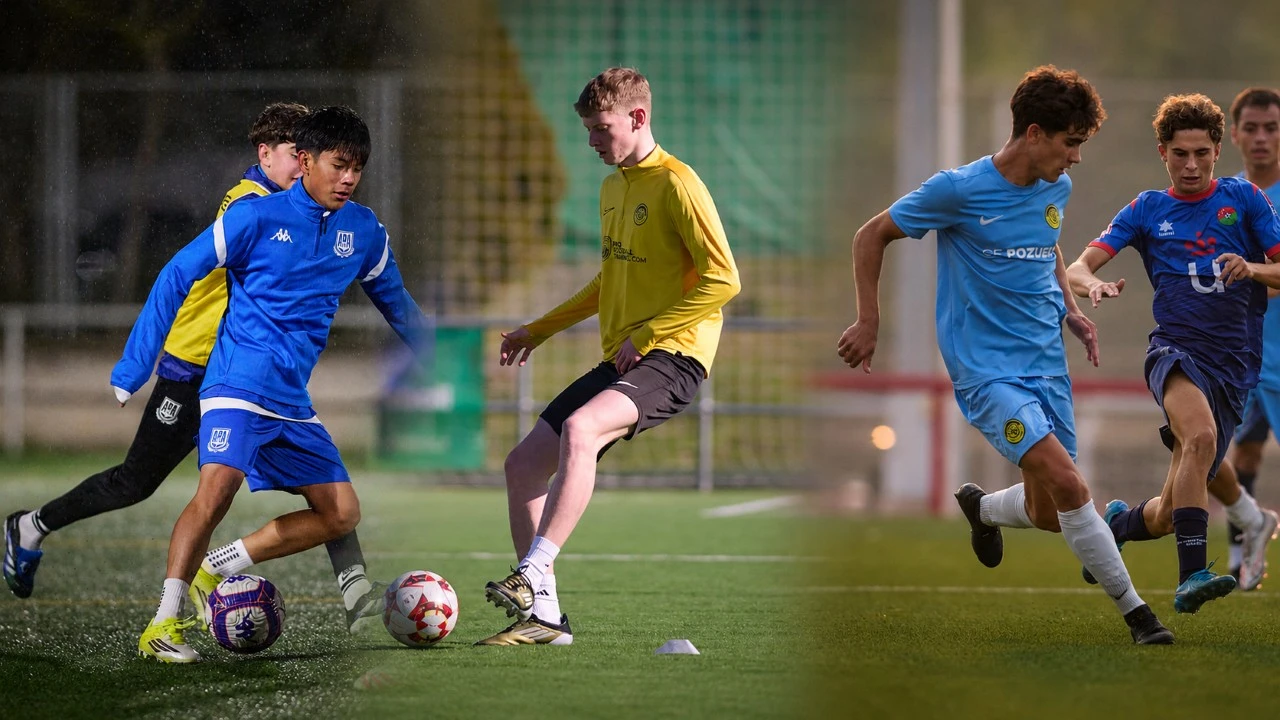
If you want to become a professional footballer, you need more than talent and one lucky opportunity. Your pathway will depend on your age, current level and competitive experience.
- In this guide, we help you build a realistic plan for ages 14, 16 and 18, understand how to measure your progress and identify which decisions may bring you closer to a more demanding environment without falling for false promises.
Age affects your priorities, but it does not determine your future on its own. At 14, the focus is usually on building strong foundations and habits. At 16, you need to turn your qualities into more recognisable competitive performance. At 18, you must show that your performance can be sustained against advanced youth or senior players.
No academy, trial, agent or programme can guarantee you a professional contract. A serious structure can provide training, assessment, competition and gradual access to more demanding environments. What happens next will depend on your level, development, position, sporting circumstances and the opportunities available.
How to become a professional footballer? The short answer
To move closer to professional football, you need technique that works in matches, a strong understanding of the game, physical preparation suited to your age and regular competitive experience. You must also learn how to respond to coaching, mistakes, time on the bench and stronger opposition.
Training for many hours is not enough if the work does not improve how you perceive, decide and execute during a match. A highlight reel is not enough either if the same level of performance cannot be sustained throughout a full match or across a season.
The most useful question is therefore not only “At what age should I become professional?” It is:
What do you need to improve and demonstrate at your current stage?
What becoming a professional footballer really means
Training at an academy, playing for a registered club, competing at a strong youth level, joining a reserve team and signing a professional contract are different stages.
You may develop within a professional structure without being a professional footballer yet. You may also play at a semi-professional level while trying to establish yourself in senior football. Having an agent does not automatically change your sporting status or guarantee that a club will sign you.
In this guide, we understand the professional pathway as a progressive process. First, you develop your abilities. You then need to demonstrate them in competition. If your performances continue to improve, you may gain access to more demanding environments and eventually move towards a contractual opportunity when your profile matches a club’s needs.
There is no single pathway. Some players enter professional club academies at an early age. Others develop through local clubs, regional leagues, college football, reserve teams, lower divisions or semi-professional competitions.
Your age guides the process, but it does not predict the outcome
Two 15-year-old players may be at very different physical and sporting stages. Being the same chronological age does not mean they have reached the same level of biological maturity, nor does it tell us how each player will develop.
Research on biological maturation presented by the FIFA Training Centre shows that early-maturing players may temporarily benefit from advantages in height, strength, power and aerobic capacity. This can influence selection and leave later-maturing players underrepresented.
If you are stronger than most players at 14, that advantage does not automatically prove that you have greater long-term potential. Similarly, being smaller or less physically developed does not mean you should be dismissed. Technique, tactical understanding, learning ability and progression over time also belong in a serious assessment.
Evaluation also changes according to your position. A centre-back, full-back, central midfielder and striker solve different problems. Comparing them through the same physical test or an isolated statistic may provide an incomplete picture.
What coaches look at when assessing your level
When a coach watches you, they do not focus only on what you do with the ball. They also analyse how you prepare to receive it, which spaces you recognise, what decision you make when time is limited and how you react after losing possession.
Technique matters when you can apply it under pressure. A good first touch is not only about controlling the ball. It should prepare your next action. A pass is not assessed only by whether it reaches a teammate; its timing, weight and ability to create an advantage also matter.
Playing quickly does not mean always playing one-touch . It means understanding how much time the situation allows and choosing an appropriate response.
Without the ball, coaches may observe your support, movement, defensive cover, body orientation, pressing and ability to stay connected with the team. Physical qualities such as speed, strength, power and endurance should be interpreted according to your age, position, training schedule and biological development.
Your ability to learn also matters. A coach needs to know whether you understand feedback, whether you can apply it and what happens when a match does not favour your strongest qualities.
The FIFA Talent Identification Guide explains that each organisation must first define its football philosophy and the type of player it needs. You may therefore be a strong fit for one project and not a priority for another without that decision defining your overall level or long-term future.
Your plan for ages 14, 16 and 18
| Age | Main focus | How progress becomes visible | Common mistake |
| 14 | Build foundations and habits | Better technique under pressure, basic positional understanding, regular playing time and greater independence | Looking for exposure before building a consistent base |
| 16 | Turn qualities into performance | A clearer position, competitive continuity, better decision-making and recent player material | Choosing a club only for its name and losing playing time |
| 18 | Demonstrate current performance | The ability to compete in advanced youth or senior football, fulfil a role and sustain your level | Expecting an agent or trial to replace performance |
This comparison is only a guide. Your real stage will depend on your playing history, competitive level, maturity, position and available opportunities.
How to become a professional footballer at 14
If you are 14, you still have significant room for development. Your main objective should not be to secure a professional contract immediately. It should be to build a foundation that allows you to make better use of the years ahead.
Learn how to play, not only how to complete drills
Technical work remains essential, but it must gradually connect with perception and decision-making. You may perform very well in an unopposed drill and still struggle to repeat those actions when an opponent reduces your time and space.
At this stage, you should work on your first touch, both sides of your body, passing quality, ball carrying and position-specific actions within situations involving teammates, opponents and realistic objectives.
The question is not only whether you can perform a technical action. You also need to understand when to use it.
This difference becomes clear in an academy training environment. A correction to your body orientation, for example, may improve both your first touch and the speed of your next decision. Development is not about accumulating disconnected drills. It is about understanding how individual details influence the full action.
Find an environment where you can play regularly
At 14, belonging to a well-known organisation may be less valuable than competing regularly in an appropriate environment. Matches teach you how to manage mistakes, communicate, read opponents, adjust to different rhythms and understand the responsibilities of your position.
Playing time also allows your coach to monitor your development. Matches reveal problems that do not always appear in isolated exercises: what you do after losing the ball, how you respond when your team is behind and whether you continue making good decisions when fatigue begins to affect you.
Before choosing a club based only on its reputation, consider whether you will receive suitable training, genuine feedback and realistic opportunities to play.
Build habits that support your development
Punctuality, sleep, nutrition and preparing your equipment all form part of the process. You must also learn to report pain or physical discomfort and review your performances without turning every mistake into a final judgement about your ability.
Your family will still play an important role, but you can begin to take greater responsibility. Packing your kit, knowing your schedule, continuing your education and listening to the coaching staff are practical ways to develop independence.
UEFA’s youth development requirements include age-appropriate football education, medical support, educational initiatives and review processes. They also state that young players must be able to continue their general education while participating in a football development programme.
Do not confuse physical development with final potential
At 14, differences in maturation can be highly visible. A player who has developed earlier may dominate certain duels, while another may need to solve the same situations through anticipation, positioning and speed of thought.
If you currently have a physical advantage, you will eventually need to show that your game does not depend entirely on it. If you are still developing physically, you need an environment that also values your technique, game intelligence and capacity to improve.
How to become a professional footballer at 16
If you are 16, you still have time to develop, but the competition is becoming stronger. At this stage, you need to turn your qualities into recognisable and repeatable behaviours during matches.
Start building a clearer player identity
Saying “I can play in any position” often provides less information than you may think. At 16, you should begin to understand your primary position, the role you can fulfil and the actions you should perform consistently.
If you are a full-back, you may stand out because of your ability to progress with the ball, defend large spaces or overlap effectively. If you are a central midfielder, a coach may value how you scan before receiving, read transitions or play under pressure. If you are a striker, you will not be assessed only through goals. Your movement, link-up play and pressing also matter.
Defining a player profile does not mean restricting yourself to one position. It means helping a coach understand what you can contribute and which environment may suit your characteristics.
Compete at a level that genuinely challenges you
Your environment should force you to make quicker decisions without leaving you permanently outside the competition. If moving to a more prestigious club drastically reduces your playing time, consider whether the change is actually helping your development.
The quality of the process can also be seen in the feedback you receive. “You have talent” and “you need to become stronger” are too general to guide your work. A useful assessment should explain what you currently do well, which behaviours need to improve and how progress will be evaluated over the following months.
The right level is not always the highest level you can access. It is a level that challenges you while still allowing you to participate, learn and demonstrate progress.
Start documenting your performance
At 16, it makes sense to have an updated football CV, a concise highlight reel that represents your actual characteristics and, where possible, one or more full matches.
The objective is not to produce the most dramatic video possible. It is to make assessment easier. A highlight reel presents selected actions, while a full match shows how you position yourself, how involved you are, which decisions you make and how you respond during less favourable moments.
- You can use our guide to create a football player CV and learn how to contact a football academy properly.
Assess an international experience carefully
If you play in the United States, Canada, Mexico, Latin America or another international market, training in Spain may expose you to a different methodology, greater personal independence and another competitive rhythm.
However, travelling without a clear sporting objective can turn a major investment into an experience that is difficult to evaluate.
Before choosing a programme, you and your family should understand your current level, how long you may need to adapt, what type of training you will receive and which competitive opportunities may be possible according to your age and documentation.
An international stay may help you train, learn and receive a different assessment. It cannot automatically compensate for an insufficient playing base, and it does not guarantee a club signing.

How to become a professional footballer at 18
If you are 18, it is not automatically too late. However, the logic of your assessment changes.
You are entering or approaching senior football. Potential still matters, but it must now sit alongside a more direct question: what can you contribute today?
Turn potential into evidence
At 18, you need recent footage and a clear competitive context. An evaluator should be able to identify your position, role, level of opposition and consistency.
The objective is not to prove that you never make mistakes. You need to show that you can sustain useful behaviours: competing in duels, reading the game, maintaining intensity, adapting to tactical instructions and performing against players of a similar or older age.
Old footage quickly loses value at this stage. Your player profile must represent your current level, particularly if your body, position or competitive category has changed.
Understand that the transition to senior football may be gradual
Becoming a professional footballer does not always mean moving directly into a top division. Advanced youth categories, reserve teams, regional competitions, college football and semi-professional divisions may all form part of a valid transition.
The quality of the environment and the realistic possibility of competing should guide your decision. A less well-known team where you train properly, receive feedback and play regularly may provide a better platform than a prestigious organisation where you are rarely selected.
Your first objective may be to establish yourself at a lower level, demonstrate consistency and prove that your performances can gradually transfer to a more demanding competition.
Make sporting and personal decisions
At 18, the cost of a poor decision may also increase.Before changing country, club or programme, you need to know who will assess your performance, which position the team needs, how long adaptation may take and what happens if the opportunity does not lead to a contract.
Having an academic or employment alternative does not show a lack of commitment. UEFA has recently reinforced the importance of education, career planning and dual-career development for young players. Preparing for different outcomes may help you sustain your football development with greater stability.
Understand what an agent can do for you
An agent may participate in negotiations, facilitate communication and represent you in certain transactions. An agent cannot create the sporting level that a club needs.
FIFA states that only licensed individuals may provide football agent services intended to conclude specific football transactions and that a written representation agreement is required.
Before signing, verify the licence, understand the services, duration and fees, and seek independent advice. Representation makes sense when there is a prepared player profile and a genuine opportunity. It should not replace training, matches or sporting assessment.
How to know whether you are really progressing
Progress should not be measured only through goals, followers, messages from agents or invitations to trials.
In some positions, a major improvement may appear in your body orientation before receiving, the speed with which you recognise an advantage or the way you close space after losing possession.
Every three months, you should be able to compare your current performance with your starting point. Consider whether you are more involved in matches, repeat the same mistakes less often and apply your coach’s corrections more consistently in competition.
You should also observe what happens when the level of difficulty increases. A skill that appears only in unopposed training is not yet fully established. When you can sustain it against quicker opponents, with less space and under fatigue, it begins to become a competitive tool.
Your coach should be able to describe your development through examples.. “He now scans before receiving”, “she defends the far post more effectively” .or .“he chooses better moments to progress” .are more useful observations than a general statement about talent.
Your 90-day plan to move closer to professional football
This plan does not replace the work of a qualified coaching staff. Its purpose is to help you establish a starting point, reduce the number of objectives and check whether your work transfers into matches.
| Period | Objective | Practical application | Expected evidence |
| Weeks 1 and 2 | Diagnose | Review recent matches, request feedback from your coach and select two or three priorities | A clear description of your current level and position-specific objectives |
| Weeks 3 to 6 | Work specifically | Integrate the objectives into suitable technical, tactical and physical training | Better execution and a clearer understanding of when to apply each action |
| Weeks 7 to 10 | Transfer improvements into matches | Observe whether the behaviours appear in competition and save complete sequences | Repeatable actions under pressure rather than one isolated highlight |
| Weeks 11 and 12 | Review and decide | Compare your starting footage with your current performance alongside your coach | Continue the plan, adjust the focus or assess a more demanding environment |
If you are a full-back, for example, you may focus on body orientation before receiving and defensive recovery runs. If you are a striker, you might work on movement off the ball and pressing immediately after possession is lost.
The key is to choose a small number of priorities that can be observed during matches. Trying to improve ten areas at the same time makes it harder to identify what is working.
At the end of the 90 days, the next decision does not necessarily have to be applying for a trial. You may benefit more from continuing your local development, adjusting your training or improving your player material before pursuing the next step.
Do you need to go to Europe to become a professional footballer?
No. Professional players develop in many countries, competitions and football systems.
Spain may be relevant if you want to experience another methodology, adapt to a different playing rhythm or receive an assessment within a structure connected to European football. Travelling to Spain, however, does not automatically make you a professional footballer or guarantee that a club will select you.
The decision should begin with your objective rather than the destination itself. A short stay may help you understand the environment and receive initial feedback. A programme lasting several months may allow for deeper adaptation and more consistent assessment.
In either case, you and your family need to understand the included services, competitive conditions, full budget and possible next steps after the programme.
You can learn more in our guide to youth football in Spain by age group and category and our article explaining how to train football in Spain as an international player.

If you are under 18, this is especially important
Training temporarily in Spain, studying in the country, joining an academy and being officially registered by a club are different situations.
FIFA regulations generally prohibit international transfers of players under 18. Only specific exceptions may apply, and they must satisfy the relevant requirements and receive prior approval.
Paying for a programme does not automatically mean that you can receive a playing licence, participate in any competition, sign a contract or remain in Spain beyond your authorised period of stay.
If you are a minor, your family must participate in the decision and review accommodation, supervision, education, medical support, documentation, immigration requirements and the actual conditions governing competitive participation.
How the Siello ecosystem may support your development
Siello connects player development, competition and professional monitoring within the same ecosystem. This makes it possible to observe your development in different settings, but it does not remove the need for assessment or turn programme participation into a guaranteed contract.
Siello Academy: daily player development
Siello Academy provides daily high-performance training in Madrid. Sessions focus on technical, tactical and physical development, with attention to individual player needs and coaching staff holding UEFA PRO licences.
The value of this environment is not simply completing training drills. It lies in receiving feedback, adapting to a methodology, training alongside different international profiles and showing how you respond to sustained demands.
Siello FC: a real competitive environment
Siello FC competes in Tercera RFEF, the fifth tier of Spanish football. Players enrolled in longer-term programmes may be assessed for possible integration into the club’s competitive structure.
Any decision depends on performance, age, position, squad requirements, programme duration, calendar and documentation.
Participating in Siello Academy does not guarantee integration into Siello FC, playing time or official match participation.
Siello Football Group: monitoring and representation
Siello Football Group manages more than 20 professional players across LaLiga, Primera RFEF and Segunda RFEF. The agency may monitor your progress within the ecosystem and consider opportunities when your profile and sporting stage justify them.
This monitoring does not mean automatic representation. Training, competition, representation and signing a professional contract remain separate stages.
Warning signs when evaluating a professional football opportunity
Stop and request more information if a person or organisation:
- Guarantees a contract or entry into a major club before assessing your level.
- Pressures you to pay immediately without providing written conditions.
- Deliberately confuses training, competing, being observed and being signed.
- Promises a starting position, playing time or official competition without considering coaching decisions and documentation.
- Uses club logos without explaining the real relationship.
- Claims to be an agent but does not allow you to verify their licence.
- Excludes your parents or legal guardians from the process if you are under 18.
A football opportunity may be commercial and still legitimate. What matters is whether you can understand what service you are purchasing, who will assess you, which conditions apply and which outcomes cannot be guaranteed.
Frequently asked questions about becoming a professional footballer
What do I need to become a professional footballer?
You need a combination of technical and tactical training, appropriate physical preparation, regular competition, strong habits, learning ability and gradual access to more demanding levels. These elements improve your preparation, but none of them guarantees a contract on its own.
Can I begin a serious football pathway at 14?
Yes. At 14, you still have time to develop your foundations, understanding of the game and daily habits. Your progress will depend on your previous level, learning ability, quality of training and opportunities to compete.
Is 16 too late to try to become a professional footballer?
Not necessarily. At 16, you need to turn your qualities into performance, define your player profile more clearly and compete consistently. You should also begin documenting your career with recent footage and an updated football CV.
Is 18 too late to become a professional footballer?
There is no universal answer. At 18, current performance carries more weight and competition becomes stronger, but pathways may still exist through advanced youth football, reserve teams, college football or semi-professional divisions.
Do I need to join a professional academy as a child?
No. A strong academy can provide structure, but professional footballers do not all follow the same route. You may also develop through local clubs, regional leagues and other competitive environments.
Can an agent help me become a professional footballer?
An agent may help with representation, communication and negotiation when a genuine opportunity exists. An agent cannot replace your sporting level or guarantee that a club will sign you.
Does joining a football academy in Spain guarantee that a club will see me?
No. An academy may provide training, assessment and access to certain competitive environments. Being observed does not mean being selected, and being selected does not automatically mean signing a professional contract.
What matters more: training or playing matches?
Both are necessary. Training develops your abilities, while matches show whether you can apply them under pressure. The right balance depends on your age, current stage, competition schedule and playing level.
Your age changes your priorities, but it does not replace the process
At 14, your main challenge is to build a strong foundation. At 16, you need to turn your qualities into competitive performance. At 18, you must show that your performance can be sustained against advanced youth or senior players.
- No age guarantees success. There is also no universal date after which everything becomes impossible.
You need to understand your current level, work towards specific objectives and choose environments that provide training, competition and useful feedback. Ambition may begin the journey, but preparation, learning and performance allow you to continue it.