

There is one question that comes up almost every time a family starts seriously considering a soccer pathway in Europe. It usually is not the first question the player asks. It is usually the first question the parents ask:
“What happens with school?”
It is a fair question. When a young player starts pushing for a higher level, the conversation around soccer often becomes extreme: either the family goes all in on the sport, or they protect academics and cool down the competitive dream. That tension has been present for years in many families across the United States, especially when the possibility of moving to Spain stops feeling distant and starts looking like a real decision.
The problem is that this supposed choice is often framed the wrong way. Not because combining both is easy, but because treating them as automatically incompatible erases one key point: what makes that balance fail is not soccer itself, but the lack of structure.
When there is no routine, no logistics, no organized schedule, and no environment that supports the player, studying and competing at a high level becomes chaotic. But when there is a clear framework — housing, schedules, discipline, support, and academic options that fit the demands of training — the conversation changes. The level of commitment does not disappear. What disappears is the improvisation.

The False Dilemma: Why So Many Families Feel Like They Have to Choose
In many situations, the feeling that academics and elite soccer cannot coexist is not an exaggeration. It comes from real experience.
Players who leave early in the morning, spend hours commuting, train late, get home exhausted, eat poorly, and end up studying at random times. Clubs that only focus on what happens on the field and provide no structure outside training. Schools that are too rigid to work around an athlete’s schedule. Families doing everything they can without a real system that supports both areas.
In that kind of setup, of course it feels impossible.
But there is a big difference between saying that without structure it is very difficult to sustain both academics and high performance, and assuming that serious soccer automatically means giving up education. In more professional environments, it is becoming increasingly clear that education is not a distraction from the player’s development. It is an important part of it.
Not because every player needs to become an academic standout, but because the habits required to stay on track in school — discipline, consistency, time management, frustration tolerance, and the ability to follow complex instructions — also matter in sports.
The Right Question Is Not Whether It’s Possible. It’s How It’s Organized.
Saying “yes, you can study and play soccer in Spain” without explaining how would be too easy. And for a family considering a major investment and a move to another country, it would not be enough.
The useful question is not just whether both worlds can coexist, but under what conditions. In practice, that depends on three factors:
- the academic format the player will follow
- the residential and logistical structure
- the player’s actual discipline
If one of those pieces breaks down, the balance starts to fall apart.
What Makes It Possible to Combine Academics and High-Level Soccer
1. Flexible Academic Formats That Actually Fit
In international programs like this, academic continuity usually does not depend on enrolling in a traditional in-person Spanish school with a rigid schedule. In many cases, the solution comes through more flexible models: online high school, an international high school program, college, or hybrid academic formats already selected and managed by the family.
That point matters. A high-performance academy does not necessarily replace the school or university. What it does is create the conditions that make academic continuity more realistic without putting it in direct conflict with the player’s soccer routine.
In other words, the program does not magically solve education on its own, but it can make it much more viable when there is a clear academic plan in place.
2. Protected Time to Study
One of the biggest mistakes in many sports projects is assuming the player will “study whenever there’s time.” That almost always ends badly.
When academics are left to whatever time is left over, academics usually lose. That is why in a well-organized structure, study time should not be treated as an afterthought. It should be scheduled as a fixed part of the routine, just like training, meals, and rest.
For many families, this is one of the biggest sources of peace of mind: knowing the player is not expected to self-manage everything in a demanding environment with no framework, but instead is living inside a daily structure that protects time for focus and accountability.
3. Less Logistical Friction
A huge part of the exhaustion does not come from training itself. It comes from everything around training.
When housing, meals, transportation, and daily routine are disorganized, the player wastes time and energy solving basic problems. That hurts both athletic performance and academics.
A residence integrated into the program changes exactly that. It reduces unnecessary commuting, brings order to the day, simplifies the operation, and allows time to be used more intelligently. For a family evaluating this kind of investment, that level of efficiency is worth far more than any emotional sales promise.
What a Well-Structured Residence Adds to This Decision
When people talk about balancing school and soccer, a residence is not just a place to stay. It is an organizational tool.
That includes, among other things:
- more stable schedules
- less day-to-day operational stress
- proper spaces for studying
- clearer recovery time
- everyday supervision
- and an environment where routine does not depend on luck
For a family, that point is central. Because the real question is never just whether the player will “have internet” or “find time.” The real question is whether the player will live inside a structure that supports habits compatible with a demanding long-term project.
That is where many programs start to separate themselves. Some offer training. At Siello Academy, we offer an ecosystem.
The Uncomfortable Part: This Only Works if the Player Also Steps Up
This also has to be said clearly: not even the best residence or the best academy can replace the player’s own responsibility.
A structure can organize the day, create habits, and support discipline. But if the player does not take academics seriously as part of the process, the balance becomes fragile. And that matters because in this kind of environment, what a player does off the field also says a lot about maturity.
For many families, this is a key point. They are not just paying for training sessions. They are investing in a complete development process. And that includes how the player responds to responsibilities when no one is applauding.
What Families Should Evaluate Before Making This Decision
Before moving forward, the family conversation should not stop at “yes, it’s possible” or “no, better not.” It is far more useful to bring the discussion down to practical questions:
- What academic format will the player follow?
- Who will manage it and supervise it?
- Is there a routine compatible with double sessions, recovery, and focused study time?
- Does the residence support that organization, or make it harder?
- Does the player actually have the discipline to sustain both fronts?
- Is the family looking for a serious structure, or just a temporary solution?
Answering those questions brings far more clarity than any generic promise about “well-rounded development.”
What Makes a Well-Structured Program Different
In a program like the one developed by Siello Academy, the value does not come from claiming that school and soccer “live in perfect harmony” as if that happened automatically. The value comes from recognizing that balance requires method, discipline, and a clear operational structure.
That is why the focus should not be on selling a fantasy of perfect balance, but on explaining what actually makes that balance possible:
- organized residence
- clearly defined schedules
- support and guidance
- a serious daily routine
- logistical compatibility
- and realistic family expectations
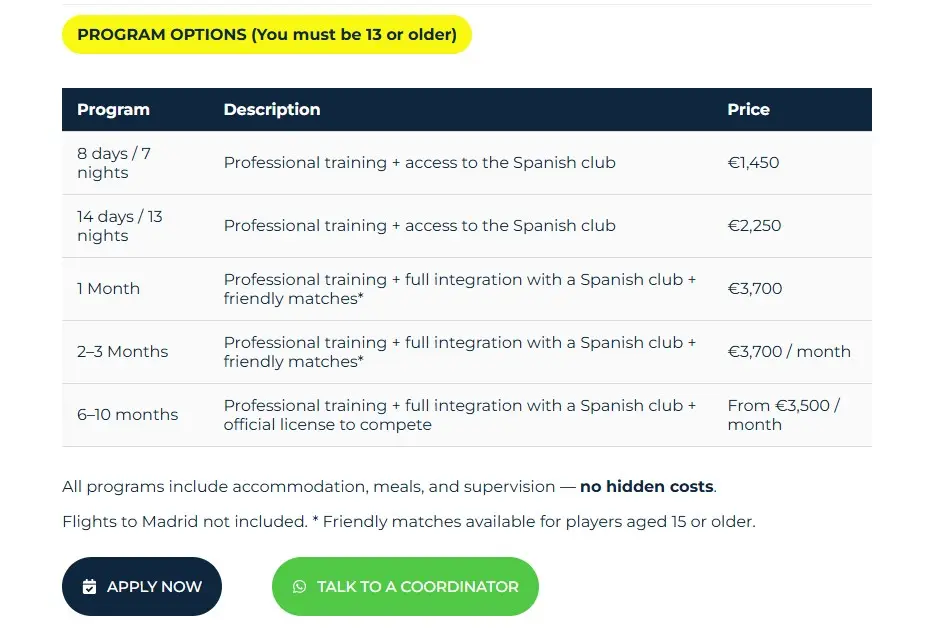
In addition, during a full-season program, the structure also includes a broader development logic: agency representation, written game-time commitments, and trials with partner clubs.
That does not remove the academic responsibility or turn the investment into a blind gamble, but it does reinforce the idea that the player is entering an environment where every part of the process has a purpose.
When This Path Makes Sense — and When It Doesn’t
It makes more sense when:
- the family wants a serious structure, not an improvised experience
- the player is ready to live with real discipline
- there is a clear academic plan
- everyone understands that performance requires order off the field
- the investment is being evaluated as a process, not as a shortcut
It makes less sense when:
- the family expects the program to solve academics on its own
- the player is not ready for a demanding routine
- there is no clarity about academic format, supervision, or responsibilities
- the goal is simply to have an international experience without real day-to-day commitment
The real issue is not whether a player can study and play soccer in Spain. The real issue is whether that player has the right structure in place to avoid improvising either one.
When that structure does not exist, the choice between sports and education starts to feel inevitable. When it does exist, what changes is not the level of demand, but the viability of the process.
That is why, for a family considering a high-performance program, the better question is not “Will my child have time to study?” but something deeper: Will my child be living inside a structure that forces him or her to organize life like a serious athlete?
Because in the end, beyond soccer itself, that is also part of the training.
FAQ about Study and Play Soccer in Spain
Can you study and play soccer in Spain at the same time?
Yes, but not just any way. It requires an academic format that fits the player’s schedule, an organized routine, and a residential structure that reduces improvisation.
Does the academy directly manage the player’s high school or college studies?
Not necessarily. In programs like this, the family usually defines the academic path, while the academy provides the environment, logistics, and discipline that make continuity possible.
What kind of academic options do international players usually follow?
It depends on the case, but families often choose flexible formats such as online high school, international high school programs, distance college, or academic models that are compatible with the training routine.
What happens if a player neglects academics?
In a serious structure, that should not be treated as a minor detail. Academics are also part of the player’s responsibility and level of maturity.
Does the residence really help balance both areas?
Yes. It brings order to the day, reduces logistical friction, protects recovery time, and makes it easier to maintain a routine that is compatible with both high performance and academic continuity.
If this decision has already stopped being just an idea in your family and is starting to feel like a real possibility, the most important thing is not to rush. It is to understand the structure clearly.