
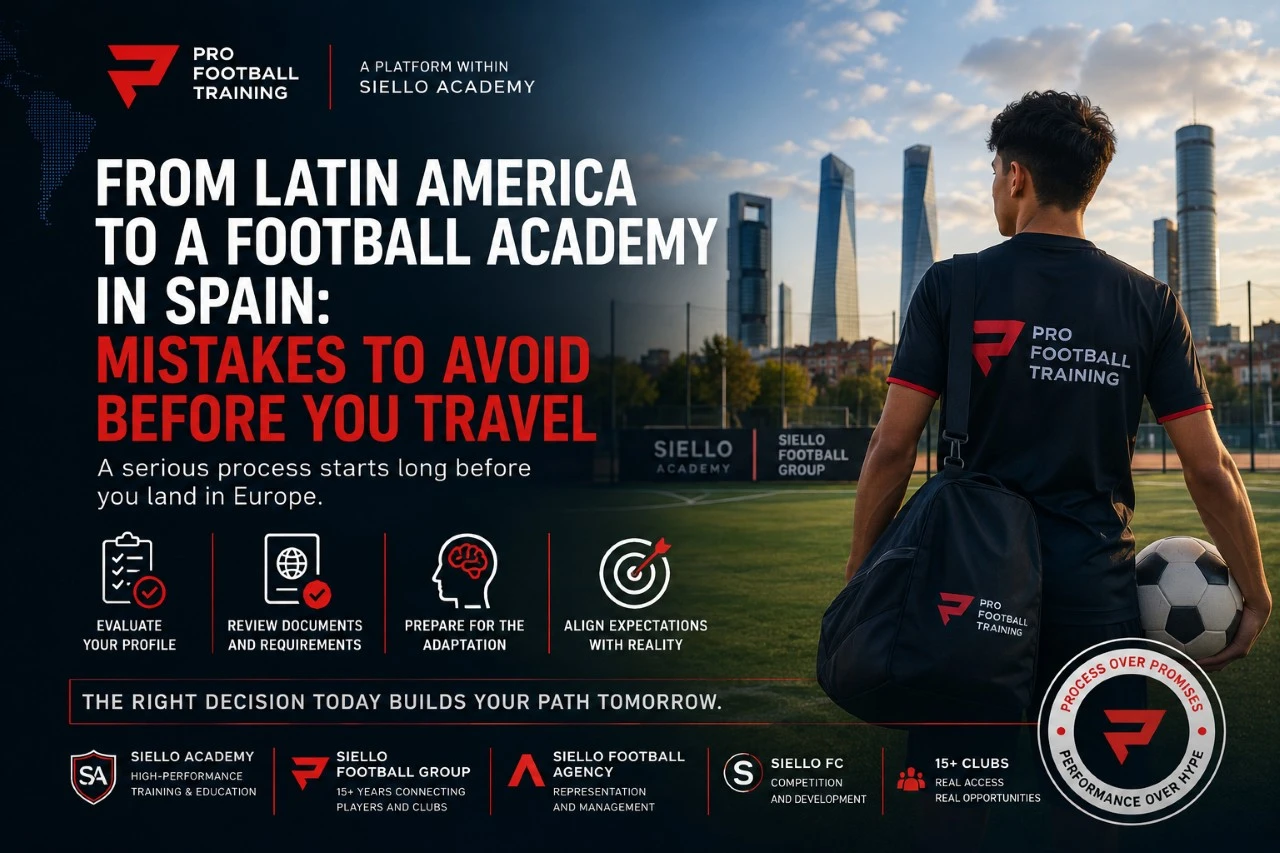
For a Latin American player, Spain can feel like a natural route. The language helps, the football culture feels familiar and many families see Europe as a logical step if the player has talent, discipline and serious intent.
But sharing a language does not mean sporting, tactical, physical and logistical adaptation will be automatic. Travelling from Argentina, Colombia, Mexico, Venezuela, Puerto Rico, Costa Rica or another Latin American country to a football academy in Spain requires much more than ambition.
Before travelling to a football academy in Spain from Latin America, , families should assess the player’s real level, program duration, documents, costs, residence, adaptation, program structure and sporting expectations. The pathway may make sense, but it should not be treated as an automatic promise of a club, contract or European career.
Pro Football Training and Siello Academy, are part of Siello Football Group, an ecosystem dedicated to the long-term development of footballers in Europe. In our programs in Madrid, we work with a clear principle: first, assess the profile; then, decide what type of process may make sense. Not every player needs the same pathway, and not every pathway fits every moment.
Why Spain attracts so many Latin American players
Spain has a clear connection with Latin America: language, football history, international visibility and a strong club culture. For many families, this reduces the sense of distance compared with other European destinations.
There is also a strong perception: if a player wants to measure himself in Europe, Spain feels like a more understandable entry point. The player does not need to adapt to a completely new language, and the football environment may feel closer than in other countries.
But that closeness can create a trap. The player may assume adaptation will be easy because he speaks Spanish. The family may assume travel will be simple. Some commercial offers may use that excitement to sell a “route to Europe” as if it were a guaranteed outcome.
Spain can be a valuable environment to train, adapt and measure level. But the value is not in the fantasy of travelling. The value is in the structure behind the process.
Mistake 1: travelling only on ambition, without profile assessment
The first mistake is travelling because “you have to try” without reviewing whether the player’s sporting moment actually supports the decision.
Ambition matters, but it is not enough. A player may have talent and still not be ready to train abroad. He may stand out locally but need more preparation to respond to a different rhythm. He may also have a good level, but choose a duration that does not allow for meaningful assessment.
Before travelling, families should review:
- age;
- position;
- current competitive level;
- club or academy background;
- training frequency;
- tournament or league experience;
- recent video;
- maturity away from home;
- football objective;
- time availability;
- family budget;
- required documents.
A profile assessment does not guarantee success. It does not predict a career. But it supports a more serious decision: whether a first immersion, medium stay, full-season program or better preparation before travelling makes more sense.
Travelling without assessment can turn an opportunity into a poorly planned experience. The issue is not coming to Spain. The issue is coming without knowing why.
Mistake 2: confusing trial, exposure and signing
One of the most common mistakes is mixing words that do not mean the same thing.
- Training is not the same as competing.
- Being seen is not the same as being evaluated.
- Exposure is not the same as signing.
- Signing with an agency is not the same as signing with a club.
- A trial is not a contract guarantee.
This distinction is essential for Latin American players because many offers use phrases such as “we take you to Europe,” “clubs will see you” or “you will have a professional opportunity” without explaining what each layer means.
A serious process should clarify:
- whether the player will train;
- whether there will be club integration;
- whether friendlies games may apply depending on age and duration;
- whether official competition is involved or not;
- what depends on performance;
- what depends on documents;
- what is not guaranteed;
- what the academy’s role is;
- what an agency’s role would be, if applicable;
- what signing with a club really means.
If an offer presents all of this as one single thing, families should slow down. In football, details matter. A serious opportunity does not need to erase distinctions to sound more attractive.
Mistake 3: not calculating duration, costs and documents
The third mistake is looking only at the program price or only at the flight, without calculating the full cost of the decision.
Travelling from Latin America to Spain may involve flights, program fees, documents, equipment, personal expenses, travel coverage where applicable, time away from home and family logistics. In addition, not every country has the same entry or stay conditions.
Spain requires foreign visitors to enter through authorized border posts, hold a valid travel document, justify the purpose and conditions of stay, and prove sufficient financial means when required. The European Union also maintains a regulation listing countries whose nationals need a visa and countries whose nationals are exempt for crossing external borders for short stays.
That is why there is no single answer for all of Latin America. A player from Argentina, Colombia, Mexico, Venezuela, Costa Rica or Puerto Rico may have different conditions depending on nationality, passport, duration of stay and type of activity.
Families should review:
- valid passport;
- entry requirements according to nationality;
- program duration;
- whether a visa is needed;
- supporting documents;
- accommodation;
- financial means;
- insurance or travel coverage where applicable;
- requirements if the player is a minor;
- conditions for stays over 90 days.
This article does not replace immigration review. The decision should be checked through official sources and with the relevant team before travelling.
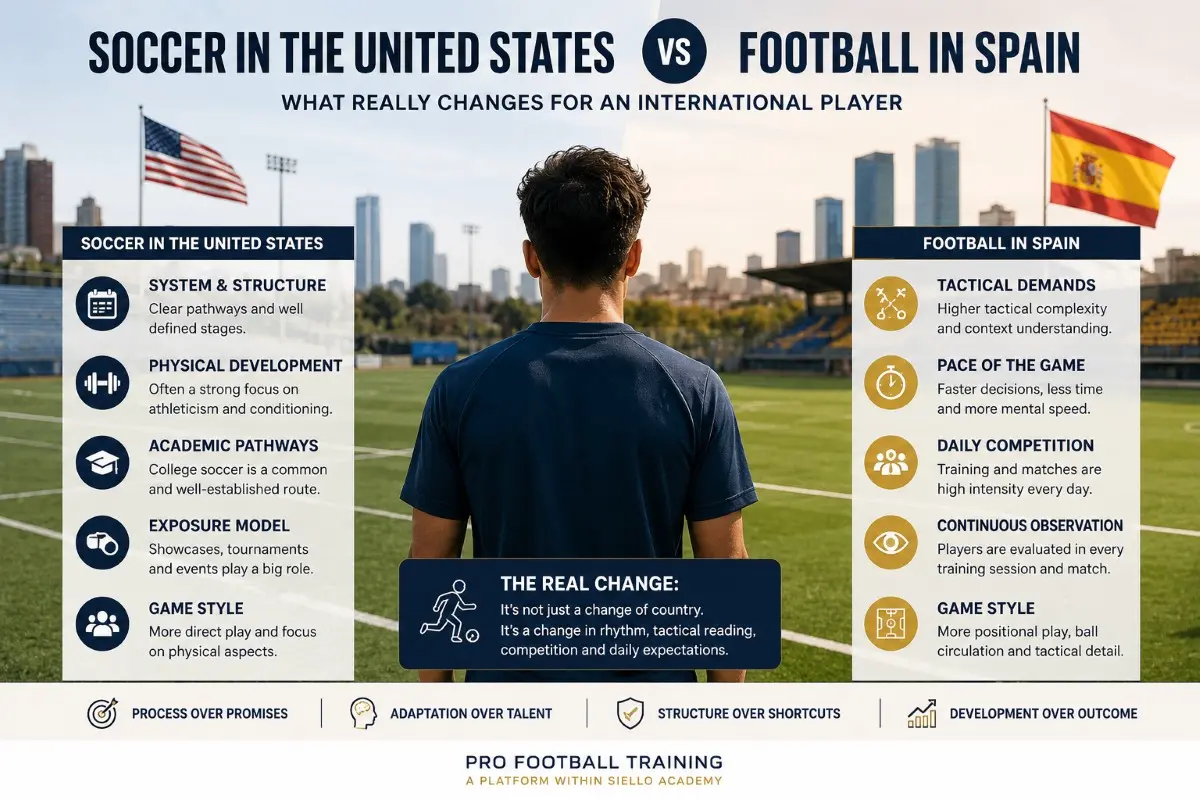
Mistake 4: underestimating tactical, physical and mental adaptation
Sharing a language does not mean sharing the football rhythm.
A Latin American player may arrive with strong technique, intensity, creativity or competitive experience in his country. But in a Spanish environment, he may face a different decision-making speed, tactical interpretation, positional demand and training style.
Adaptation is not only physical. It is also mental and tactical.
The player must respond to:
- new coaches;
- teammates with a different rhythm;
- more specific feedback;
- daily intensity;
- improved off-the-ball understanding;
- Decision making under pressure
- shared living;
- distance from family;
- schedules;
- food;
- rest;
- independence.
Some players adapt quickly. Others need more time. Some have talent but are not used to constant correction. Others perform well in matches but struggle to sustain habits away from the pitch.
That is why duration matters. A short stay may work as a first immersion. A one-to-three-month stay can provide a deeper reading. A full-season program may make sense for players who need real continuity.
Mistake 5: choosing promises instead of structure
The fifth mistake is choosing the offer that promises the most, not the one that explains the process best.
Families should be careful with phrases such as:
- “we guarantee you a club”;
- “you will sign for sure”;
- “we take you to professional football”;
- “we secure your visa”;
- “all our players are seen by scouts”;
- “your level does not matter”;
- “you only need to pay and come.”
A serious academy or program should do the opposite: ask more, explain more and promise less.
It should review the player’s profile, explain formats, separate durations, clarify inclusions, distinguish exposure from signing and be transparent about what depends on performance.
Structure matters more than the promise. A serious process should explain what is included, what is not included, what may happen, what is not guaranteed and what the player needs to do to make the most of the experience.
Common expectation vs process reality
| Common expectation | What families should understand |
| “If I travel to Spain, I am closer to signing” | Travel can create context, but performance and adaptation remain decisive |
| “One trial is enough to show my level” | A trial can show something, but serious assessment needs context and continuity |
| “Because I speak Spanish, adaptation will be easy” | Language helps, but tactical, physical and mental rhythm still require adaptation |
| “If I pay for a program, I have a guaranteed club” | Paying for a program does not guarantee a club, contract or sporting success |
| “All programs offer the same thing” | Duration, inclusions, residence, integration and assessment level can vary significantly |
| “I do not need to review documents yet” | Documents depend on nationality, duration and type of stay |
| “Europe is the pathway” | Europe can be useful, but it does not replace assessment, process and performance |
The central point is simple: the opportunity is not only travelling. The opportunity is travelling with the right process.

How to prepare a more serious pathway before travelling
Before travelling from Latin America to a football academy in Spain, the player and family should prepare the decision with more structure.
- First, organize the sporting profile. This includes position, competitive background, recent video, current level, training frequency, age and objective.
- Second, define the right duration. Families should not expect from a short stay what can only be observed over more time. If the goal is a first immersion, 8 or 14 days may make sense. If the goal is continuity, deeper adaptation or competition, longer formats may be more appropriate.
- Third, review documents. Conditions are not the same for every country. They are also not the same for a short stay and a long stay.
- Fourth, align expectations. Training in Spain can be valuable, but it does not mean signing. Club environment integration can help measure level, but it is not the same as a contract. Exposure can be real, but it does not replace performance.
- Fifth, choose structure. A serious offer should explain residence, supervision, transportation, training, integration, support and limits of the process.
How we approach this evaluation at Pro Football Training
At Pro Football Training and Siello Academy, we support international players who want to train in Madrid within a serious structure. We do not present Spain as an automatic promise. We present it as an environment where the player can train, adapt, integrate and be assessed with more context.
In our programs, families are not buying a fantasy of Europe. They are investing in a structure for immersion, training, residence, logistics, club integration and support.
Depending on the length of the program and the player’s performance, that experience can open real opportunities for exposure, competition and progression within the process. But that does not mean automatic success, a professional contract, guaranteed signing or visa approval.
The structure places the player in the right environment. The player must respond on the pitch.
Conclusion: coming from Latin America can make sense if the decision is well built
For a Latin American player, Spain can be a valuable pathway. It can offer a different rhythm, a different level of demand, another context and a clearer way to measure level. But that pathway should not be built on urgency or broad promises.
Before travelling, families should avoid key mistakes: coming without assessment, confusing exposure with signing, failing to calculate costs and documents, underestimating adaptation or choosing promises over structure.
If you want to understand whether this pathway fits your timing and objective, the next step is not buying a promise. It is reviewing your case with criteria.
See whether this pathway fits your timing and objective.
Speak with an advisor about your case.
FAQs
Can a Latin American player train at a football academy in Spain?
Yes, a Latin American player can train in a football academy or program in Spain if he meets the program conditions, has the necessary documents and the experience fits his age, level, duration and objective. Official competition is a separate issue and depends on additional factors.
What mistakes should families avoid before travelling?
Families should avoid travelling without a profile assessment, confusing exposure with signing, failing to review documents, underestimating external costs, underestimating adaptation and choosing an offer only because of commercial promises.
Do I need a European passport to come?
It depends on the case. Not all Latin American players have the same entry or stay conditions. Nationality, passport, duration and type of activity can change the requirements. Families should verify updated official information before travelling.
How can families evaluate whether a promise is serious?
A promise is more serious when it explains conditions, limits, inclusions, duration, the role of performance and the difference between training, competing, exposure, representation and signing. If an offer guarantees a club, contract, visa or sporting success without assessing the player, families should be cautious.
What duration makes sense for a player travelling from Latin America?
It depends on the objective. A short stay can work as a first immersion; one to three months allows for more continuity; a full-season program may make sense for players who need deeper integration. The right duration should be defined according to age, level, documents, budget and objective.