
Improving off-the-ball movement in soccer is not about running more. It is about moving with a clear purpose. Before you move, you need to read what the play requires: a passing lane, depth, space for a teammate, cover, or a better position to react if possession is lost.
A player can influence an action without touching the ball. A good movement can open a lane, pin a defender, help a teammate play out, create a passing option, or preserve the team’s balance. The opposite is also true: moving constantly without reading the situation can close space, draw pressure toward the ball carrier, or disrupt a structure that was already working.
That is why improving off-the-ball movement is not about memorizing running patterns. The goal is to learn how to scan, interpret and adjust your movement to the context: the ball, the ball carrier, teammates, opponents, space and the phase of play.
What Does It Mean to Play Well Off the Ball?
Playing well off the ball means that your position or movement serves a purpose within the play. The useful question is not simply “Where can I run?” but “What does the play need from my position right now?”
The answer can change depending on the situation:
- Offer support: create a passing angle that helps the team keep possession, progress, or play out of pressure.
- Attack space: exploit an open area or the space behind a defensive line when there is a realistic chance of receiving.
- Create space: move a marker or leave an area so a teammate can occupy it.
- Pin a defender: hold a position or threat that limits the defender’s ability to step into another area.
- Protect the structure: occupy a position that helps the team stay balanced, provide cover, or react better after losing possession.
FIFA Training Centre uses the concept offering to receive to describe a deliberate off-the-ball action intended to give the player in possession an option. It can be a run, a gesture, or even a change in body orientation; it does not necessarily require covering a large distance.
That explains why a player can move very little and still contribute correctly to the play. In some situations, holding your position can be more useful than starting another run.
Scan Before You Move
Useful movement begins before you run. You need to gather enough information to understand which option makes sense, and you need to repeat that process every time the play changes.
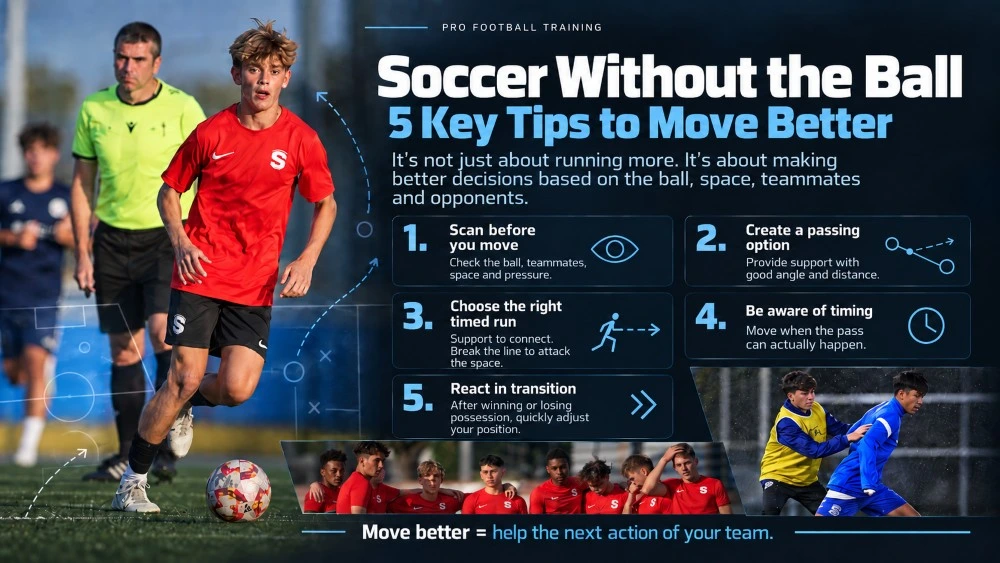
A simple reference for organizing that scan is: ball → ball carrier → space → teammates and opponents → action.
1. Ball Position and Speed
The available options are not the same when the ball is in the build-up, wide, between the lines, or near the opponent’s box. It also matters whether the pass arrives cleanly, contested, at pace, or to a player who must control under pressure.
2. The Ball Carrier’s Body Orientation
A teammate facing forward can use a run in behind that may not be available if that player is receiving with their back to goal and under pressure. Before attacking space, check whether the player on the ball actually has a window to find you.
3. Opponent Pressure
Watch who steps out, where the pressure comes from, and which space is left behind. In many situations, the opponent’s pressure creates the passing lane or open area that another player can exploit.
4. Your Teammates’ Positions
Moving toward the ball does not always help. If another player already occupies that space or lane, you may block their receiving line, attract an extra defender, or remove depth from the attack.
5. Phase of Play
The same position can require a different response in organized attack, organized defense, or either transition. There is no correct movement in isolation; there is a decision that fits a specific situation.
England Football suggests reviewing off-the-ball runs through a before, during and after framework: what the original intention was, how the speed or path changes as the play develops, and what the player does if the pass never arrives.
What to Look for Off the Ball in Each Phase of Play
| Phase | What to observe | Possible actions |
| Organized attack | Available space, the ball carrier’s body orientation, pressure and the height of the defensive line | Support, run in behind, pinning, change of angle, third-player movement |
| Organized defense | Distances between lines, ball position and immediate opponent threats | Close passing lanes, cover, track, shift with the unit |
| Attacking-to-defensive transition | Where possession was lost, nearby teammates and immediate threats | Press, delay, protect the center or recover shape |
| Defensive-to-attacking transition | Available space, disorganized opponents and nearby options | Provide width, attack depth, offer support or secure possession |
This table is not a set of instructions. Its purpose is to remind you which information changes when the phase of play changes.
How to Improve Off-the-Ball Movement in Attack
Create Support and Better Passing Angles
Useful support is not simply about moving closer to the ball. It should create a visible passing lane, offer a playable distance, and avoid bringing unnecessary pressure toward the ball carrier.
In its training content, FIFA Training Centre uses concepts such as diamond support structures, passing angles, occupation of spaces between opponents, and movement after the pass to help teams progress under pressure.
That last point is especially important: your involvement does not end when you pass the ball. The ball’s new position changes the available space, so you may need to open a new angle, move away to clear the area, offer yourself again, or attack a space that did not exist before.
Support Runs and Penetrating Runs
A support run helps maintain continuity by moving closer to the ball or appearing in an area connected to the ball carrier. A penetrating run aims to break a line and attack depth.
Neither is automatically better. If every player runs in behind at the same time, the team can lose connections and central options; if everyone comes toward the ball, the team loses depth and the opponent can defend in a smaller space.
FIFA terminology includes movement patterns such as outside-to-in, inside-to-outside, between the lines, and in behind. These are tools for interpreting situations, not rigid runs that should be repeated every time a player receives the same instruction.
The key is how the movements complement one another. While one player drops to support, another can pin a defender and a third can attack depth. The collective structure is what gives each run its purpose.
Timing: Run When the Pass Can Actually Happen
A good run with poor timing stops being a good run.
Before attacking the space behind the defense, check whether the ball carrier has time, a favorable body shape, and a realistic passing angle. If the player is still controlling the ball, receiving with their back to goal, or under immediate pressure, you may need to delay the run, change its angle, or hold your position for another moment.
That is why timing is not simply about accelerating before the defender. It is about coordinating your movement with the moment the play can realistically use it.
Defending Well Off the Ball
Off-the-ball play is not only an attacking concept. Defending well does not mean constantly chasing the nearest opponent; it means protecting the goal, space and passing lanes while staying connected to your teammates.
Five references are especially useful:
- Body orientation: position yourself so you can keep references to the ball, the opponent and the space you need to protect.
- Cover: stay close enough to help without abandoning a more dangerous threat.
- Passing lane: know which option you are trying to close before stepping out to press.
- Marking awareness: control your opponent without losing connection to the ball’s path and the team structure.
- Shifting with the unit: move with the block so unnecessary gaps do not appear between the lines.
Sometimes you should step out to press; at other times, you need to delay, protect depth, or close the center. That decision depends on the system, the coach’s instructions, distances, the score, and the numerical situation. The common principle is that the individual action must remain connected to the collective structure.

The First Decision in Transition
Transitions are especially demanding because space changes very quickly. A poor movement can cause more damage than pausing for a fraction of a second to understand what is happening.
After Losing Possession
The reaction should be quick, but not automatic. If you are close to the turnover, it may make sense to press the new ball carrier or block the first outlet. If you are farther away, you may help more by protecting the center, delaying the counterattack, or recovering a position that allows the team to reorganize.
Running straight toward the ball without coordination can open a more dangerous lane than the one you were trying to close.
After Winning Possession
First, check whether the opponent is organized and which teammates can progress. If space is available, you can provide width or attack depth; if the team needs to secure possession, a short support option may be more useful.
The best run after winning the ball is not always forward. It depends on whether the team can attack immediately or needs to build a more stable situation first.
Examples of Off-the-Ball Movement by Position
Responsibilities change according to the system, the phase of play and the coach’s instructions. These references are meant to guide observation, not act as fixed orders.
The point is not to memorize the third column. The goal is to understand which information each position needs to read in order to make better off-the-ball decisions.
How to Train Off-the-Ball Movement in Realistic Situations
Movement develops best when there is a decision behind it. Isolated runs can be useful for physical work, but by themselves they do not reproduce the amount of changing information present in a match.
That is why tasks that require players to perceive, decide and adjust are especially valuable:
- small-sided games with objectives related to support, depth, or switching play;
- numerical advantages and disadvantages that force players to recognize when to attract, pin, press, or cover;
- zone-based tasks that guide occupation of space without turning movement into a fixed pattern;
- transition situations that begin after winning or losing possession;
- short video reviews focused on what you saw, what you were trying to achieve, and what happened next.
Repetition is still necessary, but it should be combined with feedback and adaptation to the player’s role. The goal is not for every player to make exactly the same movement, but to understand how each decision changes the team’s structure.
How to Review Your Off-the-Ball Play After a Match
Do not assess your performance only through goals, assists, receptions, or total involvement. Much of your off-the-ball behavior happens before you ever touch the ball.
After a match, review a few sequences and ask yourself:
- Did I offer clear passing lanes, or did I move toward the ball on impulse?
- Did my movements have a clear purpose: support, break a line, pin a defender, or create space?
- Did I start my runs when the ball carrier could realistically use them?
- Did I ever occupy the same lane or space as a teammate?
- What did I do when the pass did not arrive: move again, hold the structure, or switch off?
- How did I react in the first few seconds after winning or losing possession?
- Did I defend space or a passing lane, or did I chase an opponent without a clear reason?
- Did my position help the team prepare for the next action?
To bring this analysis into video review, you can complement it with our guide on how to analyze your own soccer match. The key is to look for patterns across the game rather than draw firm conclusions from a single action.
Common Off-the-Ball Movement Mistakes
Many mistakes come from trying to be involved in every action. A player can have good intentions and still make the attack harder or disrupt defensive balance by failing to read the context.
Some of the mistakes worth identifying include:
- running toward the ball on impulse and drawing pressure;
- offering behind a teammate or inside a blocked passing lane;
- occupying the same lane as another player;
- starting the run too early;
- watching only the ball and losing track of the opponent and the surrounding space;
- switching off after passing or losing possession;
- pressing without cover;
- confusing activity with usefulness.
The goal is not to eliminate movement. It is to make sure every action has a reason.

Off-the-Ball Movement and Game Vision: Related, but Not the Same
Game vision and off-the-ball movement are closely connected, but they do not answer exactly the same question.
- Your game vision helps you gather and interpret information: what is happening?
- Off-the-ball movement turns that information into a spatial response: where should I be, or where should I move now?
A player can identify the right space and still make the run too late. A player can also read the opponent’s pressure correctly but move into an area already occupied by a teammate. Observation is only the first step; quality appears when that information becomes an action coordinated with the rest of the team.
If you want to work specifically on scanning, anticipation and reading the game, see our guide on how to improve game vision in soccer.
Off-the-Ball Play Is Also Part of Player Evaluation
Off-the-ball behavior does not determine a player’s evaluation on its own, but it is part of the context that coaches and scouts may observe.
Positional discipline, relationships with teammates, reactions after losing possession, cover, the ability to adjust after an instruction, and the timing of certain movements can all provide information about how a player reads the game. That does not mean there is one universally correct way to move: evaluation depends on the role, the game model and the situation.
Our guide on what coaches and scouts actually look for before recommending a player explores that evaluation perspective in more detail. The purpose of this article is different: to help you improve the behavior itself, not turn every movement into a performance designed to impress someone.
Moving Better Means Deciding Better
Good off-the-ball play is not measured by how many kilometers you cover or how often you ask for the ball. It shows when your movement improves the team’s next action: by creating a passing lane, attacking space, pinning a defender, clearing a channel, protecting the structure, or preparing a better reaction after a turnover.
The process can be summarized as: scan → interpret → move → review.
Then it starts again with every play.
At Pro Football Training, this type of development is part of a broader training process. Within the Siello Academy environment, daily work connects technique, tactical awareness, decision-making, adaptation and response in realistic game situations, because improving is not only about executing a technique better; it is also about understanding when and why to use it.
The goal is not to move more. It is to learn when, where and why to move.
FAQs
Do You Need to Move Constantly to Play Well Off the Ball?
No. Every movement needs a purpose. In some situations, holding your position can be more useful because it pins a defender, preserves a passing lane, or protects the team’s balance.
Is a Good Run Always Forward?
No. A support movement, a lateral run, movement between the lines, or even moving away from the ball can be better options than attacking depth. The direction depends on space, pressure, the ball carrier’s orientation and the phase of play.
What Is the Difference Between a Support Run and a Penetrating Run?
A support run helps maintain possession by moving closer to the ball or appearing in an area connected to the ball carrier. A penetrating run tries to break a defensive line and attack depth.
How Can a Midfielder Improve Off-the-Ball Movement?
A midfielder should constantly review distances, available angles, opponent pressure, and the positions of center backs and other midfielders. After every pass, the player needs to adjust position instead of staying in the same area and watching the play.
What Should a Forward Do If the Pass Does Not Come?
The forward can offer support again, pin a center back, attack another space, or drag a marker away. A movement is not useless simply because the pass never arrives; the effect it creates on the defensive structure also matters.
How Can I Analyze My Off-the-Ball Play?
Choose specific moments from the match and review what you saw before moving, what you were trying to achieve, whether the ball carrier could use your movement, and what you did next. Look for repeated behaviors across the game rather than conclusions based on one action.
Is Off-the-Ball Movement Only an Attacking Skill?
No. It also includes body orientation, cover, marking awareness, closing passing lanes, shifting, pressing and reacting after losing possession. Players contribute off the ball in attack, defense and transition.