

In football, being seen is not the same as being recommended. A coach may observe many players, but only recommends those who show more than talent: consistency, game understanding, response to demands, discipline, adaptation and enough evidence to sustain an opportunity in a more competitive context.
Football scouting is not only about discovering talent. A coach or scout evaluates whether the player can sustain performance in a more demanding context: applied technique, decision-making, tactical reading, intensity, discipline, adaptation, off-ball behaviour and response under pressure. A serious recommendation needs evidence, not only one standout play.
Siello Academy, is part of Siello Football Group, an ecosystem dedicated to the long-term development of footballers in Europe. From that perspective, scouting should not be understood as a discovery promise, but as part of a process of observation, assessment and criteria.
Why being seen is not the same as being recommended
Many players and families believe the main goal is “being seen.” But in serious football, being seen is only an initial part of the process.
A coach may see a player in a match, video, training session, tryout or immersion program. But observing does not mean recommending. And recommending does not mean signing.
There are important differences:
| Concept | What it means | What it does not mean |
| Being seen | Someone observes the player in a specific context | It does not mean full assessment |
| Being assessed | The profile is analyzed with sporting criteria | It does not guarantee recommendation |
| Being recommended | A coach or scout believes there is enough evidence to suggest a next step | It does not equal signing |
| Exposure | Being in an environment where the player can be observed | It does not mean contract or representation |
| Agency representation | A relationship with an agency | It is not the same as signing with a club |
| Club signing | Formal incorporation by a club | It does not guarantee a sporting career |
A coach protects his own criteria when recommending. He does not recommend every player who produces a good action. He recommends when he sees enough signs of performance, adaptation and reliability.
That distinction protects the player, the family and the process itself.
What football scouting really means
Football scouting is a process of observation and analysis. It may include matches, training sessions, video, reports, references, trials, follow-up and conversations with coaches or coordinators.
It is not only about “discovering talent.” That idea may sound attractive, but it oversimplifies reality. In serious environments, scouting tries to answer more specific questions:
- what type of player is he?
- where does he perform best?
- what does he do well repeatedly?
- what is the level of his current context?
- how does he decide under pressure?
- how does he behave without the ball?
- how does he respond to mistakes?
- how coachable is he?
- Can he adapt to a different rhythm?
- is his potential supported by habits?
A scout can detect a quality. A coach can observe performance. But a serious recommendation needs to connect both with context.
Scouting is not a quick showcase. It is a reading of the player.
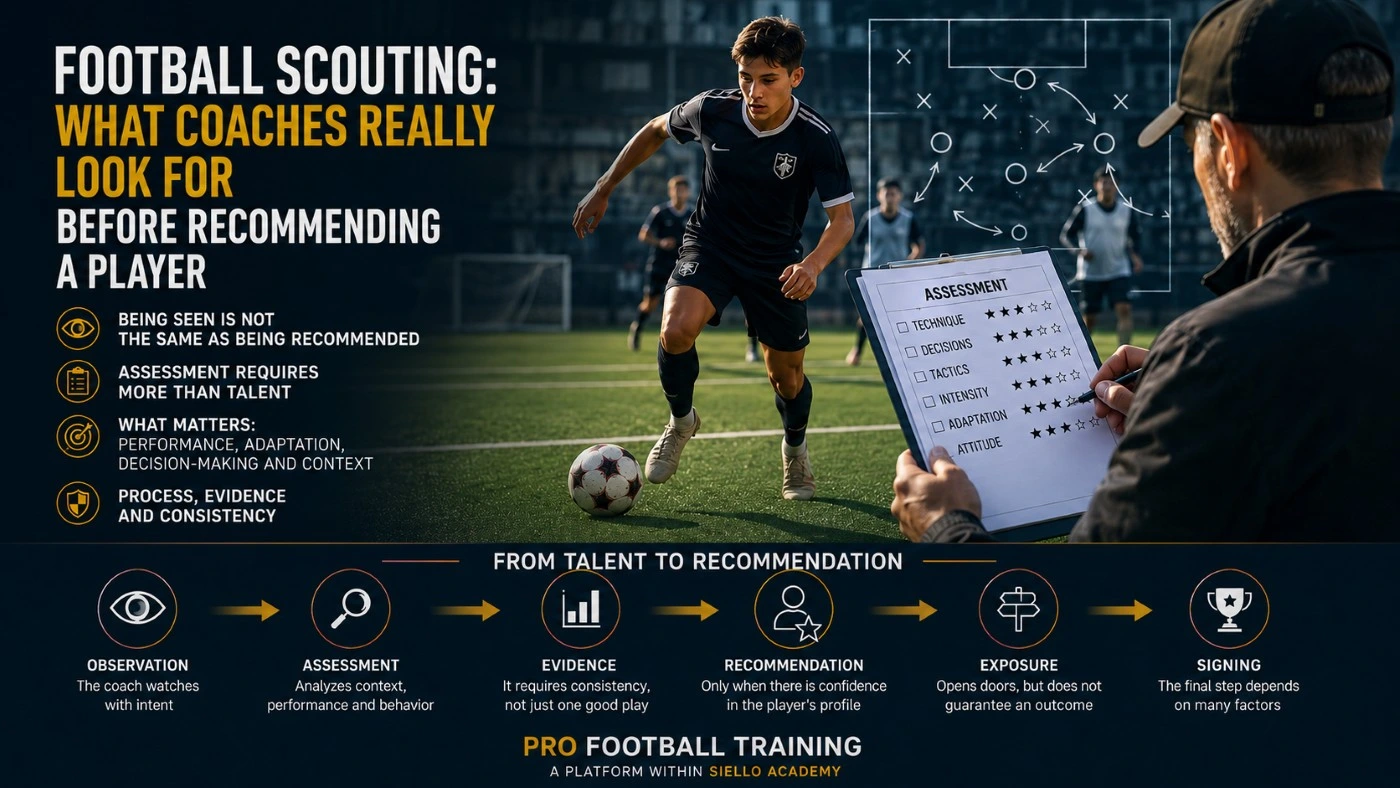
What a coach needs to see before recommending a player
A coach does not recommend only because a player has talent. He recommends when he can support an opinion with evidence. That evidence may come from training, matches, video, CV, daily behaviour, adaptation and response to feedback.
Consistent performance
One standout action can attract attention. But repetition creates trust.
A coach wants to see whether the player appears only in isolated moments or whether he can sustain performance across a session, a week, a training cycle or a more demanding competitive context.
Consistent performance means:
- competing regularly;
- sustaining intensity;
- making good decisions repeatedly;
- not disconnecting after mistakes;
- repeating positive habits;
- performing when the context is uncomfortable.
Consistency does not mean never making mistakes. It means having a base that remains stable even when the player fails.
Applied technique in context
Technique is not evaluated only for beauty or difficulty. It is evaluated for usefulness inside the game.
A coach looks at whether the player can orient the first touch, pass accurately, protect the ball, play at speed, finish with criteria and solve under pressure. He also observes whether that technique appears in real actions, not only in isolated exercises or edited clips.
The question is not “does he have tools?”. The question is: does he know how to use them when the game demands it?
A technical player without game reading may lose advantage. A player with fewer tools but better application may be more reliable.
Decision-making
Decision-making is one of the strongest signs before recommending a player.
The coach observes whether the player knows when to play simple, when to accelerate, when to pause, when to take risk, when to secure the play, when to carry and when to release the ball.
Many players try to impress by forcing actions. But in a competitive environment, a simple and useful decision may be worth more than a spectacular action without purpose.
Recommendation often depends on reliability. A player who makes good decisions, even without attracting attention all the time, may be more recommendable than one who alternates one brilliant action with five poor decisions.
Tactical reading
Tactical reading shows whether the player understands his role within the team. A coach looks at positioning, body orientation, relationship with teammates, off-ball movement, pressing, recovery runs, cover, transitions and response to instructions.
Tactical reading also appears when the player receives correction. If he understands quickly and adjusts, that is a positive signal. If he repeats the same mistake without processing the instruction, it raises doubts.
Tactics are not separate from the game. They appear in every decision, with and without the ball.
Intensity and discipline
Intensity does not mean running without order. An intense but disorganized player can break the team structure. What a coach values is intensity with criteria.
That includes:
- pressing when appropriate;
- competing in duels;
- reacting after losing the ball;
- repeating efforts;
- arriving on time to actions;
- maintaining concentration;
- not losing order because of anxiety.
Discipline also matters. Punctuality, habits, rest, personal care, respect for the group and willingness to train are part of the assessment.
A recommendable player does not only compete well. He also sustains a routine.
Adaptation to the environment
For international players, adaptation can be decisive. A player may stand out in his country and need time to transfer his performance to Spain or another European context.
Adaptation includes:
- training rhythm;
- game speed;
- football language;
- corrections;
- shared living;
- competitive culture;
- pressing;
- autonomy;
- emotional response;
- ability to learn quickly.
The coach does not expect everything to be perfect on the first day. But he does observe whether the player processes change, asks questions, corrects and integrates.
Response to mistakes and pressure
One of the best ways to understand a player is to observe what he does after making a mistake.
Does he disconnect?
Does he complain?
Does he blame others?
Does he hide?
Or does he correct, compete again and stay clear?
Response to mistakes shows maturity. It also shows whether the player can sustain himself in a demanding context.
Pressure does not appear only in important matches. It also appears when the player does not understand an instruction, when he is not starting, when he receives tough feedback, when he competes with stronger players or when the family expects too much.
A recommendable player is not one who never fails. He is one who learns and competes again.
Difference between talent, potential and recommendable player
Talent, potential and recommendation are not the same.
- Talent is an observable quality: technique, speed, coordination, power, creativity, competitive personality or natural ability to solve situations.
- Potential is a projection: what that player may develop with structure, time, correction and the right context.
- A recommendable player is someone who, beyond talent or potential, offers enough evidence for a coach to say: “this profile makes sense for a next step.”
A player may have talent but not be ready. He may have potential but need more time. He may stand out at home but not sustain performance when demands change. Examples:
| Profile | Possible reading |
| Strong technique, poor decisions | Talent exists, but application is missing |
| Good physical level, weak tactical reading | Condition exists, but understanding is missing |
| Many goals in his league, limited adaptation | Production exists, but context is missing |
| Strong highlight video, low consistency | Moments exist, but repetition is missing |
| Weak attitude under pressure | Competitive risk exists |
| Listens, corrects and sustains intensity | Coachability signals exist |
Recommendation appears when the profile combines qualities with reliability.
Why one standout play is not enough
One standout play can open a door, but it cannot sustain a serious recommendation by itself.
A goal may come from a strong action or an opponent’s mistake. A dribble may be useful or unnecessary. A long pass may be brilliant or risky without purpose. A fast run may show speed, but not necessarily game understanding.
That is why coaches and scouts try to identify patterns:
- what the player repeats;
- how he decides under pressure;
- how he positions himself without the ball;
- how he responds after losing possession;
- how he competes when tired;
- how he behaves when he is not the protagonist;
- how he processes corrections.
A highlight shows selection. Assessment looks for context.
The role of the CV, video and on-field assessment
The CV, video and on-field assessment serve different purposes.
| Tool | Purpose | Limit |
| Football CV | Organizes age, country, position, club, background and objective | It does not prove performance by itself |
| Highlight video | Provides an initial visual reading | It does not show the full context |
| Extended video or full match | Shows more continuity and decisions | It is still an indirect observation |
| Training | Shows habits, correction and adaptation | A fair reading may require several days |
| Trial / tryout | Observes performance in a specific context | It does not guarantee recommendation or signing |
| Immersion program | Provides more context about adaptation, discipline and process | Performance still depends on the player |
A strong football CV can help the evaluator understand the profile quickly. A video can open the conversation. On-field assessment allows real behaviour to be observed. An immersion process can show continuity.
None of these elements guarantees recommendation. Together, they can provide more evidence.

Mistakes that reduce the chance of a serious recommendation
Some mistakes can close a recommendation even when the player has qualities.
- The first is chasing exposure without context. If the player has no clear CV, useful video, defined position or organized competitive background, observation starts with friction.
- The second is trying to impress in every action. Forcing dribbles, shots or runs may show anxiety more than personality.
- The third is not listening to corrections. A coach can accept technical mistakes. It is harder to recommend a player who does not process feedback.
- The fourth is disconnecting without the ball. Many players stay active only when they receive. But recommendation also depends on pressing, recovery runs, cover, communication and support.
- The fifth is confusing competitive attitude with emotional disorder. Competing does not mean complaining, protesting or becoming frustrated in every action.
- The sixth is inflating the profile. If the CV or message promises more than the video shows, trust is lost.
- The seventh is assuming that being seen equals being selected. That expectation can lead to rushed decisions and family frustration.
How a player can prepare to be assessed better
Preparing for a serious assessment does not mean acting to please a scout. It means organizing the profile and improving what actually supports performance.
The player should work on:
- position clarity;
- video that shows real actions;
- verifiable football CV;
- physical condition;
- decision-making;
- tactical reading;
- off-ball behavior;
- response to mistakes;
- daily discipline;
- communication;
- adaptation to corrections;
- realistic objectives.
He should also understand what he is looking for. Preparing for a short stay, a trial, a full-season pathway or an initial profile assessment are not the same.
If the goal is for a player to be assessed with criteria, chasing exposure without context is not the best starting point. First, it is necessary to review whether the profile has enough information, level and preparation to enter a serious process.
What changes in a European football environment
In a European football environment, the player may find less time to decide, more tactical corrections, stronger positional demands, smaller spaces, more off-ball intensity and more structured internal competition.
This does not mean Europe is “better” in absolute terms. It means the context changes.
That change can reveal a lot:
- whether the player decides quickly;
- whether he simplifies when needed;
- whether he understands the role;
- whether he sustains intensity;
- whether he accepts corrections;
- whether he can live with demands;
- whether he transfers talent into another environment.
For international players, adaptation is part of the assessment. A player may need time to respond better. That is why a serious recommendation should not depend only on a video or one isolated session.
In our programs in Madrid, players train, integrate into the Spanish club environment and can measure themselves within a more real structure. Depending on the length of the program and the player’s performance, that process can open opportunities for exposure, competition and progression within the ecosystem.
That does not mean guaranteed signing. It means there is a structure to train, adapt and show level with more context.

FAQs
What is football scouting?
Football scouting is a process of observing and analyzing players. It may include matches, training sessions, video, reports, trials, follow-up and profile assessment. Its purpose is to understand whether a player has enough qualities, performance and context for a next step.
What do scouts look for before recommending a player?
They look at applied technique, decision-making, tactical reading, intensity, discipline, off-ball behaviour, adaptation, response to mistakes, maturity and consistent performance. They do not rely only on one standout action.
Does being seen by a coach mean I will be signed?
No. Being seen means someone observed the player. It may open an assessment, but it does not guarantee recommendation, representation, contract or club signing.
What is the difference between exposure and recommendation?
Exposure means being in an environment where the player can be observed. Recommendation means a coach or scout believes there is enough evidence to suggest a next step. They are different stages.
Is a highlight video enough to be recommended?
No. A video can open a first reading, but it does not replace on-field assessment, training, full-match footage, adaptation or follow-up. Recommendation needs more context.
What makes a player recommendable?
A recommendable player shows sporting qualities, but also consistency, reliability, game understanding, discipline, adaptability, response to feedback and sustained performance.
How can a player prepare for a serious assessment?
He should prepare a football CV, clear video, position profile, physical condition, realistic goals and training habits. He should also work on decision-making, tactical reading, off-ball behaviour and response to mistakes.
What mistakes reduce the chance of being recommended?
Forcing actions to impress, not listening to feedback, inflating the profile, not defending, not understanding the role, relying only on highlights, getting frustrated quickly or confusing exposure with signing.
How does adaptation to European football matter?
It matters because an international player must adapt to a different rhythm, tactical language, correction style, daily demands and competitive context. Adaptation is part of performance.
Can an academy guarantee that a scout will discover me?
No. A serious academy or program should not guarantee discovery, signing or contract. It can provide structure, training, exposure and assessment within a more serious context, but performance depends on the player.
Next step: Review whether your profile is ready for serious assessment
Football scouting does not start by chasing a showcase. It starts by building a profile that can be assessed with criteria: age, position, level, video, habits, adaptation, performance and objective.
Being seen can be useful. Being recommended requires more. And any real next step needs context, evidence and performance.
Request a profile assessment to understand whether you are ready for a more serious evaluation.
Explore which program can help you show your level within a real structure.