
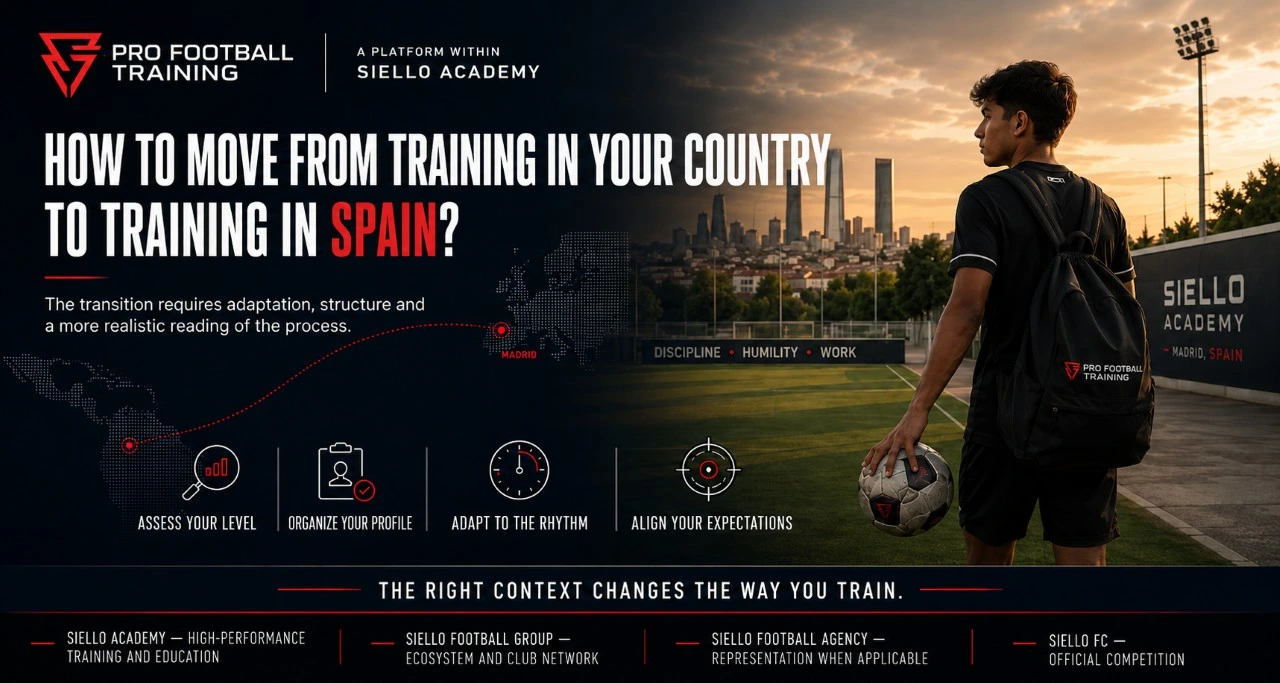
Training well in your country does not guarantee that you will respond the same way in a Spanish football environment. You may have talent, discipline and competitive experience, but when rhythm, intensity, tactical reading, football language and training standards change, the player must also change.
- The transition is not just about travelling. It is about learning to sustain performance in a different context.
To compete in a Spanish football environment, an international player needs tactical adaptation, rhythm, discipline, continuity and evaluation in context. Training in Spain can be an important part of the process, but competing, getting exposure, being represented or signing with a club are different stages and should not be confused.
Pro Football Training and Siello Academy, are part of Siello Football Group, an ecosystem dedicated to the long-term development of footballers in Europe. In our programs in Madrid, we approach this transition as a process: first the player adapts, then he integrates, then he can be assessed with more context and, depending on duration and performance, may move toward deeper opportunities within the ecosystem.
This is not about selling a quick promise. It is about understanding whether the player can respond when the environment changes.
Why competing in Spain requires more than talent
Talent can open a conversation, but it does not sustain evaluation by itself. A player may stand out in his club, city or country and still need time to understand how football is played, trained and competed in Spain.
The difference is not always a huge technical gap. Sometimes it is in the details: receiving with the right body shape, deciding earlier, releasing the ball at the right moment, sustaining intensity without losing order, occupying space well, correcting quickly after feedback or staying focused when training becomes uncomfortable.
FIFA explains that player profiles should consider technical, tactical, physical, psychological and social attributes, using both objective and subjective measures depending on the organisation’s context. This helps explain why a player is not defined only by “playing well.” He is defined by how he responds inside a model, a routine and a level of demand.
For an international player, this is even more important. He is not only competing against other players. He is also competing against the change of context.
Differences in rhythm, tactics and decision-making
One of the first differences an international player may feel in Spain is rhythm. This is not only about running more. It is about thinking earlier, deciding better and executing with less hesitation.
In a Spanish football environment, several details may matter:
- body orientation before receiving;
- speed in reading spaces;
- one- or two-touch play when needed;
- the ability to pause when the game requires it;
- counter-pressing;
- rational occupation of zones;
- off-ball reading;
- communication with teammates;
- understanding the role within the team.
A player may have strong technique, but if he always decides late, his competitive value decreases. He may also have physical strength, but if he presses badly or breaks team structure, that intensity does not help the team.
Decision-making is one of the clearest signs of adaptation. It does not mean always choosing the most spectacular action. It means choosing the right action for the right moment.
Physical and mental adaptation to the new context
Physical adaptation is visible: intensity, training rhythm, recovery, contact, speed and endurance. But mental adaptation is often just as important.
Arriving in Spain means accepting that the player may not dominate the environment from day one. He may find teammates who are more used to the local rhythm, coaches with a different way of correcting, different tactical dynamics and daily demands that are not always comfortable.
Mental adaptation includes:
- tolerating mistakes without disconnecting;
- receiving corrections without taking them personally;
- sustaining concentration;
- competing even when you are not the standout player;
- learning quickly;
- respecting the routine;
- managing distance from family;
- living with other players;
- maintaining habits away from the pitch.
UEFA’s youth development approach connects technical, tactical and fitness training with life skills such as conduct, attitude and responsibility. That logic matters: a player who wants to compete outside his country needs more than football qualities. He needs behavior, autonomy and the ability to sustain a process.

Training, integrating and competing are three different stages
One of the most common mistakes is using “training in Spain”and “competing in Spain” as if they were the same thing. They are not.
- Training means entering a work routine, receiving feedback, adapting to a methodology and starting to measure yourself in a different context.
- Integrating means participating in a more real environment: understanding teammates, rhythm, club dynamics, tactical demands, internal rules and daily functioning.
- Competing adds another layer. It may involve friendlies, competitive environments or official competition depending on age, duration, documents, program format and the sporting conditions of the case.
There is another important distinction: exposure, representation and signing are not the same thing either. Being observed does not mean being signed. Signing with an agency is not the same as signing with a club. A good training experience is not the same as a professional contract.
This distinction protects the player. If you mix every stage, you may arrive with the wrong expectations. If you understand each stage, you can make better use of the process.
Training in your country vs integrating into a Spanish environment
| Aspect | Training in your country | Integrating into a Spanish environment |
| Context | Familiar, known, more predictable | New, competitive, with another reading of the game |
| Rhythm | Adapted to your local league or academy | Shaped by different intensity and methodology |
| Decision-making | Based on habits already developed | Requires faster decisions and behavioural adjustment |
| Feedback | In familiar language and codes | May have another tactical or cultural approach |
| Internal competition | Players you already know | Teammates with different formation and rhythm |
| Emotional adaptation | Less environmental change | Distance, coexistence, routine and new pressure |
| Assessment | Reading inside your usual context | More realistic reading outside your comfort zone |
| Common risk | Believing local dominance is enough | Becoming frustrated when adaptation is not immediate |
This comparison is not meant to say one environment is always better than another. It shows that the change requires preparation. What works in your country can help you, but it does not always transfer automatically to Spanish football.
What duration allows adaptation to be assessed better
Duration changes the depth of the assessment. You cannot expect the same from a short stay as from a full season.
A short stay can serve as a first immersion. It allows the player to train, experience another rhythm, observe initial adaptation and understand whether the environment makes sense. But 8 or 14 days should not be asked to provide what only continuity can reveal.
A one-to-three-month program allows better observation of habits, response to feedback, development, discipline and tactical adaptation. It is no longer only about the first impression.
A full-season program provides a deeper context. It can allow greater integration, more continuity and a more realistic reading of performance within the ecosystem. But even a full-season program should not be understood as a guarantee of success, contract or signing.
| Duration | What it can help observe | What it should not promise |
| 8 or 14 days | Initial adaptation, attitude, rhythm, first reading | Official competition, signing or complete assessment |
| 1 month | More continuity, feedback, daily response | Automatic representation or contract |
| 2–3 months | Sustained adaptation, habits, development | Guaranteed minutes or secured club |
| 6–10 months | Deeper integration and broader competitive process | Career, professional contract or guaranteed success |
The right duration depends on the objective. If you only want to test adaptation, a short stay may be useful. If you want to compete with more continuity, you need a more serious conversation about timing, level and format.

What happens if your level is not there yet
A serious assessment may also show that more work is needed. That should not be seen as failure. It can be useful information.
Maybe the player needs physical improvement. Maybe he decides late. Maybe he does not understand his position well enough. Maybe he has talent but cannot sustain intensity. Maybe his video shows good actions, but his performance in context needs more consistency.
Knowing this early is better than travelling with false expectations.
If the level is not there yet, the next step may be to:
- prepare the profile better;
- improve the video and football CV;
- work on training habits;
- strengthen physical preparation and recovery;
- improve tactical understanding;
- gain more competition at home;
- choose a short stay before a longer program;
- wait for the right moment.
A serious process should not say yes to every player. It should also help identify when to move forward, when to wait and what needs better preparation.
How we assess whether a pathway makes sense for the player
At Pro Football Training and Siello Academy, a profile assessment does not only look at whether the player “has talent.” We aim to understand whether there is a fit between level, age, position, objective, duration, maturity and adaptability.
Relevant information may include:
- age and development stage;
- main and secondary positions;
- competitive background;
- current club or academy;
- recent video;
- physical level;
- tactical reading;
- maturity;
- autonomy;
- time availability;
- general document context;
- football objective;
- family budget;
- expectations around training, exposure and competition.
This assessment does not guarantee acceptance or results.It helps organize the decision. For some players, the right step may be a first immersion. For others, a medium stay. For others, a full-season pathway. And for some, it may be better to prepare the profile before travelling.
FIFA also highlights that talent identification requires systems, processes, player observation, video scouting and data analysis, not only one isolated impression. That is why a serious assessment should not depend on one phrase or one action. It must look at context.
What integration in Madrid feels like
Integrating in Madrid does not mean only training on another pitch. It means entering a different routine: schedules, transportation, teammates, coaches, coexistence, rest, meals, communication and daily demands.
For an international player, integration can feel demanding because everything happens at once. While trying to show level, the player must also adapt to a city, a structure, a club environment and distance from the usual context.
In our programs, the structure is designed to support that immersion: training, club integration, residence, logistics and supervision depending on the format. But the structure does not replace the player. It supports him so he can respond better.
The difference between an improvised experience and a serious process is this: it is not only about arriving in Spain. It is about knowing what needs to be assessed, how the process will be lived and what expectations are realistic.
Next step: profile assessment and timing
If you are training in your country and want to move toward competing in a Spanish football environment, the next step should not be chasing any trial or travelling without context. It should be assessing your profile and timing.
Ask yourself:
- Do I have real competitive level or only a strong local perception?
- Am I ready to train outside my usual environment?
- Do I have recent video and a clear football CV?
- Do I know what position and type of player I am?
- Can I adapt to another routine?
- What duration fits my objective?
- Am I looking for development, exposure, competition or continuity?
- Do I understand that competing does not mean signing automatically?
- Am I ready to receive a real evaluation?
If you cannot answer these questions yet, it does not mean the pathway is not possible. It means the pathway needs to be organized before making a decision.
Conclusion: Competing in Spain starts before travelling
Moving from training in your country to competing in a Spanish football environment does not start when you arrive in Madrid. It starts earlier: when you understand your level, prepare your profile, review your objective and accept that the process requires adaptation.
Spain can be a valuable environment to train, integrate and measure your performance in another context. But it is not a shortcut. It does not replace discipline, tactics, continuity or the player’s responsibility.
If you want to know whether this pathway makes sense for your level, objective and competitive timing, the next step is to review your profile with criteria.
Request a profile assessment.
Talk to our team about your level, goal and timing.
FAQs
How does an international player adapt to Spanish football?
An international player adapts by training in context, receiving feedback, understanding rhythm, improving decision-making, adjusting to tactical demands and sustaining habits on and off the pitch. Adaptation depends not only on talent, but also on discipline, maturity and continuity.
How long does adaptation to a new competitive environment take?
It depends on the player’s age, level, maturity, previous experience and program duration. Some players show signs of adaptation in a few days, but a deeper reading usually requires more continuity.
Does training in Spain mean competing automatically?
No. Training, integrating and competing are different stages. Competition may depend on age, duration, documents, program format, sporting context and performance. It should not be assumed automatically.
What happens if my level is not ready yet?
An assessment can help identify what needs work: rhythm, physical level, tactics, habits, video, profile or competitive continuity. It does not always mean the pathway is wrong; sometimes it means the timing needs better preparation.
How do I know if I am ready for an assessment?
You may be closer to ready if you train or compete regularly, have recent video, understand your position, sustain discipline, have a clear objective and accept that a serious assessment does not guarantee a signing or contract.