
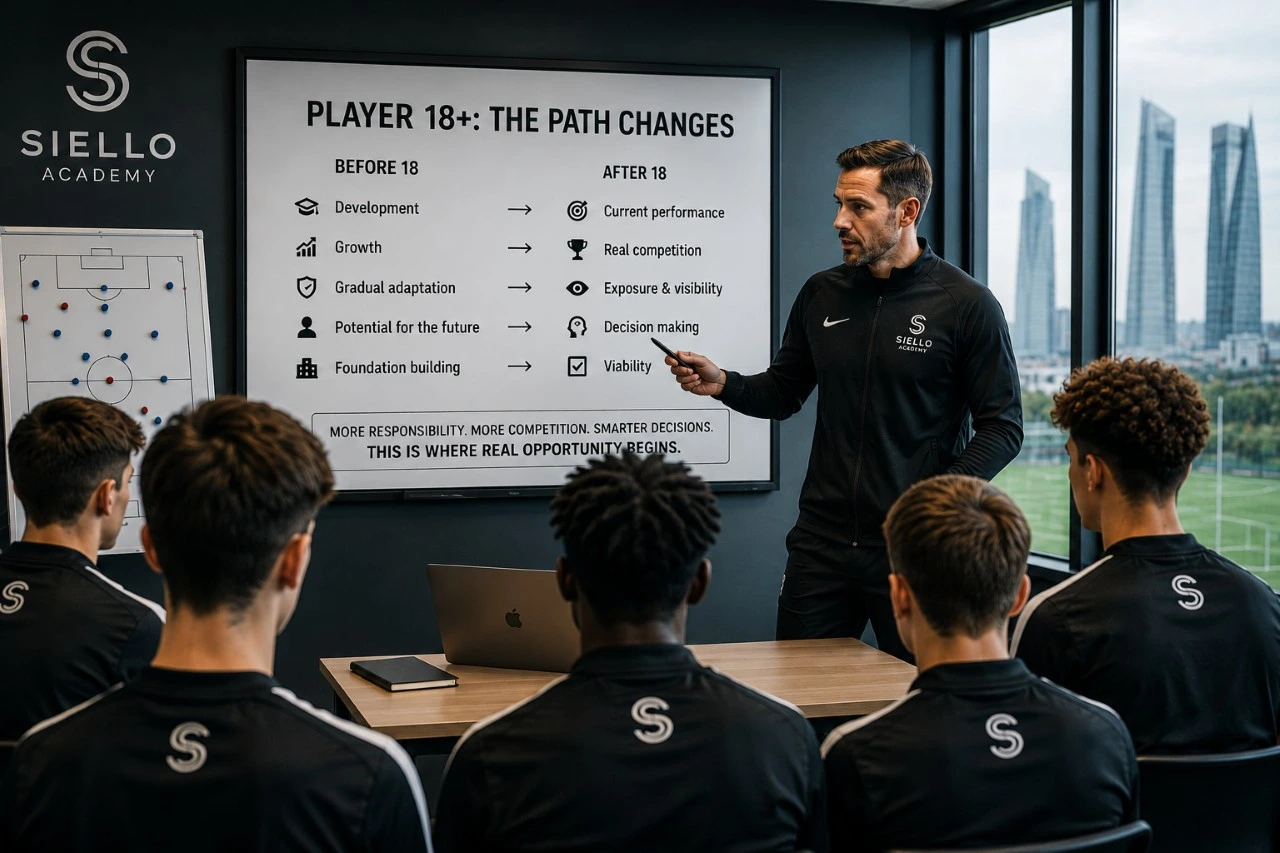
Turning 18 does not mean it is too late to pursue a football pathway in Europe.But it does mean that “training abroad” is no longer enough as a general idea. At this age, the player needs a more strategic, realistic and performance-based approach.
A football academy in Europe for players over 18 should not be sold as a second youth development stage or as a quick solution. For an 18+ player, the focus changes: it is no longer only about early development. It is about performance, adaptation, competition, exposure and timing.
Being 18 or older requires a more competitive and less exploratory pathway. The player can still improve, adapt, compete and be assessed, but there is less room to waste time on unclear offers. At this stage, every decision should be evaluated through real level, duration, context, documents, performance and objective.
At Pro Football and Siello Academy, we approach this evaluation with a clear principle: not every player over 18 needs the same pathway, and no serious program should promise a club signing, professional contract or secured career without seeing real performance.
What changes when a player is already 18?
At 18, the player begins to move beyond the early youth football stage. That does not mean development is over. It means the pathway becomes more demanding.
Before 18, the conversation often includes development, youth categories, medium-term growth and gradual adaptation. After 18, the conversation moves closer to competition, exposure, sustained performance, decision-making and real viability.
The way clubs, coaches and football structures assess the player also changes. An 18+ player is not usually evaluated only for abstract potential. His current performance, competitive ability, position, physical and tactical profile, maturity and daily response carry more weight.
There is also a regulatory difference. FIFA’s current framework places specific restrictions and exceptions around international transfers of players under 18, as part of its protection of minors. Once a player is 18, he is no longer in that same minor-protection framework, but that does not mean he automatically has a route to a club.
In short: at 18, the door does not close, but the filter changes.
Why competitive level matters more than ambition
When a player is 14, 15 or 16, there may be more room to explore, correct habits and build a base. At 18 or older, there is still room for development, but the evaluation is usually more direct.
The ambition to “play in Europe” is not enough. Standing out in a local environment is not enough if the player cannot sustain intensity, rhythm and discipline outside his usual context.
For an 18+ player, these factors carry significant weight:
- current competitive level;
- club or academy background;
- position and physical-tactical profile;
- consistency;
- understanding of the game;
- mental maturity;
- autonomy away from home;
- adaptation to another country;
- ability to sustain higher demands;
- response to mistakes;
- availability to train and compete with continuity.
This does not mean only perfect players can travel. It means the decision must be honest. If the player needs a first immersion, a short stay may help assess adaptation. If the player needs a more serious pathway, he may need to consider a longer format and a deeper structure.

Academy, club, agency and representation are not the same thing
For players over 18, one of the most dangerous mistakes is mixing different concepts.
- An academy can provide training, methodology, structure, adaptation and evaluation.
- A club competes, trains teams and makes sporting decisions according to its needs.
- An agency represents players and may support projection, contract discussions or career development.
- Representation is not the same as signing with a club.
- A club signing means a club decides to bring the player in under specific conditions.
These differences matter even more after 18 because the player may be looking for “opportunities” without knowing what type of opportunity he actually needs.
Training in an academy does not mean signing with a club. Integration into a club environment does not mean a contract. Signing with an agency does not mean automatic club signing. Exposure does not mean that a club will decide to take the player.
Within the Siello ecosystem, these layers may be part of a more complete pathway depending on the format, the player’s profile and performance. But they must be explained with precision. The structure creates the environment; the player must perform on the pitch.

What options may exist for players over 18?
A player over 18 can consider different options depending on his starting point.
1. Short stay to assess adaptation
A short stay may be useful if the player needs a first immersion in Europe. It should not be understood as a promise of a club, but as a way to train in another context, experience the rhythm and evaluate whether the environment makes sense.
This format can be useful for players who are not ready for a full-season commitment but want to understand how they respond outside their country.
2. One-to-three-month program for a deeper reading
A medium-length stay can provide more continuity. It allows the staff to observe habits, tactical adaptation, discipline, rhythm and development over more time.
For 18+ players, this may be useful when there is already a competitive base, but the player still needs to prove whether his performance can be sustained in another environment.
3. Full-season or long-stay program
A full-season program often makes more sense for players who need continuity, deeper integration and a more stable competitive context.
In our programs, long-stay formats of 6 to 10 months are designed as a more robust structure for development, competition, adaptation and exposure within the ecosystem. This can be especially relevant for players over 18 who need more than a single trial.
But even a full-season program should not be presented as an automatic result. It can provide more depth, more continuity and a stronger competitive setting, but it does not guarantee a professional contract or definitive club signing.
4. Evaluation toward higher layers of the ecosystem
For certain profiles and contexts, performance may open deeper conversations within the ecosystem: exposure, follow-up, possible steps toward representation or sporting management. But this must always be treated as conditional on performance, profile, duration and feasibility.
It is not a general promise. It is a possible consequence within a more serious structure.
Under 18 vs 18+ player: how expectations change
| Aspect | Under 18 | 18+ player |
| Main focus | Development, adaptation, gradual progression | Performance, competition, exposure and timing |
| Room for exploration | Higher | Lower |
| Evaluation | Potential + habits + development | Current level + performance + adaptation |
| Recommended duration | Depends on age and objective | Usually requires more strategy |
| Club environment | Integration and learning depending on format | Stronger weight of competitive performance |
| Correct expectation | Learn, adapt, grow | Compete, sustain level, measure viability |
| Common risk | Rushing too early | Arriving late or choosing an unserious route |
| What should not be promised | Guaranteed future signing | Contract, representation or secured club |
This comparison is not meant to discourage 18+ players. It is meant to set the right expectations. Being 18 does not eliminate the possibility of building a serious pathway, but it requires more precision.
When a full-season program makes more sense than a short stay
For a player over 18, a short stay can be useful as a first contact.But if the objective is to compete with more continuity, integrate more deeply, sustain a process and be evaluated more completely, a long-stay or full-season program may make more sense.
A full-season program may be more appropriate when:
- the player already has competitive experience;
- he needs continuity to adapt;
- he wants a more realistic reading of his level;
- he has the maturity to live away from home;
- he understands that performance is decisive;
- the family can support a deeper investment;
- the goal is not an isolated trial, but a process.
The difference is not only the number of months. It is the depth of the environment. More time allows adaptation, discipline, consistency, training response, competition and development to be observed more clearly.
Still, this must be stated clearly: a full-season program does not buy a career. It provides a more serious structure to train, compete, integrate and be assessed under better conditions.
What the player should evaluate before travelling
An 18+ player should ask difficult questions before travelling to Europe.
- What is my real competitive level?
- In what league, club or environment have I competed?
- Do I have recent video and clear material?
- Am I physically prepared?
- Do I understand my position and profile?
- Do I know what type of player I am?
- Can I adapt away from home?
- Do I have the discipline to sustain a routine?
- Am I looking for development, exposure, club or representation?
- Do I understand the difference between those things?
- What duration fits my objective?
- Are my documents and budget clear?
- Am I ready to be evaluated without guarantees?
These questions are not designed to exclude. They are designed to avoid impulsive decisions. At 18, travelling to Europe without clarity can be costly in time, money and expectations.
Documentation should also be reviewed according to nationality and duration. Short stays may fall under different frameworks than longer stays. Spain’s Schengen visa information refers to stays of up to 90 days in any 180-day period for certain non-lucrative purposes, studies or training placements under three months; longer stays or specific cases should be verified through official sources.
How we can help assess whether your profile fits
At Pro Football Training and Siello Academy, we evaluate these cases carefully because 18+ players often arrive with urgency. Some feel they are already late. Others believe they only need “one trial.” Others look for a club, agency or exposure without clearly understanding what each step means.
Our role is to help organize that decision.
In our programs in Madrid, the player enters a training, club integration and exposure environment within the Siello ecosystem. Depending on the length of the program and the player’s performance, that experience can open real opportunities for competition, visibility and progression within the process.
But the foundation remains the same:we do not promise automatic success, a professional contract or a definitive club signing. The player’s performance is decisive.
For some profiles, a short stay may be enough as a first assessment. For others, a full-season program may make more sense. And for others, the best step may be to prepare the profile better before travelling.
A serious process also knows when it is not the right time yet.
Conclusion: at 18, it is not too late, but improvising is no longer useful
Looking for football academies in Europe for players over 18 can make sense if the player understands what has changed. At this age, football requires more clarity, more performance and less fantasy.
This is not about giving up. It is about deciding better. An 18+ player can still train, adapt, compete, gain exposure and progress within a process. But he needs a more strategic pathway, not a quick promise.
If you want to know whether an academy, short stay, medium program or full-season pathway makes sense for your profile, the next step is to review your case with criteria.
Request a profile assessment.
Talk to the team about your level, goal and timing.
FAQs
Is it too late to join a football academy in Europe at 18?
Not necessarily. Being 18 does not mean it is too late, but the pathway changes. The player needs more clarity around level, competition, performance, duration and objective. At this age, it is better to avoid isolated trials without context and evaluate a more strategic structure.
What changes for players over 18?
Current performance becomes more important. After 18, players are not evaluated only on potential or early development. Competition, adaptation, maturity, position, rhythm, consistency and the ability to sustain higher demands become more decisive.
Does an academy for players over 18 guarantee a club?
No. No serious academy should guarantee a club signing, professional contract, automatic representation or sporting success. It can provide training, integration, exposure and assessment, but the player’s performance remains decisive.
What program duration is best for an 18+ player?
It depends on the objective. A short stay may work as a first immersion; one to three months allows for a deeper reading; a full-season program may make more sense if the player needs continuity, competition and more serious integration.
Do I need a European passport to join an academy in Europe?
It depends on nationality, duration and type of stay. Families and players should not generalize. Each case should be reviewed using updated official information before travelling.