
Looking for a football scholarship in Europe is understandable. For many families, the cost of travelling, training and living abroad can be significant. For many players, the idea of a free football academy or a scholarship that covers everything sounds like a possible way to access European football without paying for a full program.
The problem is not asking the question. The problem is making decisions based on promises that do not explain what is actually being offered.
Football scholarships in Europe can exist in specific contexts, but they should not be confused with guaranteed free academy programs. A real scholarship, a discount, partial aid, a trial, an exposure opportunity, agency representation and a paid program are not the same thing.
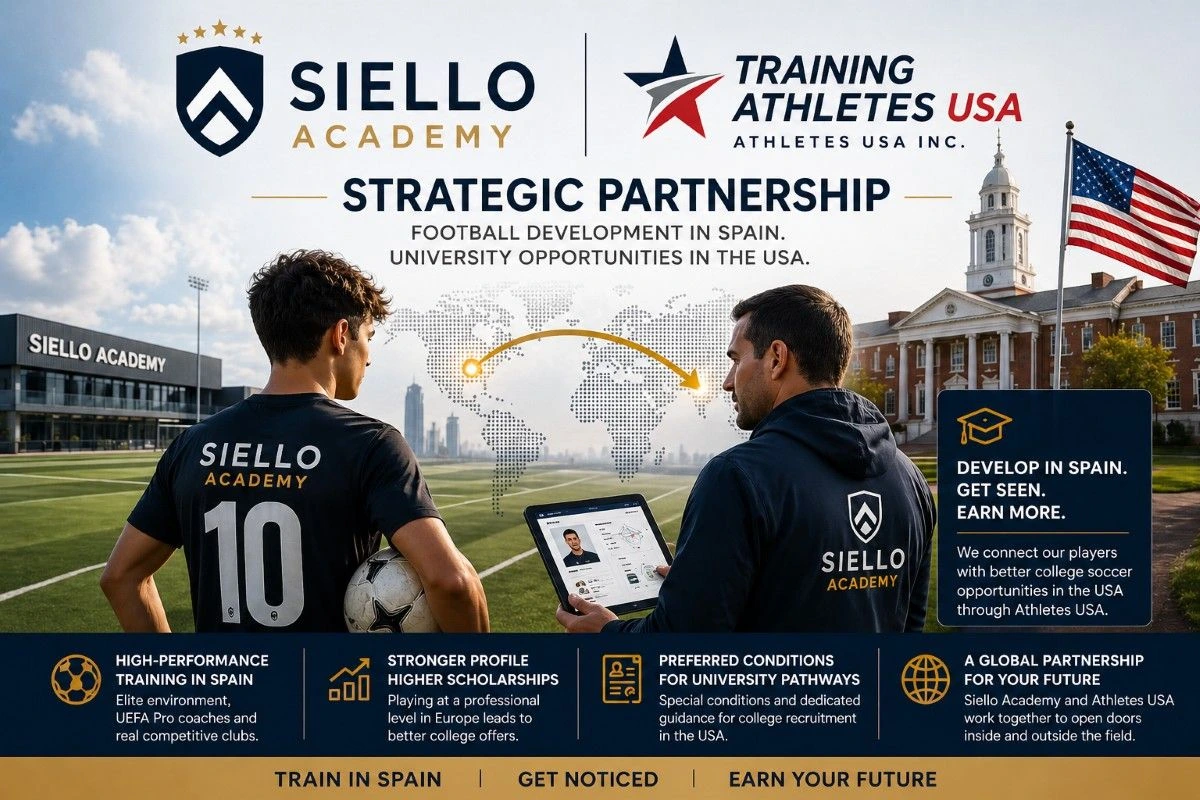
At Pro Football Training and siello Academy, we are clear about this point: our current programs in Madrid are paid programs. We do not sell automatic scholarships, we do not promise free football and we do not use the word “scholarship” as a hook to create false expectations. Within Siello Academy and the broader Siello Football Group ,ecosystem, we work through structure, immersion, assessment and process.
For families, the better question is not only “how can we get a scholarship?” The more useful question is: what type of opportunity are we evaluating, what conditions apply, what is actually covered and what should no one promise us?
Why so many families search for football scholarships in Europe
Families search for scholarships for a simple reason: international football has costs. Travelling to Europe, staying in residence, training, eating, moving around, adapting and sustaining a serious stay requires financial planning.
The idea of a scholarship is also strongly influenced by the US college sports system. In that context, an athletic scholarship can be connected to university-based financial aid and sport. The NCAA explains that Division I and II schools can provide athletic scholarships, while Division III schools do not offer athletic scholarships. It also notes that most student-athletes who receive athletic scholarships receive partial support rather than full scholarships.
Europe does not work in exactly the same way. European football development may be connected to clubs, private academies, federations, education providers, development programs or professional structures. There is no single “European football scholarship” that works the same way for every country, academy, age and profile.
That is why, when a family sees phrases such as “free football academy in Europe” or “football academy in Europe scholarship,” they should ask what that promise actually means.
What “scholarship” can actually mean depending on context
The word “scholarship” can be used in many ways. Some are legitimate. Some are ambiguous. Others can be misleading if they are used without clear conditions.
A scholarship may mean:
- partial financial aid;
- a discount on a program fee;
- support from an educational institution;
- aid connected to academic performance;
- a university-based athletic opportunity;
- a grant or institutional program;
- access to a trial at no cost;
- reduction of certain expenses, but not all expenses;
- an invitation to train, without covering housing or travel.
The issue begins when all of this is presented as “free football in Europe.” A family may believe that travel, residence, meals, training, documents, competition and continuity are covered, when the support may only cover a limited part.
A serious scholarship should explain:
- who provides it;
- what it covers;
- what it does not cover;
- how long it applies;
- what requirements must be met;
- whether it depends on sporting performance;
- whether it depends on academic performance;
- whether it can be renewed;
- what obligations the player accepts;
- what happens if the player does not meet the conditions.
If a proposal uses the word scholarship without answering these questions, families should proceed carefully.
Scholarship, discount, trial and paid program: key differences
To avoid confusion, families need to separate concepts.
| Concept | What it may mean | What should not be assumed |
| Real scholarship | Formal financial aid under clear conditions | That it covers everything or applies automatically |
| Discount | Partial reduction of a program fee | That the program becomes free |
| Trial | Sporting evaluation opportunity | That it guarantees a club, contract or scholarship |
| Paid program | Structured service with price, inclusions and conditions | That payment guarantees sporting success |
| Agency | Representation or contract-related support under specific conditions | That it is the same as signing with a club |
| Sporting opportunity | Possibility to train, compete or gain exposure | That it means guaranteed outcome |
This difference matters. Many families are not misled by price alone, but by the way words are mixed. If someone speaks about scholarship, trial, agency, club and contract as if they were the same thing, the offer needs closer review.
A serious process separates each layer. Training is not the same as competing. Competing is not the same as exposure. Exposure is not the same as representation. Representation is not the same as signing with a club.
Warning signs in “free football academy” promises
When a program talks about free football academies in Europe, families should review the language carefully. Not because every form of aid is false, but because false promises often use similar formulas.
These signs should raise concern:
- “come to Europe for free” without explaining who pays for housing, meals or flights;
- “guaranteed scholarship” without assessing level, age, documents or performance;
- “we get you a club” as an automatic outcome;
- “only pay a registration fee and everything else is covered” without clear terms;
- “guaranteed scouts” without real context;
- “professional club trial guaranteed” without conditions;
- “visa solved” or “visa guaranteed”;
- “your level does not matter”;
- artificial urgency to pay a reservation fee;
- no clear information about residence, supervision or inclusions;
- no written conditions, contract or refund policy.
A serious academy or program does not need to promise complete free access to be valuable. It needs to explain what it offers, what it costs, what is included, what depends on performance and what is not guaranteed.
Why a serious program must explain costs and conditions
Cost transparency is not just a commercial detail. It is a sign of seriousness.
If a family is sending a player to Europe, they need to understand the real cost of the decision. That includes the program, flights, stay, meals, transportation, documents, travel coverage where applicable, personal expenses and any additional requirements depending on nationality and duration.
A serious program should clearly answer:
- how much it costs;
- what is included;
- what is not included;
- whether flights are included;
- what depends on duration;
- what depends on age;
- what depends on performance;
- what documents the family should review;
- what type of support exists;
- what expectations are realistic.
When cost is unclear, families are exposed to misunderstandings. And when the promise is too broad, players may arrive with expectations that the process cannot realistically support.
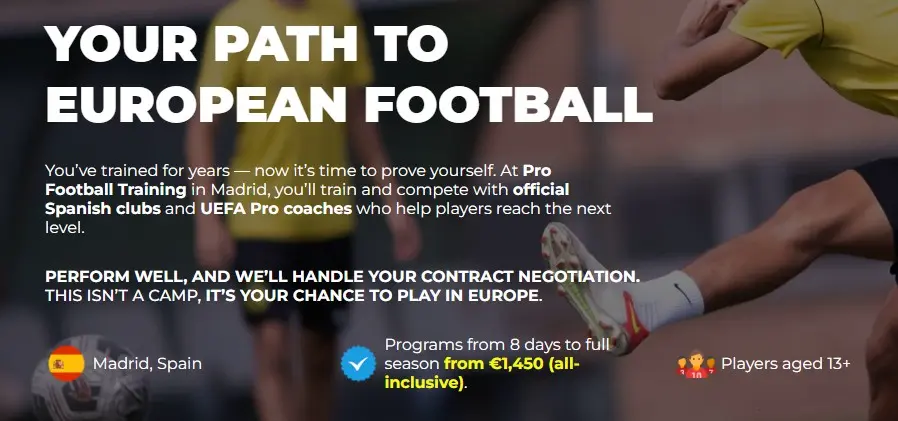
In our case, we prefer clarity: Pro Football Training works with paid programs in Madrid. That allows families to understand from the beginning what structure they are joining and what limits they should understand.

Our programs are paid: what families are actually investing in
In our programs, families are not buying a scholarship, a signing promise or automatic access to professional football.
They are investing in a football immersion structure in Madrid that may include, depending on the format, accommodation, full board, airport pickup, local transportation, daily training, integration into a Spanish club environment, 24/7 supervision and support, local logistics and visa support.
That structure must be understood correctly. It does not mean automatic success. It does not mean a professional contract. It does not mean guaranteed representation across all formats. It does not mean guaranteed playing minutes.
What a serious paid program can offer is an organized environment where the player can train, adapt, be evaluated with more context and understand whether a deeper pathway makes sense.
Depending on the length of the program and the player’s performance, the experience can open real opportunities for exposure, competition and progression within the process. But performance remains decisive.
The structure creates the environment. The player must respond on the pitch.
How to evaluate whether an investment makes sense for your profile
Not every family searching for a scholarship should automatically reject a paid program. But no family should invest without assessing whether the program makes sense.
Before deciding, it is useful to review:
- player’s age;
- current competitive level;
- club or academy background;
- position;
- maturity and autonomy;
- football objective;
- family budget;
- possible duration;
- documentation;
- ability to adapt away from home;
- realistic expectations around exposure, competition and progression;
- difference between short-stay, medium-stay and full-season programs.
Families should also ask what they are really expecting. If the expectation is “pay or get a scholarship to secure a club,” the expectation is not realistic. If the expectation is “enter a serious structure to measure level, adapt and understand whether the pathway makes sense,” the conversation becomes more grounded.
An investment can make sense when the player has a clear objective, the family understands the limits of the process and the program explains transparently what it provides.
Scholarships, college soccer and Europe: be careful mixing systems
This point is especially important for US families or players comparing Europe with college soccer.
In the United States, a scholarship may be connected to the college system and specific eligibility rules. The NCAA states that future Division I and II student-athletes must receive final amateurism certification before competing, and that situations such as using a recruiting agency, receiving funds to offset training expenses or being represented by a professional sports agent may affect amateur status.
This does not mean a player cannot explore Europe. It means that if college soccer is part of the plan, families should carefully review how any international experience, financial aid, agency relationship or representation may affect the player’s case.
Europe has a different logic. UEFA supports youth development through national associations and elite youth player development programs, but that is not the same as a private academy promising a guaranteed free scholarship to international players.
If a proposal mixes “scholarship,” “academy,” “trial,” “professional contract” and “college pathway” without explaining consequences, families should seek specific guidance before moving forward.
How to identify a false scholarship promise
A false scholarship promise usually has three traits: it sounds too broad, it requires fast action and it does not explain conditions.
It may use phrases such as:
- “100% guaranteed scholarship”;
- “come play in Europe for free”;
- “only pay a fee and the club covers everything”;
- “we get you a contract if you come”;
- “no evaluation needed”;
- “your level does not matter”;
- “all our players get clubs.”
A serious proposal should do the opposite. It should ask for the player’s profile, review age, level, position, video, objectives, possible duration and family context. It should explain costs. It should clarify what depends on performance. And it should avoid presenting an opportunity as a guarantee.
The practical rule is simple: the bigger the promise, the clearer the conditions should be. If there are no clear conditions, clear contract, clear responsible party and clear explanation, the family should not move forward.
A serious pathway does not need to promise free football
Looking for football scholarships in Europe is a valid question. What is not valid is making important decisions based on vague promises, disguised discounts or supposed free academies that do not explain conditions.
In Europe, financial aid, scholarships, discounts or specific support programs may exist depending on the institution, country and context. But they should not be confused with guaranteed free football or an automatic route to a club.
At Pro Football Training, we prefer to be clear from the start: our programs are paid and designed as a structure for immersion, training, adaptation and exposure in Madrid. We do not sell a scholarship. We do not promise an automatic outcome. We help evaluate whether this pathway fits the player’s profile, timing and objective.
If you want to understand whether this type of investment fits you or your child, the next step is to review the case with more clarity.
See whether this pathway fits your profile.
Get more information.
FAQs
Do football scholarships in Europe exist?
Yes, scholarships, financial aid, discounts or specific support programs may exist in certain contexts. They do not work the same way in every country, academy or institution. Families should verify who provides the scholarship, what it covers, what it requires and what is not included.
Can a football academy in Europe be free?
There may be specific cases of aid or partial coverage, but a guaranteed free football academy for any international player should be reviewed carefully. Families should ask for clear conditions and avoid assuming that travel, residence, meals, training and competition are all covered.
Does Pro Football Training offer paid programs or scholarships?
Pro Football Training offers paid programs in Madrid. We do not currently communicate automatic scholarships or guaranteed scholarships. Families invest in a structure that includes training, immersion, accommodation, logistics, club integration and support depending on the chosen format.
Does paying for a program guarantee a club signing?
No. Paying for a program does not guarantee a club signing, professional contract, automatic representation, playing minutes or sporting success. The program can provide structure, training, integration and exposure, but the player’s performance remains decisive.
How can families detect a false scholarship promise?
Families should question guaranteed scholarships, free football without clear conditions, secured contracts, guaranteed scouts or offers that require urgent payment without explaining who provides the aid, what it covers and what it requires.