
To structure an individual soccer training session, choose a clear objective, warm up, work on a task connected to that objective and finish by reviewing your execution and effort. Fit the session around your team training and matches. Solo practice can reinforce technical and physical skills; check how they apply in play with teammates, opponents and guidance from your coach.
If you train on your own, start by identifying a difficulty that keeps appearing in matches or team sessions. A first touch that forces you to reposition, a pass that loses accuracy with your less-used foot or a dribble that takes the ball too far from your body can become a training priority. Connecting what you observe with what you practice gives the session a clear purpose.
Next, consider what you can do with the space and equipment available and how you feel physically that day. Your age, level, experience and schedule will shape your choices. The structure below helps you organize those decisions and build an adaptable session without adding drills simply out of habit.

What Can You Develop Through Solo Training, and What Needs Other Players?
Training on your own lets you practice ball contact, passing accuracy, first-touch direction, dribbling and the coordination of specific movements. A wall, rebound surface or markers on the ground can help you set up simple tasks and check whether you connect actions with balance and control.
The main limitation is the information available. A fixed marker does not move like a defender, and a wall does not choose when or where to pass. You can practice looking around before receiving and adjusting your body position, but reading pressure and choosing between real options requires teammates and opponents.
Before starting, check that the surface allows stable footing and braking, that you have enough space and that the area you will pass or shoot into is clear. Set up your equipment before warming up. If you are under 18, agree with your coach and family where you will practice and what you will work on.
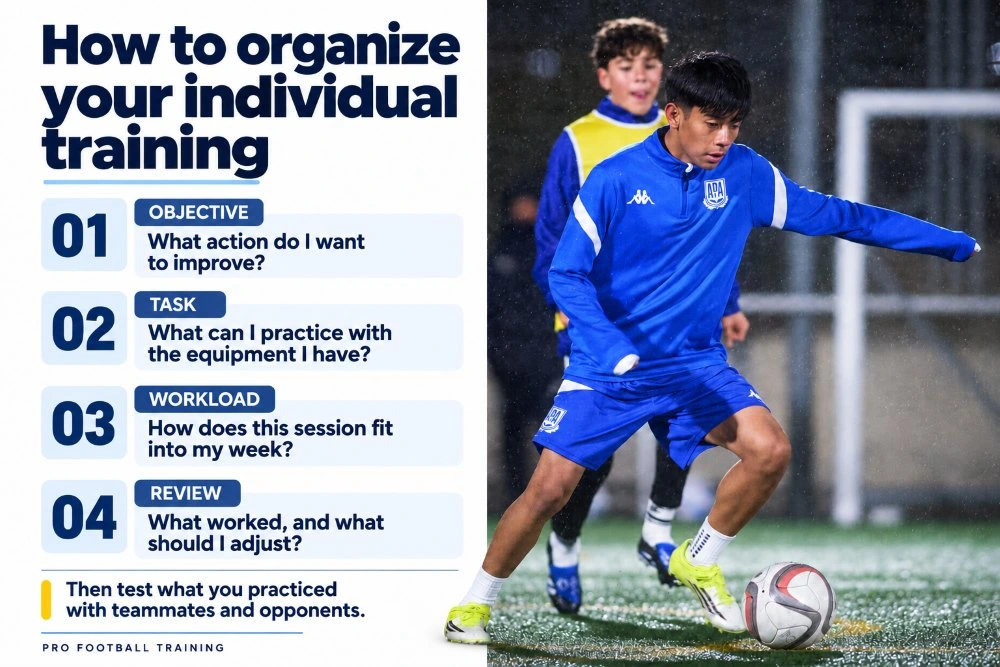
Step 1. Set an Objective You Can Observe
A useful objective describes the action you want to improve and how you will recognize a good execution. Choose one priority for the session so it is easier to see what works and what needs adjusting. You can turn a broad aim into something more specific:
- First touch: instead of simply aiming to “improve technique,” look for a touch that leaves the ball in a position from which you can continue without repositioning your feet.
- Passing: instead of aiming to “pass better,” try sending the ball between two markers from a set distance, using a defined contact surface.
- Dribbling: instead of aiming to “be faster with the ball,” check whether you can change direction and move away with the ball still within reach.
If you are not sure what to prioritize, start by reviewing several actions from your matches. The guide on how to analyze your own soccer match helps you distinguish information, decision and execution. Once you identify a pattern, use this article to turn it into a task you can practice on your own.
Step 2. Choose Drills You Can Do on Your Own
These options show how to organize practice with basic equipment. Adjust distances and speed to your level. Tasks that involve running need more space and a plan that fits your training week.
| Objective | Individual task | What to look for | How to check it in play |
|---|---|---|---|
| First touch and body orientation | Pass against a wall and direct the rebound toward one of two target areas to either side. | Your first touch sets up a dribble or pass without unnecessary adjustment touches. | Check whether you can still prepare the next action when an opponent applies pressure. |
| Acceleration | If acceleration is part of your training plan, make short runs toward a marker, allowing recovery between attempts. | Your coordination and the quality of your initial movement remain consistent. | Read the soccer speed training guide, then relate your acceleration to actions in your position. |
| Scanning before receiving | Before receiving the rebound from the wall, look at a marker to your side, then locate the ball again. | You can look around and adjust your feet in time to receive. | Check whether you gather useful information about teammates and opponents. A fixed marker does not reproduce that reading of the game. |
| Passing accuracy | Pass toward a target on the wall or between two markers, from a distance at which you can maintain control. | The ball reaches the target area with the intended direction and pace. | Observe whether your pass reaches the teammate’s feet or the space they need. |
| Dribbling and changes of direction | Dribble between spaced markers and finish each run through a defined exit. | The ball stays within a useful distance as you change direction and pace. | Check when to dribble and when to pass as you face an opponent. |
These activities are ways to prepare individual parts of the game. If a task becomes a memorized route, change one element — distance, angle or exit direction — and observe how your execution responds. Predetermined cues help you practice a sequence, but they are not the same as making a decision against an opponent.
Step 3. Organize the Session Into Three Blocks
First, prepare your body for the planned demands. Then focus the practice on your priority. At the end, record enough information to decide what to keep or change.
1. A Warm-Up That Prepares the Main Task
Begin with comfortable movements and gradually increase the demands. Include movement, dynamic mobility and ball contacts related to the main task. If you will practice receiving and passing, prepare your footwork and use both feet. If the session includes acceleration, build up progressively to that demand.
2. Main Training Block
Choose one central task and a variation that makes sense for your objective. When receiving from a wall, for example, you can start from a stable position and then change the angle of the pass. Changing just one element makes it easier to understand why an attempt is simpler or more difficult.
Decide what you will observe before starting: accuracy, first-touch direction, balance or the ability to continue the action. Take breaks that allow you to maintain that quality. If your execution repeatedly deteriorates, review the difficulty, rest or end the block. Completing more attempts does not automatically make the session more useful.
3. Finish and Record
Gradually reduce your activity and record the task, the quality of your execution and how demanding it felt. Note any discomfort and one adjustment for your next session. Keep the record brief and clear so you can compare it later and discuss it with your coach.
Individual Soccer Training Session Template
Complete these five fields before and after training. You can copy them into a notebook or your phone. The template helps you organize the session and compare similar conditions.
- Objective and context: the action I want to improve, what I observed in play and the team sessions or matches scheduled this week.
- Task and equipment: what I will do, where I will practice and which ball, wall or markers I will use.
- Work structure: planned time or attempts, breaks and the quality cue I want to maintain, following the agreed training plan.
- Outcome and sensations: what happened during the task, how demanding it felt and whether any discomfort appeared.
- Next adjustment: what I will keep or change and what I need to check with teammates and opponents.
Practical Example: A First-Touch Session With a Wall
Imagine you have noticed that some first touches force you to take another touch before continuing. This session will focus on directing the rebound toward an exit area and linking it with a short dribble. You need a ball, a wall suitable for passing against and two target areas to either side, marked with cones or references on the ground. Leave enough space to move after receiving.
- Preparation: if you already follow a training plan, agree the focus and amount of work with your coach. Warm up with gentle movement, changes in body position and comfortable passes against the wall. Adjust your distance so you can receive the rebound without rushing your footwork.
- Main task: pass against the wall, prepare your body before the ball returns and direct your first touch toward a target area to one side. Continue with a short dribble, return to the starting point and prepare the next attempt. Work in both directions at a difficulty that allows you to maintain balance.
- Variation: change the pass angle or your distance from the wall, one at a time. Check whether you need to adjust your foot position or the weight of the touch. If you use a marker to practice looking around before the rebound, locate the ball again in time. Practicing that movement alone does not demonstrate better reading of pressure.
- Record: note the total attempts and those in which your first touch allowed you to continue without correcting it. Define that criterion before starting and use similar conditions next time. Record which side was more difficult and how demanding the work felt.
- Check it in team training: bring the same focus into tasks with teammates and opponents. Review whether you prepare to receive when the pass changes and recognize when to direct your touch, shield the ball or play first time. Compare your improvement at the wall with those situations.
If you do not have a suitable wall or rebound surface, choose another objective, such as passing accuracy toward markers or dribbling. A self-pass can help you practice ball contacts, but it does not reproduce receiving a pass from another player. Keep that distinction clear when assessing your practice.
How to Manage Training Load When You Train Alone
Before adding a session, review your playing minutes, planned team training and how well you have rested. Individual practice also adds to your workload. Close to a demanding match, with accumulated fatigue or after an intense week, reducing the demands or using that time to recover may be more appropriate.
Adjust the amount of work, its intensity and the type of effort. FIFA Training Centre examines these variables, together with repeated exposure to similar demands, when studying the transition from youth football to the first team. The reference is a reminder that workload needs context; the study does not prescribe a solo routine that suits every player.
Compare your records over time and discuss them with your coach. In its resource on monitoring training load, FIFA Training Centre emphasizes that trends and professional judgment should carry more weight than an isolated number. Finding one attempt very demanding does not diagnose your condition or determine how much you should train.
If you experience pain or persistent discomfort, stop the task and seek advice from a healthcare professional. If you have symptoms consistent with concussion after an impact, stop the activity and seek medical assessment as soon as possible, as advised by the FIFA and WHO campaign. For injuries or return to play, follow the plan provided by the healthcare professional responsible for your care.
How to Check Whether You Are Making Progress
Compare the same quality cue under similar conditions across several sessions. In the wall example, you can track how many first touches allow you to continue without an adjustment. If you change the distance, angle or speed of the pass, record it. A different result may reflect the new difficulty rather than a change in your ability.
- Use one simple, comparable criterion, such as reaching a defined target area or linking the next contact.
- Record your attempts and the conditions of the task, as well as the outcome.
- Introduce a variation when you can maintain quality, then observe how your execution changes.
- Check the behavior with teammates and opponents, where the options change.
- Review the pattern with your coach to decide what needs attention.
Mistakes That Make Individual Training Less Useful
Constantly changing drills, working only with your dominant foot or repeating a route without a clear objective makes it difficult to know what you are improving. You may also increase speed before controlling your execution and end up practicing touches that do not prepare the next action. Use a recognizable task, work on both sides when relevant and review the difficulty.
Another mistake is turning every extra session into an endurance test or assuming that an improvement without opposition has already solved the problem in a match. The effort should match your objective and training week. Check whether the technical skill helps you choose and execute more effectively when pressure, supporting teammates and less time are involved.
Make Individual Practice Part of Your Development Process
A session on your own can prepare you to address a specific difficulty. Development also needs observation, feedback and game situations. Pro Football Training, a platform within Siello Academy, is part of Siello Football Group, an ecosystem dedicated to the long-term development of footballers in Europe.
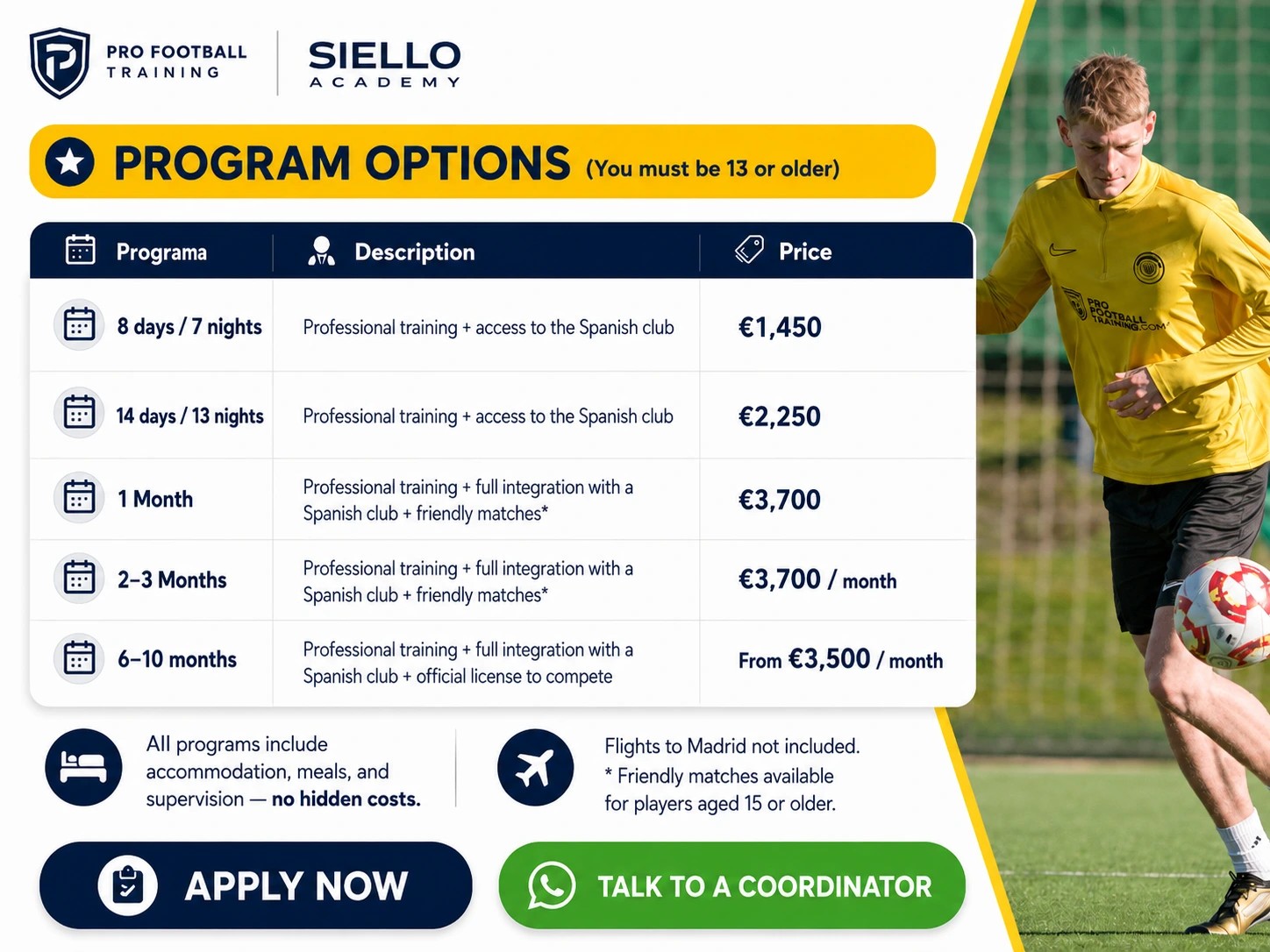
Si quieres conocer las opciones de inmersión y formación en Madrid, conoce nuestros programas To learn about immersion and training options in Madrid, explore our programs and review which format may suit your age, level and goals. Your choice should start with your profile and the development process you can sustain.
Frequently Asked Questions About Training Soccer on Your Own
How Long Should an Individual Soccer Training Session Last?
The duration depends on your objective, level and weekly workload. If you follow a training plan, agree the work and breaks with your coach. Check whether you maintain quality. Do not extend the session just to reach a set number of minutes.
Can I Train on My Own After a Match?
It depends on the demands of the match, how you feel and the next planned workload. Avoid automatically adding intense practice. The guide on how to recover after a soccer match helps you prioritize before deciding whether more training makes sense.
Which Skills Can I Practice Without a Partner?
You can practice passing toward targets, receiving from a wall, dribbling and movement coordination. Choose a task connected to a specific difficulty, then check how useful it is in team play. Decisions against opponents require opposition.
How Do I Know If I Am Doing Too Much?
Compare your usual response with what happens over several sessions. Accumulated fatigue, repeated deterioration in execution or greater effort for a similar task may justify reviewing the plan with your coach. If you experience pain or persistent discomfort, stop the task and seek medical assessment.
Do I Need a Coach to Improve?
You can practice on your own, but a coach can help you choose priorities, adjust tasks and identify errors you may not notice. Their judgment also helps you check whether your practice applies to your position and the team’s needs.
Does Solo Training Improve Your Reading of the Game?
It can help you practice scanning before receiving and preparing your body position. Without teammates and opponents, you do not have real changes in pressure or passing options. Improving your reading of the game means applying those habits in situations with changing information.