

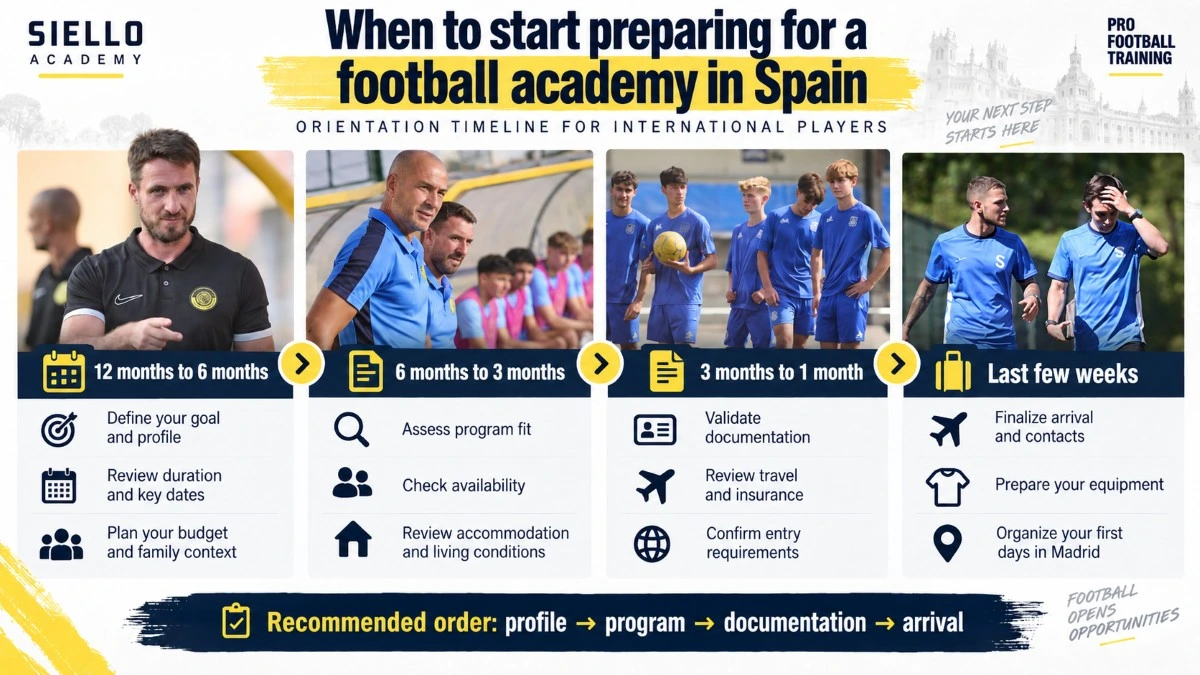
For a soccer stay in Spain, it is best to start planning as early as reasonably possible, especially for a long stay, a minor travelling without their parents, a possible education requirement or a case that needs immigration review. The recommended order is: player goal and profile → program fit and availability → documents and travel → arrival logistics.
Planning does not begin when you buy a flight or start collecting documents. It begins when the player and family define what they need the stay to achieve: an initial immersion, a longer adaptation period or a sustained development process in Madrid.
From there, the player’s age, level, sporting calendar, nationality, length of stay and family situation determine what needs to be reviewed first.
Pro Football Training, a platform connected to the training environment of Siello Academy and part of Siello Football Group, offers programs in Madrid for international players aged 13 and over, ranging from short stays to 6–10 month programs. The depth of integration and the conditions vary by format; starting earlier can support better-informed decisions, but it does not guarantee a place or a sporting outcome.
In this guide, we use T-12, T-6, T-3 and T-1 to indicate approximately how many months remain before the planned start of the stay. This is a planning framework, not an administrative calendar or a universal admissions deadline.
Before You Apply
The question “when should we apply?” is incomplete if it is still unclear what the player is looking for and what the family needs to organize.
A short stay can work as a first immersion in the Spanish training environment. A one- to three-month program requires more coordination and allows for a more sustained adaptation period. A long stay adds dependencies related to the sporting calendar, family logistics, documentation and, depending on the case, education requirements.
Length alone does not turn a stay into a tryout, representation agreement or club signing.
Training, competing, gaining exposure, being represented, negotiating a contract and signing with a club are different stages.
Before choosing a travel window, review how to choose the right soccer program length in Spain based on the player’s age, sporting objective and the family’s ability to sustain the process.
Planning Timeline: From T-12 to the Final Weeks
T-12 to T-6 Months: Organize the Goal, Profile and Availability
This stage is especially useful for long stays, minors travelling without their parents or families that need to coordinate education, budget and adult support.
This does not mean every player should apply twelve months in advance. It means that the more complex the case, the more useful it is to identify dependencies before committing money or dates.
At this stage, it helps to organize:
- age, position, current level and competitive experience;
- the main objective of the stay: immersion, adaptation, assessment, training continuity or a longer development process;
- an approximate travel window;
- possible conflicts with the season, school or family commitments;
- the overall budget, including costs outside the program;
- the need for adult accompaniment or support, especially when the player is a minor;
- passport, nationality, country of residence and possible entry or stay requirements.
This is also a good time to make an initial enquiry.
The family does not need to have every document resolved before making an enquiry, but it should provide enough specific information for the team to understand the player profile, approximate dates and objective.
To prepare that first contact without turning this guide into an application tutorial, see how to contact a football academy with a clear player profile.
T-6 to T-3 Months: Assess the Fit and Confirm a Viable Format
With a more defined date window, the next step is to request a profile assessment and determine which program format may make sense for the player.
At this stage, the following should be confirmed:
- indicative availability;
- program length;
- program scope;
- conditions that apply to the player’s age and program format;
- accommodation and arrival arrangements;
- supervision;
- outstanding documentation;
- and any insurance or travel requirements the family still needs to verify.
An initial enquiry or assessment does not equal final admission, a tryout, federation registration or a club signing.
If friendly matches or competition are discussed, the specific conditions also need to be confirmed. Medium-length programs may include friendly matches when applicable, and the public program information sets an age condition of over 15 for this point; long-stay programs have a different competitive structure.
Not every format offers the same depth of integration, so a stay of a few days should not be compared with a process lasting several months as if they were equivalent.
T-3 to T-1 Months: Validate the Program, Documents and Travel Route
At this stage, the family should move from exploration to validation.
The family should have sufficiently clear confirmation of the program and review which entry, documentation, authorization, insurance or travel requirements may affect the player.
For nationals of non-EU countries, entry into Spain may require a valid passport, a visa when applicable and documentation supporting the purpose of the stay. Minors need their own travel document and, if required by their nationality, their own visa. The exact conditions must be checked for each individual case.
Not all sports programs follow the same immigration route.
A short stay and a long-stay authorization are different situations. It should also not be assumed that every soccer program automatically qualifies a player for a “student visa.”
When the route that actually applies is a study authorization or student visa, or one of the training activities covered by Spanish regulations, the specific rules for that route must be checked with the competent authority. Current official information establishes, for those applications, a general minimum lead time of two months before the start of the studies, except in certain justified circumstances.
That timeline should not be extrapolated to every player, nationality or Pro Football Training program format.
Visa assistance is part of the support communicated by the program, but assistance does not mean visa approval.
T-1 and the Final Weeks: Finalize the Arrival Without Last-Minute Improvisation
Flights and other major commitments should be finalized once the program fit, dates and relevant conditions are sufficiently confirmed.
In the final weeks, the family can focus on execution:
- original documents and copies;
- arrival contacts;
- equipment;
- authorized payments;
- communication with the player;
- and organization of the player’s first routine in Madrid.
Arrival is not a minor detail.
The player should understand who their contact person will be, how accommodation, transport and supervision will be coordinated and what to expect during the first few days.
Well-organized logistics reduce unnecessary uncertainty and allow the player to focus on adaptation and the sporting process.
Planning Dependencies: What Can Be Reviewed Early and What Depends on the Case
| Decision or task | Can it be reviewed in advance? | What may affect it | Who should confirm it |
| Player profile, age and objective | Yes | The intended program and sporting context | Family and program team |
| Program availability | Yes, as an initial enquiry | Dates, duration and program conditions | Pro Football Training |
| Accommodation and arrival | Yes, initially | Length of stay and confirmed arrangements | Program team |
| Passport and entry to Spain | Yes | Nationality, purpose of travel and documentation | Consulate, embassy and competent authorities |
| Visa or long-stay route | Yes, to identify the possible route | Nationality, specific activity, duration and the authority’s decision | Competent consular or immigration authority |
| Insurance and additional documentation | Yes, as an item to verify | Immigration route, nationality and travel requirements | Provider, program and authorities, depending on the case |
| Friendly matches | Can be discussed | Program format, player age and applicable conditions; when available, for players over 15 | Program team |
| Official competition or federation registration | Should be identified as a separate issue | Program length, age, eligibility and applicable conditions | Program and competent entity |
| Representation, contract negotiations or club signing | Should not be assumed | Separate agreements, player performance and decisions by each entity | Siello Football Agency or the relevant club, as applicable |
This table helps distinguish a key point: some decisions can begin to be organized very early, but not all of them can be finalized with the same lead time.
If the Player Is a Minor: Decisions the Family Should Address Earlier
When a minor travels internationally, family planning should begin earlier.
A parent or guardian should be involved in the process and understand what the program includes, who coordinates arrival, how supervision is organized and which communication channels will be available.
They should also review whether the stay is compatible with the player’s education requirements and documentation status.
It is important to check:
- the minor’s passport and personal documentation;
- who will accompany the player, or how the journey will be organized if they travel alone;
- authorizations that may be required by the country of departure, Spain, the airline or the custody arrangement;
- contact details for arrival, residence and emergencies;
- compatibility with school and the academic calendar;
- which documents the player should carry;
- which copies the player’s legal guardians should keep;
- the specific supervision and communication arrangements.
There is no single parental authorization that applies to every family.
Rules for minors travelling alone, with an adult who is not their guardian or with only one parent may vary by country, and airlines may set additional requirements. The EU recommends checking both the rules of the countries involved and the airline’s own requirements.
Documents and Visas: How to Plan Without Assuming an Automatic Route
Nationality matters, but it does not determine the entire process on its own.
Mexico, Argentina, the United States and EU countries should not be treated as if they had identical requirements. The length and purpose of the stay, the player’s age, passport and specific activity also matter.
For a short visit, the family should verify the entry rules that apply to the player’s nationality. For a long stay, the family should determine which authorization, if any, applies.
A soccer program should not automatically be described as a student-visa route. Spanish regulations link this authorization to specific categories and requirements for studies or training, so eligibility depends on the individual case and the decision of the competent authority.
If a player does obtain a study-stay authorization lasting more than six months, current official guidance states that they must personally apply for the TIE within one month of entering Spain. This requirement belongs to that specific route and should not be generalized to all sports programs.
Practical rule: first identify the possible documentation route; then confirm the requirements and deadlines with the competent authority; only then commit to flights or non-refundable expenses.

Timing Mistakes That Can Complicate the Process
- Making contact without even an approximate date window or program length.
- Buying flights before confirming program fit and the important requirements.
- Treating a short stay as if it were equivalent to a long-season program.
- Leaving passport checks, minor travel authorizations or consular enquiries until the final weeks.
- Confusing assessment or exposure with definitive selection, representation or a club signing.
- Budgeting only for the program and overlooking the overall cost of travel and family logistics.
- Assuming that receiving visa assistance means the visa will be approved.
- Assuming that the same immigration route applies to every sports activity.
Family Checklist Before Applying or Booking
Before moving forward, it helps to have at least the following points identified:
- age, position, level and current competitive context;
- the main objective of the stay;
- preferred program length and a possible alternative;
- an approximate date window;
- sporting and academic calendars;
- passport and nationality;
- whether a visa or exemption needs to be reviewed for the specific case;
- the minor’s situation: accompaniment, authorizations and custody;
- questions for the consulate, embassy and airline;
- insurance or other documents that still need to be confirmed;
- the total budget for the stay and travel;
- what the program includes and what the family needs to organize;
- payment, booking or cancellation conditions that need to be reviewed;
- arrival contacts;
- and program questions prepared in writing.
The Right Order Reduces Rushed Decisions
Good planning does not mean applying as early as possible without a clear reason. It means organizing decisions that depend on one another:
profile and objective → program and availability → documents and travel → arrival and adaptation.
The longer or more complex the stay, the more valuable it is to start with enough lead time.
An assessment should not be interpreted as a promise of progression either. Observation or a profile assessment does not guarantee a club signing, contract, representation, federation registration or continued place within a club.
The program can place the player within a real training and integration environment, but performance, age, adaptation, eligibility and individual circumstances remain decisive. PFT’s public communication specifically separates exposure, competitive integration and any later representation or contracting processes.
If the family already knows the player’s country of residence, age and position, approximate dates and intended length of stay, it can move on to three decisions: review which program may be the best fit, check the budget for a soccer season in Spain and understand what it can be like to live in Madrid while training soccer.
If you already have these basic details and want to review the fit before moving forward, the next step is to request a profile assessment.
FAQs
When Should You Contact a Soccer Academy in Spain?
It makes sense to make initial contact once the family has a reasonable idea of the player’s age, objective, preferred length of stay and approximate travel window. For a long stay, a minor travelling without their parents or a case that requires education, documentation or immigration review, starting earlier makes it easier to identify dependencies. There is no universal application deadline.
Can I Make an Enquiry Before I Have All the Documents?
Yes. An initial enquiry can help clarify profile fit, program length and the documentation issues that will need to be reviewed later. Before booking or travelling, the specific requirements should be confirmed with the program and, when applicable, with the consulate, embassy, competent authorities and airline.
Do I need a visa to train in Spain?
It depends on the player’s nationality, length and purpose of the stay and the documentation route that applies. A short stay and a long-stay authorization are not the same. Participating in a soccer program also does not automatically create eligibility for a student visa. The correct route must be confirmed with the competent consular or immigration authority.
When Should You Check the Passport?
From the earliest planning stage. The document must be valid and meet the requirements that apply to the trip. If the player is a minor, they need their own travel document and the authorizations that apply to their situation should also be reviewed.
What Changes If My Child Travels Alone?
It is advisable to review accompaniment, authorizations, custody, supervision, accommodation, communication and airline requirements earlier. There is no universal authorization that applies to every case; the requirements depend on the countries involved, the carrier and the family situation.
Does an Application Mean a Tryout or Club Signing?
No. Making contact or applying starts a conversation about the player profile, fit and availability. It does not automatically mean a tryout, federation registration, representation, contract negotiations or a club signing. Each of those stages depends on different conditions and decisions.
Is the T-12/T-6/T-3/T-1 Timeline Mandatory?
No. It is a framework for organizing decisions, not an administrative requirement.
Some stays can be arranged with less lead time, while others require more because of program length, nationality, documentation, education requirements or travel by a minor. Actual administrative deadlines must be verified for the specific case.