
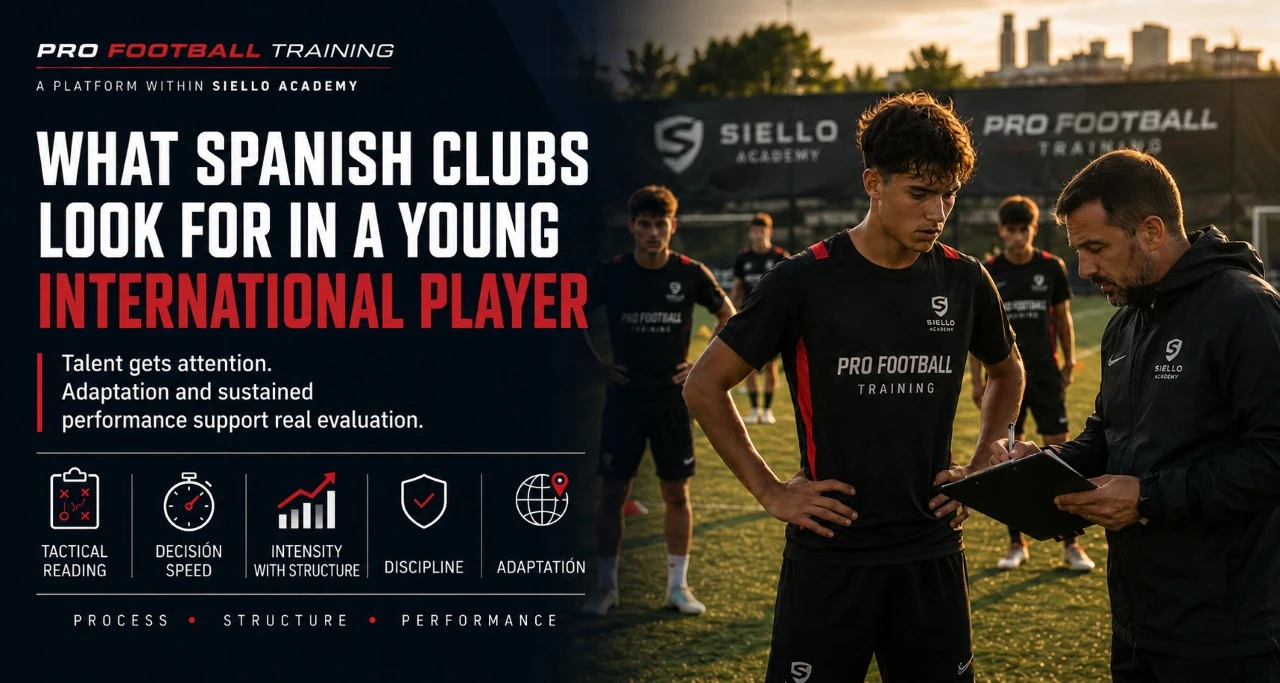
Talent gets attention, but adaptation sustains evaluation. For a young international player, arriving in Spain and showing good technique in one action is not enough. A club may look at much more: how the player reads the game, makes decisions under pressure, adapts to rhythm, responds to mistakes, communicates and sustains performance in a new environment.
Spanish clubs may value a combination of technical level, tactical adaptation, speed of decision-making, intensity, discipline, maturity, communication and sustained performance in a young international player. Talent matters, but it does not replace the ability to adapt to Spanish football and perform consistently.
This does not mean every club looks for exactly the same profile. Every club, category, coach and competitive context may have different needs. But there are general criteria that help players understand how they may be evaluated when arriving from another country.
At Pro Football Training, a platform within Siello Academy and part of Siello Football Group, an ecosystem dedicated to the long-term development of footballers in Europe. In our programs in Madrid, we do not approach exposure as a magic promise. We approach it as part of a serious process where the player can train, adapt, integrate and show performance with more context.
Visible talent vs evaluable performance
Many players believe visible talent is enough: a strong dribble, powerful run, good strike, speed or a standout action on video. All of that can help create a first impression, but it is not always enough to sustain an evaluation.
A club does not evaluate only what the player can do in his best action. It also observes whether he can repeat good decisions, understand when to accelerate or slow down, position himself without the ball, listen to feedback and maintain intensity when the session becomes uncomfortable.
The difference between visible talent and evaluable performance is continuity. Talent can appear in one action. Performance is observed through repetition, context and demand.
FIFA describes talent identification as a structured process involving player profiles, observation, scouting environments, video and data analysis. It is not only about “seeing talent”; it is about understanding what the organisation is looking for and how the player is evaluated within a playing philosophy or squad need.
For an international player, this matters. He may have qualities, but he must show that those qualities survive the change of environment.
What Spanish clubs may look for beyond technique
Technique matters, but in a competitive environment it is not evaluated alone. A player may have good control, passing, striking or dribbling, but if he makes poor decisions, arrives late to cover spaces or does not understand the rhythm of the game, the evaluation remains incomplete.
A Spanish club may observe:
- body shape when receiving;
- what the player does before receiving the ball;
- whether he scans the pitch;
- how quickly he decides;
- whether he plays simple when needed;
- whether he understands his position;
- how he moves without the ball;
- whether he can press and recover shape;
- whether he sustains intensity;
- how he communicates with teammates;
- whether he responds to corrections;
- whether he stays focused after mistakes.
This explains why a highlight video does not always tell the full story. A video may show goals, assists or standout actions, but it may not show off-ball behavior, tactical discipline, response to mistakes or consistency.
A modern player assessment needs to consider several dimensions. A review of tactical evaluation tools in youth football notes that comprehensive sport assessment should include psychological, social-emotional, physical, physiological, technical and tactical variables.
Tactical adaptation and speed of decision-making
Tactical adaptation is one of the most important areas for an international player in Spain. It is not only about knowing how to play football. It is about understanding how the game is played in a new context.
In Spanish football, a player may find training environments where body orientation, ball circulation, space interpretation, support angles, switches of play, counter-pressing, occupation of zones and decision-making under time pressure carry significant weight.
An international player may stand out technically but need adaptation if he:
- holds the ball too long;
- always plays forward when the game requires pause;
- does not understand when to fix defenders or release the ball;
- loses defensive references without the ball;
- struggles with collective pressing;
- depends too much on individual action;
- decides too late before receiving.
Speed of decision-making does not mean always playing fast. It means choosing well in limited time. Sometimes the best decision is to accelerate. Other times, it is to play simple, protect possession or offer support.
For a club, this ability can matter as much as technique because a player who decides well usually adapts better to the team, the playing model and the competitive demand.
Intensity, discipline and response to mistakes
Intensity is not only running a lot. It is sustaining concentration, rhythm, competitive aggression and order throughout the session or match.
A player may have strong physical output, but if he presses badly, breaks structure or loses control, that intensity can work against him. That is why clubs do not look only at energy. They look at intensity with criteria.
Discipline also matters. For a young international player, discipline appears in specific details:
- arriving prepared;
- listening to instructions;
- applying feedback;
- respecting the routine;
- taking care of rest and nutrition;
- training consistently;
- accepting internal competition;
- staying connected when he is not the standout player;
- responding well to demands.
Response to mistakes is another key point. In a new environment, the player will make mistakes. What matters is how he reacts. Does he get frustrated? Does his intensity drop? Does he hide? Does he try to correct? Does he keep competing? Does he listen to the coach?
Coaches often observe this behavior because it reveals maturity. A young player does not need to be perfect, but he must show the ability to learn.
How the international player context influences evaluation
An international player is not only competing against other players. He is also competing against a change of context.
Arriving in Spain means adapting to a new routine, new coaches, new teammates, a new city, a different training method and another way of reading the game. Even when language helps, sporting adaptation is not automatic.
The international player’s context may influence:
- adaptation rhythm;
- communication with teammates;
- understanding of instructions;
- tolerance to frustration;
- distance from family;
- autonomy;
- habits away from the pitch;
- emotional control;
- response to internal competition.
That is why a club or evaluation structure should not look only at whether the player “plays well.” It also needs to see whether the player can function inside a team, routine, pressure environment and away from his usual context.
UEFA’s elite youth academy program links player development not only to technical, tactical and fitness training, but also to life skills such as conduct, attitude and responsibility. That helps explain why behavior beyond the technical action also matters.
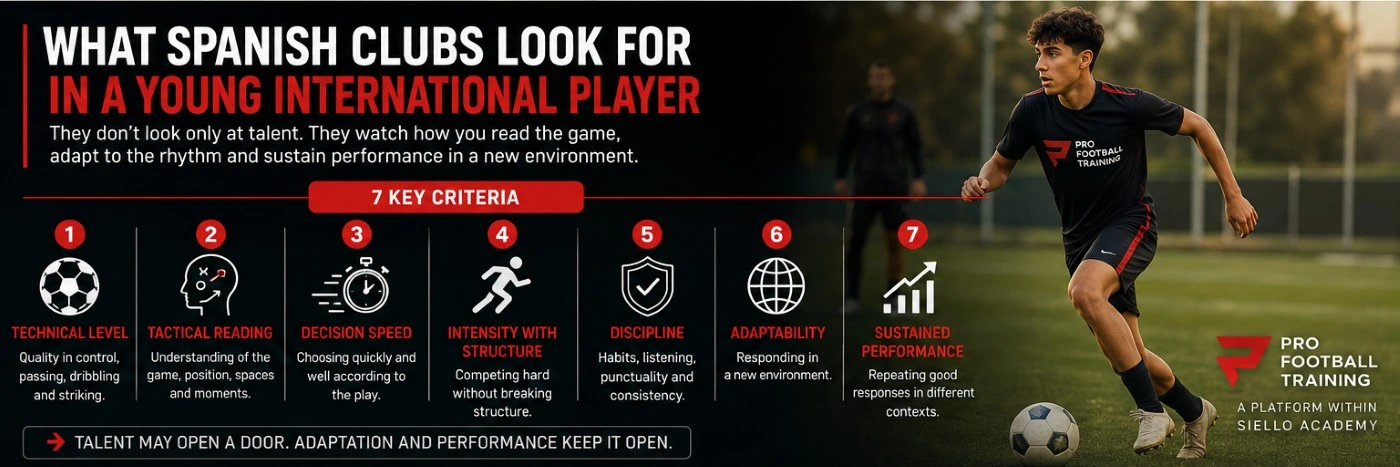
7 criteria a Spanish club may observe in a young international player
Although every club has its own needs, these seven criteria help organize the evaluation:
| Criteria | What it means | What the player can show |
| Technical level | Control, passing, dribbling, striking and solutions under pressure | Security on the ball and ability to solve situations |
| Tactical reading | Understanding of the game, position, spaces and timing | Intelligence to make better decisions |
| Decision speed | Choosing quickly and correctly according to the play | Adaptation to the team’s rhythm |
| Intensity with order | Competing hard without breaking structure | Ability to sustain demands |
| Discipline | Habits, listening, punctuality and consistency | Seriousness and learning capacity |
| Adaptation | Responding in a new environment | Maturity and competitive flexibility |
| Sustained performance | Repeating good responses in different contexts | Reliability, not only isolated talent |
These criteria are not a universal formula. They do not guarantee a signing or selection. But they help explain what may separate a player who shows qualities from one who becomes evaluable inside a real football environment.
What matters more: physical level, technique or tactics?
The answer depends on position, age, playing model and competitive level. A centre-back, winger, central midfielder or striker will not be evaluated in exactly the same way.
However, for a young international player, the issue often appears when one quality hides the rest. A very physical player may stand out locally but struggle if he cannot make good decisions. A very technical player may attract attention but lose value if he does not understand rhythm. A tactically intelligent player may adapt better but still need to improve intensity or power.
That is why evaluation should be integrated. FIFA recommends defining player profiles through technical, tactical, physical, psychological and social attributes, using both objective and subjective measures to understand whether a player fits what the organisation needs.
In practice, the most interesting player is not always the one who stands out in only one dimension. Often, it is the player who combines sufficient level, game intelligence, discipline, adaptability and development potential.
Is a highlight video enough?
A video can open a first reading, but it should not be the only basis for evaluation.
A strong video can show position, profile, technical resources, speed, decision-making and relevant actions. But if it only shows goals or spectacular plays, it may hide important details.
To be more useful, a video should include:
- name, age, position and dominant foot;
- club or competitive context;
- actions on the ball;
- actions off the ball;
- defensive actions;
- decision-making;
- involvement in different phases of the game;
- recent clips;
- enough context to understand opponent, rhythm and situation.
The video does not replace training. It also does not guarantee exposure. It is a tool to start understanding the profile, not definitive proof of level.
If the player wants to be assessed more seriously, he should prepare a complete profile: video, football CV, competitive background, position, availability, objectives and honesty about current level.

Why training in a Spanish environment helps measure real level
Training in a Spanish environment can help measure real level because it takes the player out of his usual context. It forces him to adapt to another rhythm, methodology, teammates and way of reading the game.
That does not mean the player will be signed. It means the environment may show more clearly what is already strong and what still needs work.
For some players, adaptation confirms that they have tools to compete in a more demanding context. For others, it reveals areas to develop: mental speed, tactical discipline, intensity, autonomy, communication or consistency.
In our programs in Madrid, we approach this immersion as part of a process. The structure includes training, integration into a club environment and support within the ecosystem. Depending on the length of the program and the player’s performance, the experience can open real opportunities for exposure, competition and progression within the process. But this does not mean a guaranteed signing or guaranteed scouting.
The role of the structure is to place the player in a more realistic environment. The player must respond.
What to prepare before looking for exposure
Before looking for exposure, a player should prepare his profile. It is not only about asking for a trial or sending a video. It is about presenting clear information and entering the process with realistic expectations.
Before seeking an opportunity, a player should have:
- updated video;
- clear football CV;
- defined position;
- competitive background;
- basic physical information;
- date availability;
- documents reviewed;
- realistic football objective;
- clarity around age and category;
- willingness to receive feedback;
- physical and mental preparation;
- understanding that exposure does not mean signing.
Attitude also matters. A player looking for exposure must be ready to be evaluated, not only admired. Evaluation can show strengths, but also limits. That information is part of the process.

How Pro Football Training supports this assessment
At Pro Football Training and Siello Academy, we support international players who want to train in Spain within a serious structure. We do not treat exposure as an empty promise. We treat it as part of a process of immersion, training, adaptation and assessment.
Our role is not to tell a player that a club will sign him. Our role is to help him enter an environment where he can measure his level more clearly, understand what Spanish football demands and assess whether a deeper pathway makes sense.
A young international player needs more than talent. He needs structure, rhythm, discipline, adaptation and the ability to sustain performance. If additional opportunities appear after that process, they must always be understood according to performance, profile, duration and context.
Conclusion: a club does not look only for talent, but adaptation and performance
Spanish clubs may value the talent of a young international player, but they rarely evaluate only that. They also look at how the player reads the game, adapts, decides, sustains intensity, responds to mistakes and behaves inside a competitive environment.
For the player, this should change the focus. The question is not only “how do I get seen?” The more serious question is: am I ready to be evaluated in a real context?
Si quieres entender qué exige realmente entrenar en Europa, el siguiente paso es revisar tu perfil, tu nivel y tu capacidad de adaptación con más criterio.
Understand what training in Europe really demands.
Request a profile assessment.
FAQs
What do Spanish clubs look for in an international player?
They may value technique, tactical reading, decision-making speed, intensity, discipline, adaptation, communication and sustained performance. Every club has different needs, but an international player must show he can adapt to the rhythm and context of Spanish football.
Is technical talent enough?
No. Technique matters, but it is not enough if the player cannot make good decisions, understand the game, sustain intensity or adapt to the environment. Talent must become evaluable performance.
How important is tactical adaptation?
It is very important. An international player may have strong qualities, but he needs to understand positioning, rhythm, pressing, support angles, off-ball behavior and decision-making within the team model.
How should a player prepare a profile for evaluation?
The player should prepare recent video, a football CV, position, competitive background, basic physical data, availability, football objective and realistic expectations. He should also be ready to receive feedback and be evaluated with criteria.
Can a Spanish club sign a young international player?
It can happen in specific contexts, but it should never be assumed as an automatic outcome. It depends on age, level, documents, category, club needs, performance and feasibility.