
If you are looking to sign with a club in Spain, there is a recurring confusion (which often ends in frustration, lost money, or false expectations): «signing» doesn’t always mean the same thing.
Sometimes «signing» is used to mean «I was recruited» (me ficharon), other times to say «I have a federation license» (tengo ficha), and in other cases «I have a professional contract and earn a salary.» In practice, these are different scenarios and each involves different rights, obligations, timelines, and risks.
This article will help you understand, with a realistic approach, what it means to sign with a club, what a serious process looks like, what documents you should expect, and what phrases should set off alarm bells.
Important: This content is informational and for guidance purposes. It does not replace legal advice. Actual conditions depend on the club, the division, the federation, and the player’s immigration/labor status.
In 30 Seconds:
- «Fichaje» (Recruitment/Signing) usually refers to the club deciding to bring you in (it can be with or without a salary).
- «Ficha» (License) usually refers to your federation registration/license to be able to compete officially.
- «Professional contract» implies an employment relationship between the athlete and the club, with conditions agreed upon in writing (duration, salary, obligations, etc.). In Spain, the special employment relationship of a professional athlete is regulated by specific laws.
- You can have a federation license and compete without having a «working» professional contract.
- A serious process does not promise an «automatic contract»: it defines criteria, timelines, steps, and evidence.
Recruitment, License, and Contract (To avoid confusion)
1) «I was signed» (Fichaje / Recruitment)
- The club wants to add you to their structure.
- It can be an amateur, semi-professional, or professional team.
- It may include a salary… or not.
2) «I have a license» (Ficha / Federation License)
- It means you are registered to compete with a club under a specific competition/regulation.
- It is essential to play official matches.
- It does not guarantee a salary or a «professional contract.»
3) «I have a professional contract» (Employment Contract)
- There is a written contract with labor/sporting conditions.
- It implies obligations, duration, compensation, and a specific legal framework.
- In professional competitions, there may also be collective regulations and sector agreements.
1) What it means to «have a license» in Spain (and why it’s not the same as «being a professional»)
In Spanish football, to compete normally, you need a federation license or registration (often called a «ficha»). In simple terms: it is your authorization to play officially with a club.
What a federation license DOES give you:
- Being registered to compete.
- Belonging to a specific division/competition.
- A framework of sporting regulations (sanctions, eligibility, etc.).
What a federation license DOES NOT guarantee:
- A salary.
- An employment contract.
- «Automatic visibility» or guaranteed tryouts with big clubs.
- That the club will keep you for the next season.
👉 Therefore, when someone tells you: «I’ll get you a license in Spain,» the right question to ask is: In which club, what division, what competition, under what conditions, and with what real objective?
2) What a professional contract is (and when it applies)
A professional contract (in the labor sense) is associated with a special employment relationship for professional athletes: you provide sporting services within the club’s organization and direction, in exchange for compensation.
This is important because it changes the «baseline» of the conversation:
- there are written conditions,
- there is a duration,
- there are commitments,
- and there are consequences if either party breaches the agreement.
In football, furthermore, the international framework of transfers and contractual relationships is coordinated with FIFA regulations (for example, provisions on contracts between professionals and clubs).
What should a serious contract include (reasonable minimums)?
Without getting into legal technicalities, a serious contract should allow you to understand:
- Duration of the agreement (dates).
- Financial conditions (if any): salary, bonuses, premiums.
- Obligations: training sessions, matches, discipline, behavior.
- Medical coverage / insurance (depending on the case).
- Termination or exit conditions.
- Image rights (if applicable).
- What happens in case of a prolonged injury (according to the agreement).
Red flag: If everything is «by word of mouth» and the club or intermediary avoids putting it in writing, it’s time to hit the brakes.
3) «Signing with a club» in real terms: 4 common scenarios
When a player or a family says «we want to sign,» they are usually referring to one of these scenarios:
- Scenario A — Joining a club to compete (with a license)
- Objective: to play a season, improve, get minutes, build a competitive track record.
- Objective: to play a season, improve, get minutes, build a competitive track record.
- Scenario B — Joining a club + getting exposure (scouting / tryouts)
- Objective: to play and get exposed to club networks for a higher-level opportunity.
- Objective: to play and get exposed to club networks for a higher-level opportunity.
- Scenario C — Semi-professional contract / assistance
- Objective: to compete with support (housing, stipends, partial scholarship, incentives), not necessarily as a «full employment contract.»
- Objective: to compete with support (housing, stipends, partial scholarship, incentives), not necessarily as a «full employment contract.»
- Scenario D — Professional contract (labor) and career
- Objective: for football to be your formal and main professional activity.
The problem: Many people sell Scenario D when they are actually offering A or B.
4) What it is NOT (mandatory to avoid false expectations)
If your goal is to play in Spain and truly grow, these phrases should be read with caution:
- «Guaranteed professional contract» (without evaluation, without timelines, without steps).
- «We will sign you no matter what.»
- «With us, you go straight to the First/Second Division.»
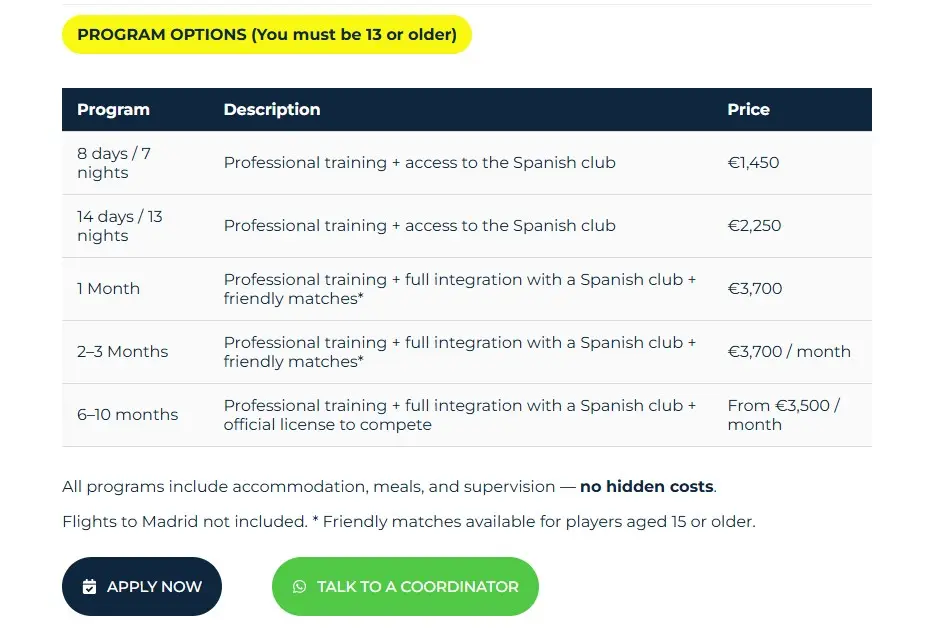
- «If you pay X, you are signed» (paying for a program is not the same as an employment contract with a club).
- «No need for a video, CV, references, or track record.»
The reality: Serious processes have filters, and results depend on performance, adaptation, club needs, and the market.
5) So… what does a serious process to «sign with a club» look like?
Although every case varies, a serious process usually follows this logic:
Step 1 — Real evaluation (not just highlights)
- Current level (technical/tactical/physical).
- Position and profile.
- Verifiable competitive track record.
- Realistic objective (division, type of club, 6–12 month horizon).
Step 2 — Season plan (roadmap)
- Where you are going to compete (an environment that gives you minutes).
- What you need to improve (and how it is measured).
- What exposure is sought (club networks / tryouts).
Step 3 — Exposure (it’s not «magic», it’s a system)
- Matches, training sessions, scouting.
- «Presentable» material: sporting CV, useful video, references.
Step 4 — Tryouts / opportunities
- Tryouts with specific clubs based on a real fit.
- Managing expectations: timelines and probabilities.
Step 5 — Negotiation and signing (if the time comes)
- Terms are reviewed.
- Whatever applies is signed in writing.
- Federation/administrative matters are managed according to the case.
6) What role does a representation agency play (and what to ask them)?
A serious agency (or a real link to representation) can provide:
- Network of contacts and opportunities.
- Negotiation.
- Career strategy.
- Timing management.
But beware: an agency does not «manufacture contracts.» Contracts appear when there is a sporting fit, club need, and proper timing.
Checklist of questions (to filter the noise):
- What type of clubs are in the network and in what divisions?
- How do they select profiles?
- What metrics and criteria do they use to move a player?
- What cases are verifiable?
- What concrete deliverables does the player receive during the season?
7) Signs that you are on the right track (and red flags)
Green flags 🟢
- They talk to you about specific divisions and reasons.
- They ask for verifiable material (track record, references).
- There are clear steps and a schedule.
- They don’t promise «automatic» results; they promise a process and exposure.
- They explain in writing what the program includes and what it doesn’t.
Red flags 🔴
- Absolute promises without evaluation.
- Pressure to pay «today» to «secure» a spot.
- No clarity on division/club/objective.
- They refuse to put anything in writing.
- They mix «program» with «contract» as if they were the same thing.
Protect Your Future and Demand a Transparent Process
In the football world, the word «signing» is used far too lightly. As we have analyzed, having a federation license to compete, joining a sports development program, or signing a professional employment contract are completely different scenarios.
The biggest mistake a player or their family can make is getting carried away by the excitement of a promise without demanding clarity, written documents, and a truly realistic plan. Your sporting career and your investment deserve a serious process, where your goals on the pitch match your current abilities, and where there is a clear roadmap for your growth in Spain.
At Siello Academy, we understand how important it is to take this step with confidence. We are ready to support your development, provide you with the necessary tools, and help you advance to the next level with complete transparency and professionalism.