
A summer football program in Spain should not be evaluated as a recreational camp. For an international player, a short stay in Madrid can be a serious first immersion: training in a different context, adapting to a new rhythm, entering a structured environment and understanding whether a longer pathway makes sense.
But a short stay also has limits. It should not be sold as a quick promise of a club, representation, signing or sporting outcome. In a few days, a player can show a lot, but not everything. It is possible to observe initial adaptation, training response, attitude, autonomy and rhythm. What should not be done is turning a short program into a guarantee.
A short-stay program helps measure adaptation and train in another context. It does not guarantee sporting results. That is the central idea families should understand before booking dates.
Pro Football Training and Siello Academy, are part of Siello Football Group, an ecosystem dedicated to the long-term development of footballers in Europe. Our short-stay programs in Madrid are designed as a serious entry point into the process: structure, training, club integration and support, with clear expectations from the start.
Why summer can be a good moment for a first immersion
Summer often creates a practical window for international families. School schedules may be more flexible, travel may be easier to organize and players may have more room to try a short experience without disrupting the full academic or competitive year.
For some profiles, this can be useful. A player who has never trained in Spain can use summer to understand how he responds to a new environment. A family that is unsure whether a full-season program makes sense can start with a more limited stay. A player who wants to test adaptation can use a short window to train, experience a different rhythm and receive a first reading of the process.
But summer does not automatically make every program the right decision. The question should not only be “are dates available?” The better question is: what do we want to evaluate during this stay, and what expectations are realistic for such a short period?
If the goal is a first immersion, a short-stay program can make sense. If the goal is sustained competition, official licensing, deeper continuity or a more complete performance assessment, more time may be required.
What an 8-day or 14-day stay can provide
An 8-day or 14-day stay can be valuable when it is understood as the first stage of a process. It does not replace a full season, but it can help answer important questions.
It can help the player experience:
- daily training in a different context;
- adaptation to Madrid’s rhythm;
- initial integration into a club environment;
- life within an organized structure;
- distance from the usual environment;
- response to new demands;
- autonomy away from home;
- contact with a different methodology;
- an initial reading of level and adaptation.
For families, it can also help determine whether the player is ready for a longer process. Sometimes a short stay confirms that the player needs more time. In other cases, it shows that the player should prepare his profile better before taking on a bigger investment.
The value of a short program is not in promising too much. It is in creating context. One or two weeks can show how the player behaves outside his comfort zone, how he responds to training, how he adapts to routine and how he handles higher demands.
The limits of a short-stay program
The main limit of a short-stay program is time. In 8 or 14 days, there can be training, initial adaptation and observation, but not the same continuity as in a one-to-three-month program or a full season.
A short stay should not promise:
- club signing;
- professional contract;
- automatic representation;
- guaranteed friendlies;
- official matches;
- federation license;
- playing minutes;
- guaranteed scouting;
- sporting success.
This does not reduce its value. It simply places the format where it belongs. A short-stay program is meant to start an immersion, not to solve an entire football pathway.
It is also important to distinguish exposure from signing. A player can train in a real environment, integrate into the club context and be observed with more criteria, but that does not mean a club will take him. The structure can create the environment, but performance still depends on the player.
When families should consider one month or more
Families should consider a one-month program or longer when the goal is no longer only a first immersion, but observing adaptation and performance with more continuity.
A 1-month format may make more sense if the player needs time to:
- adapt to the rhythm;
- receive feedback and apply it;
- show consistency;
- train with more continuity;
- move beyond the initial nerves or adjustment period;
- understand the environment better;
- assess whether a longer pathway makes sense.
A 2–3 month program allows for an even deeper reading. At that point, the process is no longer only about first impressions. There is more room to observe habits, discipline, development, response to mistakes and tactical adaptation.
A full-season program has a different scope. It may be appropriate when the player needs competitive continuity, deeper integration and a sustained process. But even in a full-season pathway, the result still depends on performance, profile and context. More time creates better conditions for assessment, but it does not buy a career.

8 days vs 14 days vs 1 month vs full season
| Format | What it can provide | What should not be expected |
| 8-day / 7-night program | First immersion, initial adaptation, contact with the environment | Club signing, guaranteed friendlies, representation or a complete profile reading |
| 14-day / 13-night program | Short-stay immersion with more training and adaptation time | Automatic sporting outcomes or equivalence with a long-stay program |
| 1-month program | More continuity, more time for feedback and performance reading | Contract, official license or automatic representation |
| 2–3 month program | Sustained adaptation, deeper assessment, greater integration | Guaranteed minutes or secured signing |
| Full-season program | Longer process, greater integration and competitive continuity | Success, professional contract or guaranteed career |
This comparison helps set expectations. If the player needs only to test adaptation, a short stay may be enough. If he needs to sustain performance and enter a deeper process, a longer duration may be more appropriate.
What families should evaluate before booking dates
Before booking a summer football program in Spain, families should clarify several questions.
- The first is the objective. Does the player want a first immersion, an initial assessment, international training, adaptation to European football or a longer pathway?
- The second is level. Does the player train and compete regularly? Does he have club experience? Does he have recent video material? Is he ready to respond outside his usual environment?
- The third is maturity. Travelling to Spain means living with a different routine, adapting to schedules, meals, transportation, training and distance from family. Initial excitement is not always enough if the player does not have habits.
- The fourth is documentation. Entry and stay conditions in Spain depend on nationality, duration and purpose. For short stays, Spain applies the Schengen framework of up to 90 days in any 180-day period, subject to entry requirements and applicable documentation; this should not be understood as an automatic right of entry or guaranteed approval.
- The fifth is expectation. If the family expects 8 or 14 days to solve signing, representation or a contract, the format is being misunderstood. If the family expects a serious first immersion, it may be a more coherent decision.
What our short-stay programs in Madrid include
In our short-stay programs, families are not booking only training sessions. They are joining an initial immersion structure in Madrid.
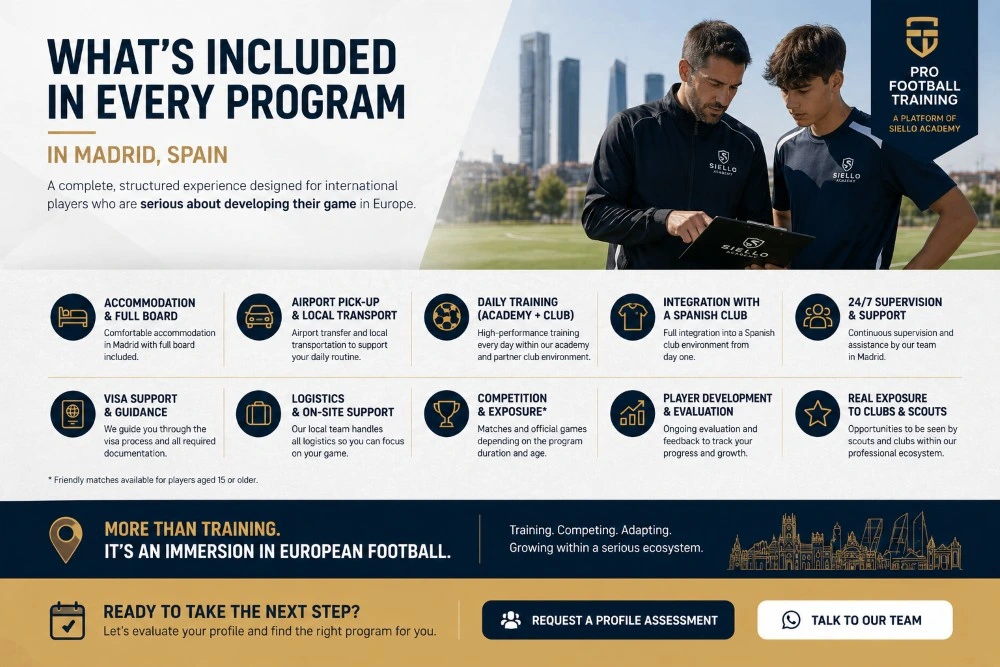
According to our current program structure, the programs include:
- accommodation in Madrid;
- full board;
- airport pickup;
- local transportation;
- daily training;
- academy and club training context;
- integration into a Spanish club environment;
- 24/7 supervision and support;
- visa support;
- local logistics and on-site support in Madrid.
These elements matter because a short stay requires organization. If the player travels from another country, logistics cannot be improvised. Families need to know where the player will stay, how he will move, who will support him, how the routine is organized and what type of training he will receive.
Still, precision matters. Club environment integration does not mean a signing. Exposure does not mean the player will be discovered. Visa support does not mean visa approval. The difference between what is included, what is possible and what is conditional must be clear from the start.
Siello Academy is a summer camp?
No. Our short-stay programs should not be understood as recreational summer camps or sports tourism.
The difference is the objective. A camp is often associated with a more recreational, massive or leisure-oriented experience. A short football immersion program has another logic: training, adaptation, structure, residence, supervision and contact with a club environment.
That does not mean the player cannot have a positive experience. It means the main objective is not entertainment. The objective is to enter a more demanding environment and measure how the player responds.
For some families, this distinction is essential. If they are looking for a recreational holiday experience, this may not be the right format. If they are looking for a serious first immersion in Madrid, then it makes sense to review dates and fit.
Does it help a player get seen by clubs?
A short stay may provide initial exposure within a more realistic environment, but it should not be understood as a guarantee of being signed, represented or selected.
The question “does it help the player get seen?” needs nuance. It can help the player train in another context, be observed by the technical team, integrate into the club environment and receive an initial reading of adaptation. But in a few days, it is not always possible to assess the full profile.
If the family’s main objective is deeper exposure, sustained competition or more complete follow-up, a longer format should be considered.
Being seen is not the same as being evaluated with continuity. And being evaluated is not the same as signing.
How to decide if a short-stay program fits your profile
A short-stay program may fit if the player:
- is 13 or older;
- trains regularly;
- wants a first immersion in Madrid;
- needs to measure adaptation before a larger decision;
- has the maturity to travel;
- understands there are no automatic sporting guarantees;
- wants to experience a different training rhythm;
- can take advantage of a summer window;
- has a family looking for an informed decision, not a quick promise.
It may not be the right format if the player or family expects immediate results, official competition, representation, signing or a complete evaluation in just a few days.
In those cases, it may be better to consider a longer stay or prepare the player’s profile more carefully before travelling.
How Pro Football Training approaches this immersion
At Pro Football Training and Siello Academy, we approach short-stay programs as a structured first immersion. We do not present them as a complete solution or an automatic route to a club.
The goal is for the player to train, adapt, experience the context, understand the rhythm and receive an initial reading within the process. Depending on level, attitude, age and objective, that experience can help decide whether a longer duration makes sense.
The structure places the player in a real environment. The player must respond with discipline, adaptation and performance.
That is the difference between a serious program and an empty promise: not everything is solved in summer, but summer can be a useful entry point when it is understood correctly.
A short stay can be useful if you do not expect what it cannot provide
A summer football program in Spain can be a good decision when the family understands its real function. It can support a first immersion, training in another context, adaptation and an initial reading of whether a deeper pathway makes sense.
It does not buy a guarantee. It does not replace a full season. It does not secure a signing, representation, contract, playing minutes or official competition.
If you are evaluating travel this summer, the next step is to review dates, objective and player profile to understand whether a short-stay program makes sense or whether another format would be more appropriate.
Check available dates.
Assess whether this short-stay format fits your profile.
FAQs
Is a summer football program in Spain a camp?
No. In our case, we do not treat it as a recreational camp or sports tourism. We approach it as a short football immersion with training, structure, accommodation, supervision and contact with a club environment in Madrid.
What can a short-stay program provide?
It can provide initial adaptation to the training rhythm in Spain, contact with a different football environment, supervision, structured routine and a first reading of the player’s level and response outside the usual context.
Is an 8-day or 14-day stay enough to be seen by clubs?
It may provide initial exposure within a more realistic environment, but it should not be understood as a guarantee of club signing, representation or selection. A deeper assessment may require more time.
Are matches included in short-stay programs?
Matches, friendlies or official competition should not be assumed in short-stay programs. They depend on age, duration, program conditions and sporting context. Not every format offers the same scope.
How should families choose between a short stay and a full-season program?
It depends on the objective. If the player needs a first immersion, 8 or 14 days may make sense. If he needs continuity, competition, deeper adaptation or a more complete assessment, a 1-month, 2–3 month or full-season program may be more appropriate.