
Feeling your pulse race before a match, tension in your legs, discomfort in your stomach or thoughts about what could go wrong does not automatically mean that you are unprepared.
The goal does not have to be to eliminate every nervous feeling.
Before competing, you need activation to run, react, communicate and make decisions. The problem begins when your attention leaves the game and starts revolving almost entirely around your own state:
- “I cannot make a mistake.”
- “Everyone is watching me.”
- “I have to prove everything today.”
- “If I lose the first ball, I have ruined the trial.”
To manage nerves before a football match, it is usually more useful to reduce the uncertainty you can control, regulate your activation without forcing it, choose two or three clear actions and prepare yourself for the opening phase of the game.
In other words: you do not need to prove that the nerves have disappeared. You need to know what your next action is even when they are still there.
Nerves do not always mean the same thing
Two players can arrive at the pitch with the same racing heartbeat and experience the situation very differently.
- One may interpret it as: “I am switched on. My body is getting ready to compete.”
- Another may think: “I am losing control. I am going to play badly.”
The physical sensation may be similar. What changes is the way the player interprets it and where their attention goes next.
In sport psychology, there is no solid basis for the idea that peak performance necessarily requires being as relaxed as possible. Models of individual zones of optimal functioning recognise that each athlete may respond better within a different range of activation. Recent research also reinforces the need to adapt psychological strategies to the athlete and the context rather than search for one universal formula.
So instead of asking yourself: “How can I stop feeling nervous?”
try asking: “What do I need to do to keep reading the game while I am nervous?”
That small shift moves your attention away from a feeling you cannot fully control and towards behaviours you can actually execute.
Mental preparation does not start five minutes before kick-off
Breathing, self-talk and visualisation can be useful tools, but they do not work like a switch that should be tested for the first time before the most important match of the year.
- In 2026, a study involving 55 U19 footballers from professional club academies compared normal training with an additional eight-week psychological-skills programme. The programme included breathing, progressive relaxation, self-talk and imagery, followed by their application in football situations. The findings support the idea that these skills can be trained in a structured way, not that one isolated technique guarantees better performance.
The practical lesson is simple: practise your routine while the pressure is still manageable.
A normal training session is a much better place to discover whether a breathing pattern helps you, which words you actually remember or how long you need to refocus than the changing room before a decisive trial.
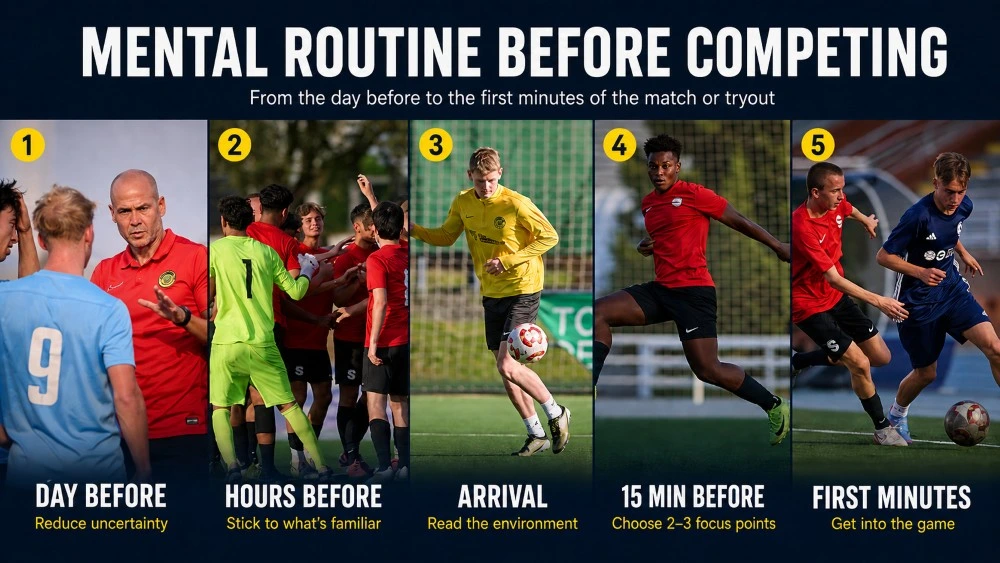
A practical routine from the day before to the start of the match
You do not need to turn mental preparation into another test. A useful sequence can be organised around five moments:
| Moment | Main priority | What to avoid |
| Day before | Reduce uncertainty | Turning the match into “the biggest day of your life” |
| Hours before | Stay with what you know | Changing routines, food or other variables unnecessarily |
| Arrival at the pitch | Connect with the environment | Comparing yourself with everyone |
| Final 15 minutes | Regulate and focus | Trying to remember twenty objectives |
| Opening minutes | Enter the game | Trying to prove everything immediately |
The day before: remove problems you do not need
Part of what we experience as “nerves” becomes stronger when too many questions are still unresolved.
- What time do you need to arrive?
- How are you getting there?
- Do you have the right kit?
- Do you need any documents?
- Do you understand how the trial will work?
Solving those details does not remove sporting pressure, but it prevents you from adding avoidable logistical pressure.
Prepare your equipment, confirm the schedule, organise your journey and keep the habits you already know. Also avoid a common trap: spending the evening analysing other players, watching clips of the opposition or talking for hours about everything that is supposedly “at stake”.
What if you sleep worse than usual?
One poor night can be uncomfortable, but worrying obsessively because you did not reach an exact number of hours may increase your activation even further.
Keep a reasonable routine and reduce stimulation before going to sleep. If sleep problems become frequent, severe or begin affecting your daily life, it is worth seeking qualified support.

In the hours before: stay with what your body already knows
The day of an important trial is not a good time to experiment. Stick with food and hydration that you already tolerate and follow the guidance of your team or qualified professionals working with you. Do not suddenly introduce supplements, stimulants or nutritional routines because somebody claims they will improve your performance.
This article is not intended to provide an individual nutrition plan. The principle is simpler: the fewer unnecessary variables you introduce, the more attention you have available to compete.
When you arrive: stop evaluating yourself and start observing
A football trial can create a very particular feeling: you walk onto the pitch and it seems as though everybody is watching you. Usually, they are not.
The coaching staff are organising the session. Other players are thinking about themselves. There are instructions, equipment, positions and timings to understand.
Before deciding whether everybody else looks better than you, identify:
- where the session will take place;
- who is leading the session;
- what instructions are being given;
- what tempo the group is working at;
- what position or role you will have.
Comparing yourself does not help you play yet. Reading the environment does.
A short breathing exercise may help lower your activation slightly
If you have already practised slower breathing and find it comfortable, you can use it for one or two minutes before going onto the pitch.
A simple reference is to breathe in gently and allow the exhale to last slightly longer than the inhale. For example, some people may feel comfortable with something around four seconds in and six seconds out.
But 4–6 is not a medical prescription or a universal formula. Research on slow-paced breathing in sport uses different protocols and does not support presenting that specific ratio as “the correct breathing pattern” for every footballer. A longitudinal study published in 2026 found changes in cognitive anxiety and self-confidence following a pre-competition intervention, but it involved American football players and combined slow breathing with another technique, so the results cannot be attributed to breathing alone.
For practical use:
- The purpose is not to “erase” the nerves.
- Keep the rhythm comfortable.
- Allow some tension to leave your shoulders and jaw.
- Avoid prolonged breath holds.
- If you feel dizzy, short of breath or more uncomfortable, return to normal breathing and stop.
The purpose is not to “erase” the nerves.
It is to see whether you can reduce the activation slightly and redirect your attention towards the game.
Fifteen minutes before: choose three cues you can control
There is an important difference between an action and an outcome. “I have to score,” “I have to be the best,” “I need them to select me.” None of those outcomes depends entirely on you.
Before going on, it is much more useful to choose two or three observable behaviours.
- A midfielder might use: scan — receive on the right angle — provide a passing option.
- A striker: attack space — guide the press — move on after the action.
- A centre-back: communicate — manage distance — decide quickly.
- A goalkeeper: organise — position — decide.
You do not need to remember fifteen instructions; you need a few references that can bring you back to the game when your attention moves towards the result.

Five minutes before: visualise something going wrong as well
Visualisation does not mean creating a perfect film where you score three goals and everything works. It can be more useful to rehearse the beginning:
see the pitch, hear your teammates, make your first run, scan before receiving and complete one clear action.
Then add something less comfortable. Imagine losing your first touch, receiving a correction from the coach or making a decision that does not work.
Then rehearse the response.
- Lose it → react.
- Get corrected → listen.
- Make a mistake → move to the next task.
At that point, visualisation stops being a fantasy about the outcome and becomes a rehearsal of behaviour.
The first five minutes: enter the game before trying to stand out
Nerves often produce two opposite responses. Some players hide; others try to prove too much. They force a dribble, chase the ball outside the team structure, attempt a spectacular pass or accelerate a situation that actually required patience.
During the opening minutes, the objective can be much more concrete:
read the tempo, find your position, communicate and perform your role.
That does not mean playing with fear or always choosing the safest option. It means connecting with the match before trying to solve everything yourself.
In a football trial, this becomes even more important: a serious assessment needs to understand how you make decisions, interpret space, behave without the ball, respond to coaching and adapt.
What to do after your first mistake
For a nervous player, the first mistake can feel much bigger than it really is. The ball goes out, you lose a duel, you play a pass to an opponent, and for the next twenty seconds you are still mentally playing the previous action. That is often the bigger problem.
A reset routine can be reduced to three steps:
- 1. Exhale
You do not need to stop moving. One normal, comfortable exhale can simply act as a mental cut-off point.
- 2. Use one word
Next, Recover, Reset, React.
Keep it short; you are not trying to give yourself a motivational speech in the middle of the match.
- 3. Find the next task
Where should you be? Who should you be tracking? Where can you offer support? Should you press or recover your position?
Analyse the mistake later; solve the game now.
Match and trial: the nerves come from different places
A normal match and a football trial can create similar sensations, but they do not produce exactly the same problem.
| In a regular match | In a football trial |
| You know your teammates | Many players are unfamiliar |
| You know the model and instructions | You need to interpret a new methodology |
| Your role is usually defined | Your role may change |
| There is continuity | Evaluation time may feel limited |
| You know the coach | You may not know what each evaluator is looking for |
| The focus is on competing as a team | There is additional pressure from being assessed |
Before a regular match, you can focus more strongly on your role within the collective plan.
Before a trial, add three priorities: understand quickly, adapt and let the coaching staff see how you actually play.
You do not need to turn every involvement into a highlight. And taking part in a trial does not guarantee selection, team integration, representation or a contract.
What can parents do without adding more pressure?
One of the heaviest sentences before a trial can come from somebody who is only trying to help. “This is your opportunity”, “Remember everything we have invested”, “You need to prove yourself today”, “The scouts are watching you.”
The problem is that the player already knows the situation matters; they do not need the volume turned up.
It can be far more useful to help with what is concrete: “Do you have everything ready?”, “Do you want to talk or would you rather have some quiet time?”, “Is there anything you need before we leave?”
And after the match, the journey home does not need to become an immediate tactical review. Sometimes the best first question is: “Do you want to talk now or later?”
The IOC consensus on elite youth athletes highlights that performance pressure, maladaptive perfectionism, injuries, burnout and other factors within high-level sport can affect young athletes’ psychological wellbeing, and places mental-health protection within a safe and sustainable sporting environment.
The coach is also part of the mental environment
A coach does not replace a sport psychologist, but coaches can make the environment easier or harder for a player to interpret. A clear instruction reduces uncertainty, and explaining how an assessment will work removes unnecessary questions.
Correcting an observable behaviour is more useful than labelling a player as “weak” or saying they “lack character”, and establishing in advance what should happen after a mistake gives the player a reference when pressure rises.
When the distress clearly goes beyond the sporting context, the coach’s role is not to diagnose. It is to recognise that a different kind of support may be required.

When we are no longer talking only about normal pre-match nerves
It is worth speaking with a psychologist, sport psychologist, doctor or another qualified professional when distress becomes severe or persistent; for example, when there are repeated episodes of panic or loss of control, frequent vomiting before competition, persistent sleep problems, avoidance of training because of fear, significant changes in eating or mood, anxiety that also appears away from football or a marked loss of normal functioning or enjoyment.
A pre-match routine is designed for performance preparation, not for treating mental-health conditions.
If thoughts of self-harm appear or there is an immediate risk to the player or somebody else, emergency assistance should be sought in the place where the person is located.
FIFA maintains its #ReachOut initiative to encourage recognition of mental-health problems and to support players and others in football in speaking with someone they trust and seeking professional help when necessary.
A breathing technique does not replace that kind of support.
Pressure can also be managed within a longer development process
A single trial concentrates many variables into a short period. A process lasting several weeks provides more context to observe adaptation, consistency, response to coaching, habits, decision-making, development and how a player responds after a difficult training session.
Pro Football Training, a platform within Siello Academy, is part of Siello Football Group, an ecosystem dedicated to the long-term development of footballers in Europe. The brand architecture clearly distinguishes the platform, Siello Academy’s training layer, Siello FC’s competition layer and Siello Football Agency’s representation layer.
Within that context, longer programmes may allow for more continuous observation and, where applicable, deeper integration into the football environment. Any possible progression towards official competition depends on the player’s profile, level, technical decisions, age and category, squad availability, documentation, eligibility and other applicable conditions.
- Training does not automatically mean competing. Being assessed does not mean being represented. And representation does not mean signing for a club.
Joining a programme does not guarantee team integration, squad selection, playing time, representation or a professional contract.
A 15-minute mental routine before competing
This is the short version worth keeping as a clearly scannable block and potential downloadable resource:
| Time | Action |
| 15–12 min | Observe the environment, listen and stop comparing yourself |
| 12–10 min | Regulate your breathing without forcing it |
| 10–7 min | Choose 2–3 controllable cues |
| 7–5 min | Visualise the beginning and one difficult moment |
| 5–0 min | Connect with the warm-up and enter the task |
Your goal at the end of those fifteen minutes is not to ask whether you feel completely calm; it is to know what you are going to do when the game starts.
FAQs
Is it normal to feel nervous before a football match?
Yes. Some physical and mental activation before competition is common. Different players may need different levels of activation to perform well. The important question is whether you can still listen, read the game and make decisions.
How can I get rid of football nerves quickly?
There is no universal technique that removes nerves immediately. A familiar routine, less uncertainty, comfortable breathing and controllable objectives may help regulate your activation.
What breathing exercise can I use before playing?
If you have practised it before, you can try slow, comfortable breathing for one or two minutes and allow the exhale to be slightly longer. A rhythm such as four seconds in and six seconds out is only a reference, not a universal rule.
What should I think about before a football match?
Choose two or three actions connected with your role: scan before receiving, communicate, manage your distance, attack space, provide support or react after losing possession.
How can I calm down before a football trial?
Reduce logistical uncertainty first. Then understand the instructions, avoid constant comparison with other players and focus on showing how you read and respond to the game. You do not need to secure the entire assessment with one spectacular action.
What should I do if I make a mistake with my first touch?
Exhale, use a short cue such as “next” and immediately identify your next task. You can analyse the mistake after the action has finished.
Do nerves mean that I am not prepared?
Not necessarily. You can feel nervous and still be well prepared. What matters is how those nerves affect your ability to participate and respond.
When should I speak with a sport psychologist?
When the distress becomes severe or frequent, affects sleep, eating, training or other areas of life, or when the strategies you normally use are no longer enough.
Does joining a programme at Siello Academy guarantee official match participation?
No. Training, assessment and competitive integration are separate processes. Any possibility of official competition depends on player level, technical evaluation, category, squad availability, eligibility, documentation and the other applicable competitive conditions.

Competing while nervous is also a skill
Learning how to manage nerves before a football match does not mean forcing yourself to become completely relaxed; it means recognising the activation without allowing it to absorb all of your attention.
Prepare what you can control, go onto the pitch with two or three clear references and have a response ready when something goes wrong.
Breathing can be one tool. Visualisation can be another. Self-talk can help bring your attention back to the task. Recent evidence involving young footballers supports the value of training psychological skills in a structured way rather than looking for a miracle technique five minutes before competing.
You do not need to feel perfect before stepping onto the pitch. You need to know what the next action is.
Prepare for a process, not only for a trial.
Explore our programmes and understand which type of structure, duration and development environment fits your current stage as a player.