

Not having an EU passport does not automatically mean a player cannot come to Spain. But it does make planning more important.
This is one of the points where families tend to make the biggest mistakes. Some rule Spain out too quickly. Others assume that if the football project looks strong enough, the paperwork will somehow solve itself. Neither approach is useful.
When an international player is considering a football program in Spain without an EU passport, the right question is not only whether he can come. The useful question is more specific: what type of program is he considering, how long does he plan to stay, what nationality does he have, which requirements apply to his case, and whether the whole process is being structured correctly from the start.
In other words, not having an EU passport does not automatically close the door. It simply makes serious planning more important.
An EU passport is not the only filter
In this market, people often talk about an EU passport as if it were the single factor that defines whether a football program in Spain is viable. It is not.
European citizenship can make part of the administrative path easier, but it is not the only variable that matters. The player’s nationality, the length of stay, the type of activity involved, the available documentation, and the rules of the relevant consulate also matter.
That is why a serious brand should not answer this question with a simplistic yes or no. It should explain that the immigration and documentation side depends on the case and that not every program format requires the same level of preparation.
That approach is consistent with Pro Football Training: visa support is communicated as part of the structure, but it should never be presented as guaranteed approval or as an automatic solution for every nationality or every length of stay. The support exists; the outcome depends on the specific case and the official requirements that apply.
Program length changes this conversation a lot
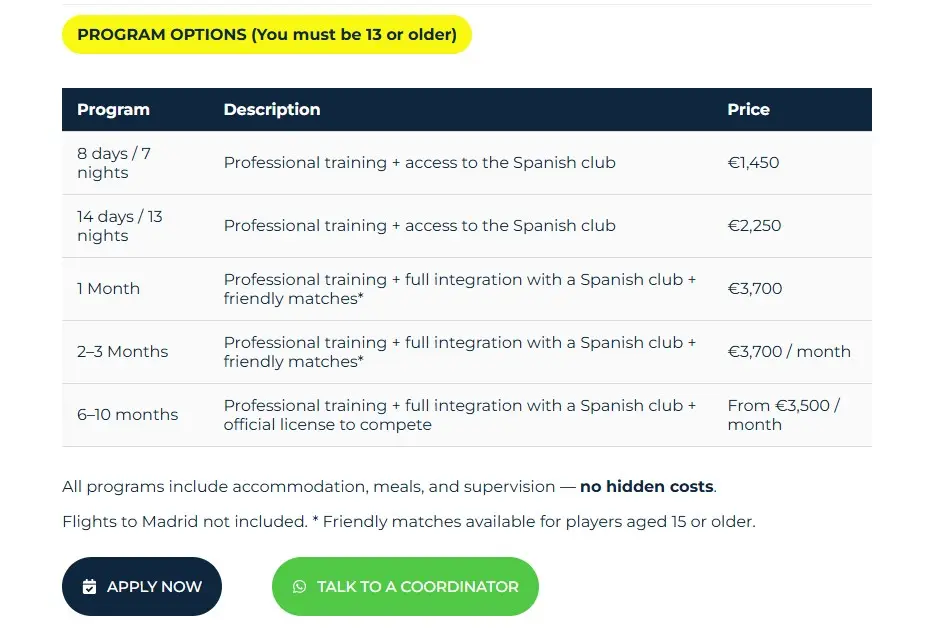
A short stay is not evaluated the same way as a long one. In Pro Football Training and Siello academy, programs range from 8-day and 14-day formats to 1 month, 2-3 months, and a full-season pathway of 6 to 10 months. That difference does not only change the football experience. It also changes the level of planning that may be required around travel and documentation.
Official European sources explain that, for non-EU nationals, short stays in the Schengen area follow the general logic of up to 90 days in any 180-day period, and whether a visa is required depends on the traveller’s nationality. For longer stays, the documentation route changes and national procedures come into play. In practice, that means the answer can vary a lot depending on the program format and the player’s country of origin.
Translated into a real decision: a short program should not be evaluated the same way as a full-season pathway, either from the football side or from the documentation side.
What usually applies in short programs
When a family is considering a brief stay – for example, 8 or 14 days – the most useful way to frame it is as a serious first immersion. It can help assess the player’s level, adaptation, response to the pace, reaction to the environment, and ability to handle a real experience outside his usual setting.
From the documentation side, these cases are often more manageable than a long stay, but they still should not be oversimplified. European and consular information makes it clear that even for short stays, visa requirements depend on nationality and the entry conditions that apply. The point is not to assume that a short format solves everything, but to verify what the specific case requires before travelling.
That is why, when a player does not have an EU passport, a short format can be a sensible entry point if the family wants a serious experience but is not yet ready to commit to a much deeper stay without first validating the football and logistical side.
What changes in 1-month or longer formats
As the duration increases, the conversation stops being only about football and becomes clearly strategic.
A 1-month or 2-3-month program requires a much more careful reading of the case. There is more time, more adaptation, deeper integration, and a much more meaningful opportunity to observe the player inside the structure. But there are also more variables that need to be organized in advance.
When the stay goes beyond certain thresholds, official Spanish and European sources indicate that the type of visa or authorization involved may change. In practice, that means families should not make the decision only on football fit or budget. They also need to confirm which documentation route applies based on nationality, program length, and consular jurisdiction.
At Pro Football Training, that distinction also matters: not every format offers the same depth of integration, and not every format should be communicated as if it implied the same journey. The longer the stay, the more important it becomes for the football, logistical, and documentation sides to be aligned.
A full-season pathway is not for everyone
A long-stay or full-season structure can be the right option for some profiles, but not simply because the player has or does not have an EU passport. It makes sense when the player and family need a deeper pathway with continuity, official competition, and a much more complete integration inside the ecosystem.
In Siello Academy the 6-to-10-month format is the most robust option and includes an official competition license. Precisely because of that, it also requires the most serious planning from the start. It should not be sold as an automatic answer to the lack of an EU passport, nor as a guaranteed route toward a later football outcome. It should be treated for what it is: a longer, deeper, and more demanding process on every level.
Spanish consular authorities also explain that study, training, or educational stays above 90 days fall under national or study visa logic, with specific documentation that must be handled through the relevant consulate. That is another reason why a full-season pathway requires real planning, not improvised enthusiasm.
So, can coming to Spain still make sense if you do not have an EU passport?
In many cases, yes. But the serious answer is not based on a short slogan. It is based on an evaluation.
The first thing to understand is that not having an EU passport does not automatically exclude a player. The second is that the case should not be assessed only through the desire to play in Spain, but through four much more practical questions:
- What nationality does the player hold and which requirements apply?
- How long is the intended stay?
- Which program format makes sense for the player’s stage and level?
- Is the family ready to manage the documentation and logistics with the same seriousness they apply to the football side?
When those questions are answered well, the decision improves a lot. It prevents families from discarding a viable route out of fear, but it also prevents them from entering a poorly planned process out of pure excitement.
What matters is not having a generic answer. It is having a clear route.
For a player without an EU passport, coming to Spain can be completely viable, or it may require more careful preparation depending on the case. What does not help is reducing the whole decision to a simplistic phrase.
A serious structure should help families separate the football side, the documentation side, and the logistical side. It should also explain honestly which part of the process depends on the program and which part depends on nationality, consular procedures, and official documentation.
If you want to bring this question down to your real case, the next step is not to assume or to rule it out. It is to evaluate which program fits your profile and how viable the process looks based on your nationality, intended stay, and football stage.
FAQs about going to to Spain Without an EU Passport
Can I come to Spain if I do not have an EU passport?
In many cases, yes. But viability depends on the player’s nationality, the length of stay, the type of program, and the documentation requirements that apply through the relevant consulate.
Does a short program require the same paperwork as a full-season pathway?
No. The football side and the documentation side change a lot depending on the duration. A short stay is not evaluated the same way as a multi-month route.
Does Pro Football Training guarantee visa approval?
No. The program may offer visa support as part of its structure, but approval depends on the specific case and the official requirements that apply.
Does not having an EU passport automatically rule me out?
Not necessarily. The right approach is to evaluate the full case: nationality, duration, documentation, the player’s objective, and the overall viability of the process.
What is the best next step if this is my main concern?
Request a profile assessment and review the viability of the chosen format before making a bigger decision.