

For many international footballers, traveling to Europe for football tryouts in Spain seems like the decisive step toward professionalism. The scene is usually imagined very simply: a tryout, a good performance, someone watching from the stands, and an opportunity that changes the future.
The problem is that the reality of serious European football works differently.
Today, much of the frustration experienced by many players and families doesn’t necessarily stem from a lack of skill, but from participating in evaluation formats that do not reflect how decisions are truly made within competitive structures. It’s not that tryouts don’t exist. It’s that a quick trial, on its own, is rarely enough to measure what a club or academy actually needs to know.
Pro Football Training, a platform of Siello Academy, is part of Siello Football Group, an ecosystem dedicated to the comprehensive development of footballers in Europe. From this working logic, the important question is not just “where to get a tryout,” but what kind of evaluation makes sense if you are truly looking for a serious opportunity.
How to train in football in Spain: Requirements, levels, and steps for international youth players
Whether you live in Latin America or the United States, the process of applying to a Spanish academy can feel challenging at first, but with the right information, everything starts to fall into place.
The problem with the «express tryout»: why it’s so tempting and why it usually falls short
The idea of a quick tryout is attractive for a very simple reason: it promises speed. For a player who wants to be seen and for a family looking for a concrete opportunity, the possibility of being evaluated in one or two days seems efficient, direct, and even logical.
But competitive football doesn’t usually make decisions like that.
A massive trial, a weekend tryout, or a 90-minute evaluation might show flashes of brilliance, but it is almost never enough to understand if a player can sustain themselves within a real European environment. And that is the critical point: detecting a flashy play is one thing; projecting fit, performance, and evolution is something entirely different.
Lack of tactical context
In a short tryout, many players try to stand out quickly. That usually leads to broken games, forced decisions, poor collective reading, and too much anxiety to shine. For a serious evaluator, that environment offers very little information about what matters most: how the player interprets the game, how they occupy spaces, how they respond without the ball, and how they understand a tactical structure.
It doesn’t measure adaptation
An international player arriving in Spain doesn’t just change pitches. They change pace, demands, environment, tactical reading, and often their entire routine. Expecting that adaptation to be clearly visible in the first 24 or 48 hours is, at the very least, limited.
A bad day weighs too heavily
Football is also about mistakes, adjustments, and learning. In an express tryout, a bad afternoon can close a door that, in a longer and fairer context, might have provided a very different reading of the player. When the sample size is minimal, the margin for interpretation is also reduced.
What serious clubs and structures in Spain actually evaluate
If you want to understand how decisions are made in a more professional environment, you have to step away from the highlight logic and enter the process logic.
A serious structure doesn’t just look at whether a player has talent. It looks at what kind of player emerges when that talent is put into context.
1. Tactical intelligence
It’s not enough to know what to do with the ball. In Spanish and European football, a huge part of the evaluation comes down to what the player does when they don’t have it: body positioning to receive, covers, interpreting spaces, timing, pressing, tracking back, and reading the system. Often, a footballer might stand out in an isolated action while simultaneously showing serious difficulties in something more important: playing within a collective idea.
2. Ability to sustain intensity
They don’t just evaluate a sprint or a spectacular play. They evaluate how many times the player can repeat efforts, maintain concentration, sustain the pace, and physically respond to a demanding structure. In that sense, competitive European football quickly punishes those who only perform in bursts.
3. Daily professionalism
This point is often underestimated, but for families and serious programs, it is central. Punctuality, response to correction, coexistence, discipline, the ability to listen, rest, and daily attitude are part of the real evaluation. All of this is invisible in a two-hour tryout but decisive in a longer process.
Why continuous observation is worth more than a one-day trial
If a short tryout shows a snapshot, continuous observation shows the player’s real behavior.
That’s where a key difference emerges between a «quick» opportunity and a serious development process. Prolonged observation allows you to see:
- how the player adapts to the Spanish pace
- how they respond to consecutive training sessions
- how they compete when the initial novelty wears off
- how they process tactical demands
- how they evolve with corrections
- what level they sustain over time
That completely changes the quality of the evaluation.
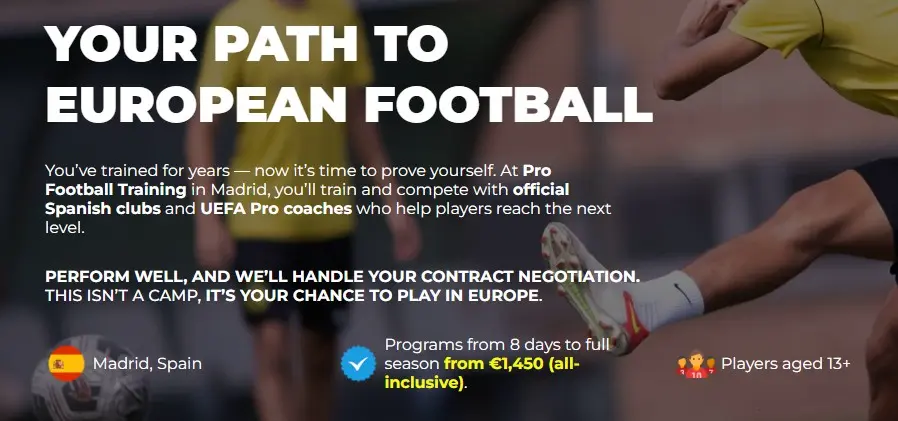
For this reason, the model used by Siello Academy does not rely on open, one-day tryouts as its main decision-making axis. The logic is different: integrate the player into a working environment, observe them, push them, correct them, and only then evaluate with greater depth what kind of projection and opportunities they have within the ecosystem.
What a serious process offers vs. a quick promise
It’s important to state this clearly: paying for a program does not buy a professional career. Performance still depends on the player. No serious structure should sell you otherwise.
But it’s also true that not all programs on the market offer the same thing.
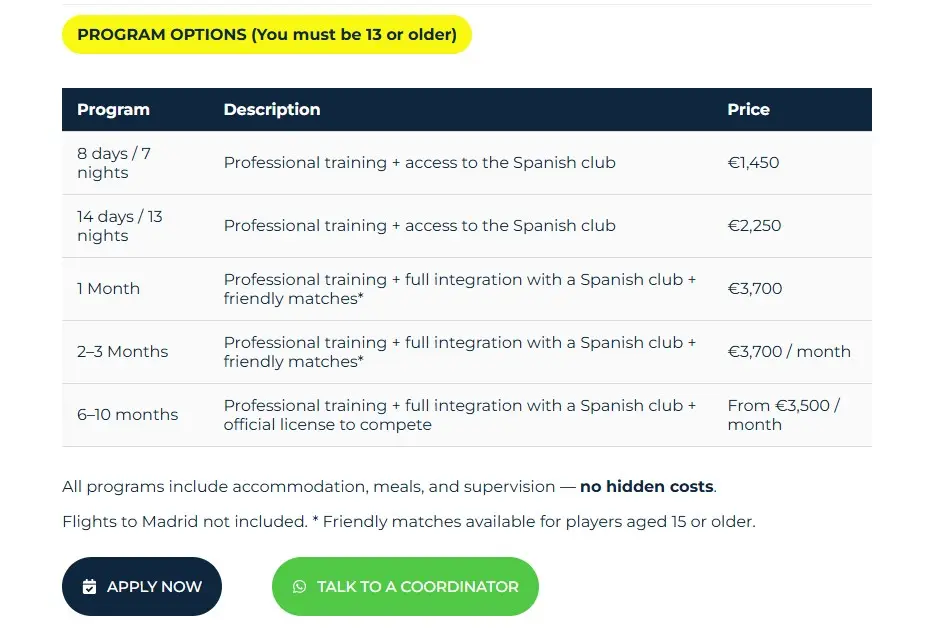
In the case of Siello Academy, by paying for and completing the full season, the ecosystem does guarantee three concrete elements:
- signing with its representation agency
- playing minutes in writing
- trials with partner clubs
The difference is significant. This is not a promise of automatic success, but a structure that puts the player on the right stage to compete, be seen, and be evaluated within a real process. The structure’s job is to open the right context. The player’s job is to perform within it.
How to distinguish a serious opportunity from an empty promise
If you are currently looking for how to get a tryout at a Spanish club, there are some signs that can help you filter better:
Signs of a serious proposal
- they explain the entire process, not just the initial event
- they talk about evaluation, adaptation, and monitoring
- they clarify who it is for and who it is not for
- they answer family questions about structure, security, and routine
- they don’t turn everything into hype or urgency
- they can justify what the investment includes and why
Warning signs
- everything seems to be resolved in a one-day tryout
- they promise visibility without explaining the context
- there is no structure behind the process
- it’s unclear who is developing the program
- it’s not understood what happens after the «tryout»
- the message is more emotional than operational
What to do if you really want to seek opportunities in Spain
The best decision usually isn’t to run after any tryout. It’s usually to organize the process.
1. Rethink the question
Instead of just asking «where do I do a tryout,» it’s better to ask:
- in what structure can I be evaluated seriously?
- how is a player’s fit really measured?
- what process allows me to show more than an isolated play?
2. Prepare better material
The sports CV and video are still important, but not as a substitute for the process. They serve to open doors, not to close decisions. A good video has to show real gameplay, decision-making, tactical profile, and actions that allow the player to be read, not just goals or epic music.
3. Understand that Europe doesn’t just reward visible talent
It rewards context, reading of the game, adaptation, discipline, and sustainability. The player who understands that is in a better position for any serious evaluation.
For players: an uncomfortable but necessary question
Before investing in a tryout, it’s worth asking yourself something you might not always want to hear:
Am I looking for quick validation or a real evaluation?
It’s not the same thing. And it doesn’t lead to the same type of decision. A serious process demands more, takes longer, and filters more. But exactly because of that, it has more value.
For parents: what to look at before paying
For a family, this decision isn’t just about football. It’s about money, security, human context, daily structure, and institutional credibility.
Before investing, it’s worth checking if the program:
- clearly explains how it evaluates
- shows who is behind it
- has a visible and coherent structure
- distinguishes between a promise and a process
- filters profiles instead of accepting just anyone
- understands family concerns, not just the player’s ambition
In this category, seriousness isn’t just communicated with big words. It’s communicated with order, coherence, and the ability to explain how the path actually works.
Football tryouts in Spain are not useless by definition. What is usually insufficient is thinking that a single day can summarize everything that matters to project a player within a serious competitive environment.
In today’s European football, the observation that truly counts rarely looks like a movie scene. It looks more like a process: adaptation, training, competition, high demands, repetition, and sustained evaluation.
Therefore, if what you are looking for is a real opportunity, perhaps the right question is no longer «where do I do a tryout?», but «what kind of process is worth entering?».
FAQs
Are football tryouts in Spain useful for reaching a club?
They can serve as a first filter or initial contact, but on their own, they are rarely enough to thoroughly evaluate a player. Serious structures usually need more context, tracking, and observation.
Do clubs sign players after a one-day tryout?
It can happen in very specific cases, but it is not the usual logic in serious processes. Normally, much more is observed than a single isolated session.
What does a serious evaluator look for besides talent?
Tactical reading, sustained intensity, adaptation, daily behavior, discipline, ability to compete, and response to correction.
Does Siello Academy host open, one-day tryouts?
It does not use that format as its main evaluation axis. Its model relies on training, continuous observation, and development within a broader structure.
What does Siello Academy guarantee in the full season?
Signing with its representation agency, playing minutes in writing, and trials with partner clubs. That does not equate to guaranteeing a professional career, but rather offering a real stage for development and exposure.