

Having a federation license in Spain does not simply mean training with a club. Player registration links the footballer to a team within a club, while the license is the federation document that authorizes the player’s regulated participation. For an international player, eligibility for official competition may also depend on age, previous registration in another country, documentation, category, registration window and specific eligibility rules.
This may sound like an administrative distinction, but it completely changes what a family should expect from a football program in Spain.
A player may train for several weeks, integrate into a club’s day-to-day environment, take part in sessions with other players and even enter certain match contexts without that automatically meaning the player is registered for official competition.
That is why, before asking “Will I play matches?”, it is better to ask a more precise question:
Are we talking about training, club integration, friendly matches, or official competition with player registration and licensing?
These are different stages.
What Does It Really Mean to Have a Football Federation License in Spain?
The regulations of the Royal Spanish Football Federation (RFEF) distinguish between two concepts that are often mixed together in everyday conversation.
- A player’s registration is the formal link between the footballer and a club through the applicable commitment or contract.
- The player license is the document issued within the federation system that recognizes the footballer as a registered player and allows lawful selection in matches and competitions. The definitive license confirms the player’s registration with a team within a club.
So when a family talks about “having a registration” or “having a license,” there are actually several layers behind those terms:
player → club/team → registration → license → eligibility for the specific competition.
There is another important distinction: being properly registered does not require the coach to select or field the player in every match. The license makes participation possible; it does not guarantee minutes, a starting place or competitive continuity.
Nor does it necessarily mean there is a professional contract. The federation system includes both professional and non-professional players, so federation registration, a professional contract and a professional career are not equivalent concepts.
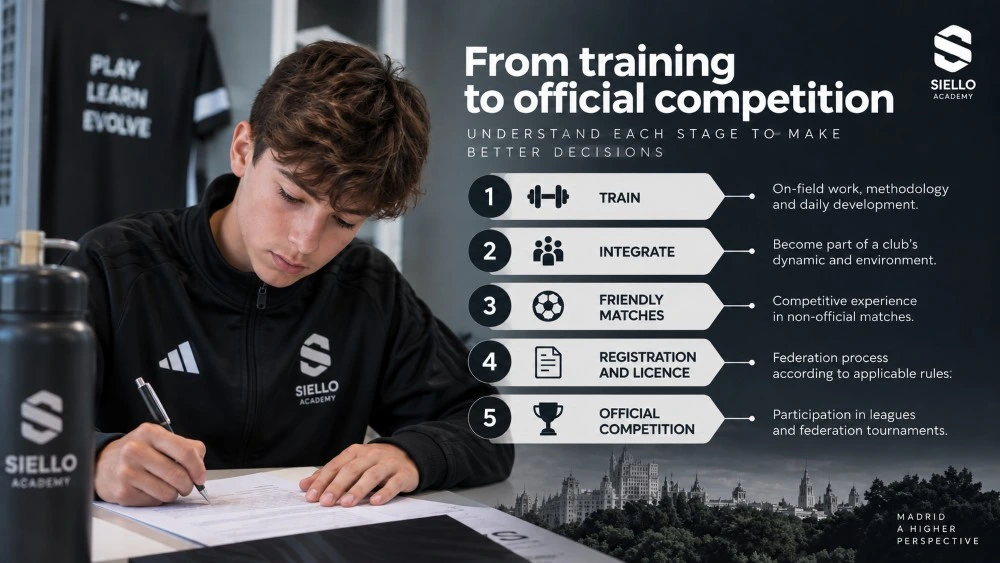
Training, Club Integration, Friendly Matches and Official Competition: What Is the Difference?
For an international player, this is probably the most important distinction in the entire article.
| Stage | What it means | Does it involve official competition? |
|---|---|---|
| Training | Taking part in training sessions, methodology and on-field development | No |
| Club integration | Becoming part of a club’s sporting environment, training structure and day-to-day dynamics | Not automatically |
| Playing a friendly match | Taking part in a match that is not part of an official competition | No |
| Registration / licensing | Formalizing the player’s federation registration with a team and completing the applicable licensing process | It is a necessary step when official competition applies |
| Official competition | Being eligible and properly registered to participate in a specific official competition | Yes |
A friendly match can be very useful for assessing pace, adaptation and competitive behavior, but it should not be confused with playing in an official league competition.
The fact that a match is a friendly does not mean it falls outside every form of regulation. The RFEF itself distinguishes between official competitions and non-official or friendly matches, and certain activities may still be subject to federation and organizational rules.
The practical conclusion is simple:
playing in a friendly match does not, by itself, prove that the player has a license or is eligible for official competition.
Why the Situation Is Different for an International Player
When a footballer arrives from another country, looking only at sporting level is not enough. The player’s registration history also matters.
A player who has never been registered with a federation does not necessarily face the same situation as a player who has already competed officially in Mexico, Argentina, the United States or another country.
If the player was already registered with another national association and moves to a different association, FIFA rules on international transfers may apply and, where required, so may the International Transfer Certificate (ITC). Under the FIFA framework, a player registered with one association must complete the applicable procedure before being registered with another.
That does not mean every foreign player follows exactly the same procedure.
Factors that may need to be distinguished include:
- whether the player is an adult or a minor;
- whether the player has a previous federation registration;
- the country in which the player was previously registered;
- the club and age category in which the player intends to register;
- whether the case involves a first registration or an international transfer;
- which documentation applies to the case;
- and which registration windows are open for the relevant competition.
For that reason, another player’s case should not be used as a template.
Two footballers of the same age and nationality can have different registration situations if one was already registered in their home country and the other had never taken part in organized federation football.
Registration Windows Matter Too
A player license cannot simply be processed at any time just because the player has arrived in Spain.
The RFEF Competition Regulations establish that players must formalize their registration within the applicable registration periods, and those periods are set for each season through the rules and competition provisions governing each competition. Certain regulatory exceptions exist, but they should not be treated as the general rule.
This introduces a variable that many international families do not consider when planning the trip.
It is not enough to ask: “When can I arrive in Spain?”
It may also be necessary to ask:
“If my goal is to compete officially, how does my arrival date fit with my age category, the season and the relevant registration window?”
A training program can begin on a given date without that date automatically meaning that any federation registration can be completed at that time.
What Changes When the Player Is Under 18?
For international minors, the review must be even more careful.
FIFA rules provide enhanced protection for international transfers involving players under 18. The general principle remains that such transfers are prohibited, subject to specifically regulated exceptions. In February 2026, FIFA published a new edition of its guide to applications involving minors to explain these procedures and the documentation required.
In addition, the rules may apply not only to an international transfer but also to certain first registrations of foreign minors.
FIFA’s guide explains that if a minor has never been registered with an association and wants to register for the first time with a club belonging to another national association, the case is treated as a first registration; if the player was already registered in another country, the move may constitute an international transfer.
The RFEF also has a specific procedure for these cases. Under its manual for the authorization of minors, documentation moves from the player and family to the club, then to the relevant regional federation and finally to the RFEF; where FIFA rules require it, the corresponding authorization procedure also applies.
For a family, this has an important consequence: coming to Spain to train as a minor and being eligible for an international federation registration are two different issues. One does not guarantee the other.
What if the Player Is Already 18?
Once the player reaches adulthood, the specific protections governing international transfers of minors no longer apply, but that does not mean every registration becomes automatic.
An adult international player may still need to address issues such as:
- previous registration with another association;
- an International Transfer Certificate, where applicable;
- documentation;
- age category and team;
- the registration period;
- specific requirements of the competition.
The central point remains the same: nationality alone does not determine the entire process. What matters is the player’s actual federation status.
Federation Registration Does Not Mean Representation or a Professional Contract
This distinction also needs to remain completely clear. A federation license belongs to the club and competition layer; representation is a separate relationship. A professional contract belongs to another stage again.
Within our institutional structure, Siello FC is the club connected to official competition and the federation layer, while Siello Football Agency is specifically responsible for representation and negotiation. These functions should not be mixed.
This sequence helps set expectations more clearly:
training → integration → competitive assessment → registration/licensing where applicable → official competition → potential additional exposure → representation, negotiation or club signing only if the relevant conditions are later met.
A player license does not mean the player has signed with an agency. It also does not automatically mean there is a professional contract. And representation does not replace federation registration.
How This Works Within Pro Football Training and the Siello Ecosystem
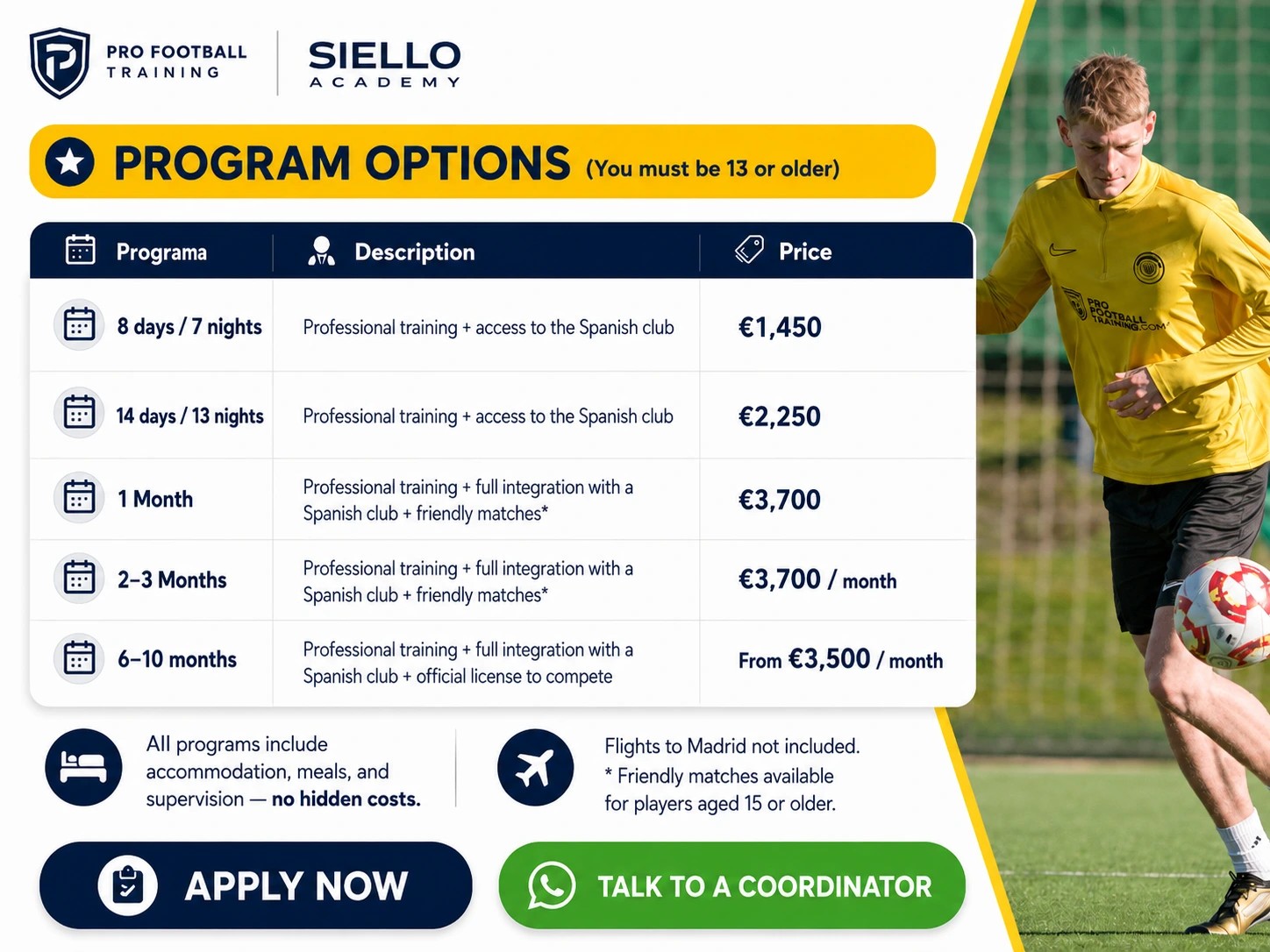
At Pro Football Training, our programs allow international players to travel to Madrid to train and integrate into the Siello sporting ecosystem. Training, methodology and the daily performance environment are delivered through Siello Academy. When we are specifically talking about the club, federation licensing and official competition, the relevant entity is Siello FC.
This institutional distinction matters because it prevents the entire process from being presented as a single service. Not all of our program formats provide the same level of competitive integration.
Short programs are primarily focused on training, immersion and initial integration. Medium-length formats may provide deeper integration and, where applicable, friendly matches; friendlies are communicated for players aged 15 and older and should never be assumed for every participant.
In long-stay programs of 6 to 10 months, an official license to compete forms part of the intended program structure. That is precisely why these formats are built around greater continuity, integration and competition.
This should not be interpreted to mean that every international player can be registered without reviewing the individual case.
The registration and eligibility process must comply with the rules applicable to the player, including age, registration history, documentation and competition.
It also does not imply a guaranteed professional club signing, club contract or sporting career. These layers must remain separate, and competition or exposure should not be turned into an automatic promise of outcome.
Why Is a Short Program Not the Same as a Competitive Season?
Because duration changes both the objective and the depth of the process. A short stay may allow the player to:
- train;
- experience the methodology;
- adapt to a different pace;
- begin integrating into a football environment;
- and be assessed with more context.
But it should not be presented as a federation season compressed into a few days.
Reaching an official competitive structure may involve documentation, calendar timing, eligibility, registration, adaptation to the club and enough continuity within the process.
This is why more time does not simply mean “more training sessions.” A longer stay can create a different relationship with the season, the club and competition.
If you are still comparing formats, you can review our guide on how to choose a football training program in Spain based on duration and objective. Our current offer clearly distinguishes between short stays, one-to-three-month programs and season-length formats.
Before Choosing a Program: 8 Questions You Should Ask
If official competition is a real priority, these questions should be clarified before making a decision:
- Is this format designed for training, integration, friendly matches or official competition?
- Does this program include federation licensing or not?
- Are my age and category compatible with the type of competition I am looking for?
- Does my previous registration in another country change the procedure?
- Is any additional authorization required because I am a minor?
- At what point in the season would I arrive, and how does that affect the registration process?
- Which parts depend on documentation and eligibility, and which depend on sporting performance?
- Are we talking about licensing and competition, or representation and a club signing?
These questions are much more useful than simply asking: “Will I play with a Spanish club?” That sentence can mean very different things.
Practical Example: Three Players, Three Different Situations
Imagine three international players.
- Player A: is 14 years old, arrives for a few weeks and has never been registered in Spain.
The priority may be to train, adapt and understand the environment. The family should not interpret that experience as automatic registration for an official league.
- Player B: is 17, has competed under a federation in another country and wants to spend a season in Spain.
This raises questions about registration history, rules applicable to minors, a possible international transfer, documentation, category and eligibility.
- Player C: is 19 and has already been registered with another national association.
The same minor-specific rules do not apply, but registration in Spain may still require an international procedure, documentation and alignment with the competition’s registration periods.
All three may have a similar sporting level. But their federation situations are not the same.
That is precisely why a serious program should assess a player using more than a video or a position on the field.
Does a License Guarantee Match Time?
No. The license makes the player eligible within the relevant federation framework, but it does not replace sporting decisions. The coach still decides selections, lineups, positions and minutes.
The player also has to adapt to the environment, respond in training and sustain an appropriate competitive level.
This distinction matters because “having a license” and “getting minutes” are not the same thing. The license resolves an administrative and regulatory layer. Performance determines a different part of the process.
What About Exposure?
That also needs to remain separate. A player may gain exposure in training, a friendly match, an official match or an assessment environment.
But exposure does not mean representation. And representation does not mean a club signing.
These levels need to be distinguished: competitive integration, exposure and representation are separate layers of the ecosystem. That is why our approach does not present a license as the end of the process.
Where applicable, the license is one part of a broader structure of development, adaptation and competition.

What Should a Family Check Before Planning for Official Competition?
Before organizing a stay with that objective, four areas should be clear:
Age and category.
The category depends on the season and the player’s year of birth. You can review our guide to [youth football in Spain: age groups, categories and what an international player can expect]. The structure may vary according to category, season and applicable regulations.
Federation history.
You need to know whether the player was previously registered in another country and under what conditions.
Documentation.
Being legally able to travel to Spain and being eligible for federation competition are related issues, but they are not the same. If you need to review the travel side first, see our guide to visa requirements for football training in Spain.
Duration and objective.
Not every format is designed for the same level of competitive integration.
Official Competition Is a Stage, Not a Generic Promise
For an international player, understanding federation registration and licensing leads to much better decisions.
The key idea is this:
training in Spain is not the same as being registered; being registered is not the same as having a professional contract; and having a license does not guarantee minutes or a club signing.
The RFEF regulates registration, licensing, registration periods and player eligibility for lineups. FIFA adds specific rules when international transfers are involved and enhanced protection for minor players.
Within Pro Football Training, program duration determines how deep the competitive process can go. Long-stay formats allow for a more complete structure of training, integration and competition, while short and medium-length programs serve different objectives. That distinction is part of the offer and should not be blurred by presenting every program as equivalent.
If your goal is to compete officially in Spain, the next step is not to assume that a license can be processed automatically.
Understand which program fits your age, documentation and objective, and review with our team which conditions apply to your case.
FAQs
What Is a Football Federation License in Spain?
It is the federation document that recognizes the footballer as a registered player and allows lawful selection under the applicable regulations. The definitive license confirms the player’s registration with a team within a club.
Are Registration and Licensing the Same Thing?
Not exactly. The RFEF defines registration as the link between the player and a club. The license is the federation document that records and authorizes that status under the regulations. The two concepts are related, but they do not mean exactly the same thing.
Can I Train in Spain Without a Federation License?
Training within a program does not, by itself, mean being registered for official competition. Whether a license is required depends on the context and the specific activity. A player can therefore take part in a training and integration experience without that automatically being interpreted as federation registration for official competition.
Does a Friendly Match Count as Official Competition?
No. By definition, a friendly is not part of an official competition. However, it may still be subject to organizational or federation rules, so families should not assume that every player can take part in every friendly without checking the relevant conditions.
Can an International Player Obtain a License to Compete in Spain?
It may be possible if the player meets the requirements applicable to the specific case. The situation can depend on factors including age, registration history, documentation, category, club and registration period.
What Changes if the Player Is Under 18?
International transfers involving minors are subject to specific FIFA protections and are only permitted within regulated exceptions. Certain first registrations of foreign minors are also subject to additional rules and procedures.
Does Having a License Mean I Will Play Every Match?
No. The license allows the player to be selected when the regulatory conditions are met, but call-ups and minutes still depend on sporting decisions and performance.
Does a License Mean I Have Signed a Professional Contract?
Not necessarily. Non-professional player licenses also exist. Federation registration, a professional contract, a representation relationship and a potential professional club signing are different concepts.
Which Pro Football Training Programs Include Official Competition?
The currently validated structure places the official license to compete within the 6-to-10-month long-stay programs. Short formats should not be presented as if they include the same competitive layer, and friendly matches in medium-length programs are communicated only where applicable.
How Long Does It Take to Process a Federation License?
There is no useful universal timeframe. The process may depend on the type of registration, documentation, federation, competition, registration period and, for international players or minors, additional procedures. Planning should be based on the individual case.
