

Some players seem to arrive at the play earlier. They receive with the right body orientation, find a quick passing lane or turn just as space opens up. From the outside, it may look like intuition or pure talent, but the difference often begins before the first touch: with the information the player was able to gather.
If you want a direct answer, improving game vision in football means learning to scan before receiving, interpret what is happening around you more effectively, orient your body to keep options open and make better decisions in less time.
It is not only about “getting your head up.” Looking around more often is not enough either. Game vision improves when perception, tactical understanding, decision-making and technical execution work together in real game situations.
What Is Game Vision in Football?
Game vision is the ability to perceive what is happening around you, understand what that information means and choose a useful response for the play.
It is not exactly the same as having good eyesight. A player may see clearly and still fail to direct attention toward the most relevant information. They may also spot a free teammate but fail to recognise that the pass will be exposed because an opponent is closing the lane.
In simple terms, game vision brings together several connected processes:
| Process | What it involves |
| Perception | Gathering information about the ball, teammates, opponents and space |
| Interpretation | Understanding what that information means within the play |
| Anticipation | Predicting what may happen next |
| Decision-making | Selecting one response from the available options |
| Execution | Performing the selected touch, pass, dribble or movement |
| Review | Evaluating the outcome and adjusting future decisions |
This approach is consistent with the general model of cognition in elite footballers described in recent research: first the situation is assessed, then an action is selected, next it is executed and, finally, the outcome is evaluated so the player can continue learning.
This sequence helps explain why a play can go wrong for very different reasons: sometimes the reading of the situation was wrong, sometimes the choice was wrong, and in other cases the idea was correct but the execution did not match it.
Seeing, Understanding and Acting Are Not the Same
Many mistakes are summed up with one phrase: “I didn’t see my teammate.” But very different problems can sit behind that sentence.
Sometimes the player never looked away from the ball. Other times they did look, but too early, and by the time they received it the situation had already changed. In other cases, they spotted a free teammate but did not see the opponent closing the lane. It is also possible for the reading to be correct and the problem to appear later, when body orientation or the first touch limits the chosen option.
That is why it helps to think of the action like this:
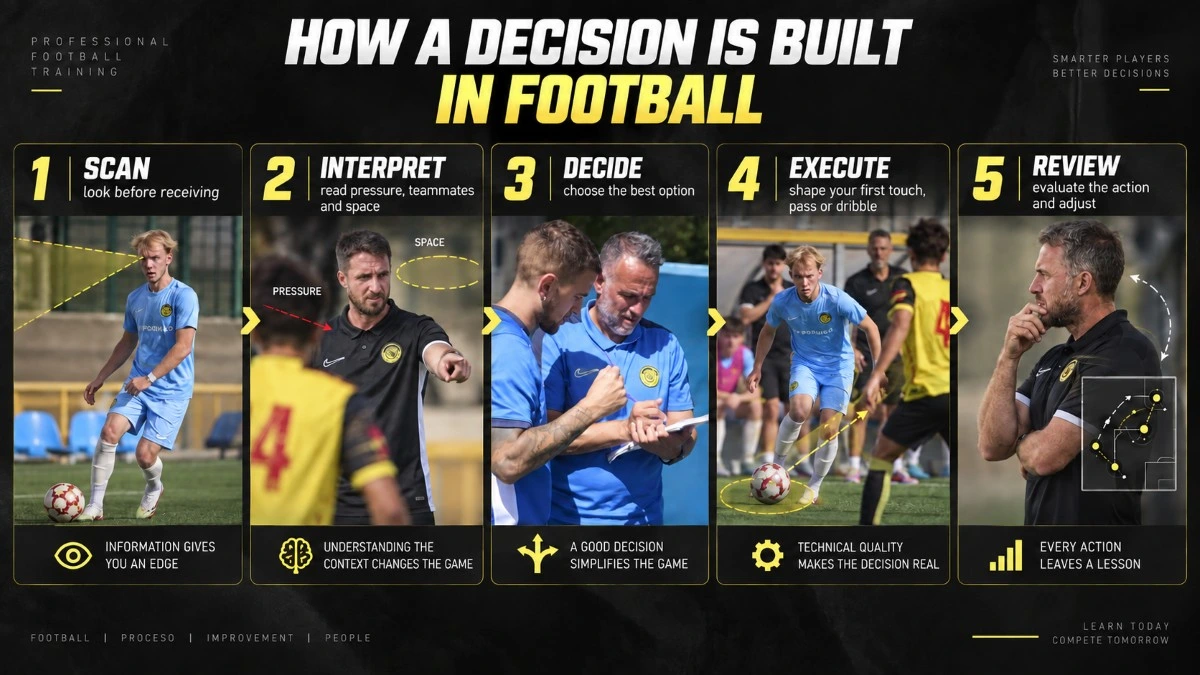
Scan → interpret → decide → execute → review
Each step affects the next. Looking does not guarantee understanding. Understanding does not guarantee a good decision. And a good decision does not guarantee accurate execution. Game vision does not replace technique: it relies on it.
What Does “Scanning” Mean in Football?
Scanning in football means deliberately looking away from the ball to gather information about your surroundings. That information may include approaching pressure, a teammate’s position, available space, an opponent’s location or the next action that may be available.
Scanning should not be trained as an empty movement. It is not about moving your head out of habit, but about looking with a clear purpose: understanding what problem is coming and what options are available to solve it.
That is why the important question is not only “how many times did the player scan?”, but “what information did they gather and what did they do with it?”
When Should You Scan Before Receiving?
There is no single correct moment. Information changes quickly, and a scan made too early may no longer be useful by the time the ball arrives.
In general, a player can gather information before a teammate receives the ball, while that teammate prepares the pass, while the ball is travelling and, if the play allows it, immediately after the first touch to update what is happening around them.
The greater the pressure, the less time there is to scan. That is why the skill is not about following a perfect sequence, but about gathering enough information without compromising the reception.
What Should You Look for Before Receiving?
Game vision improves significantly when a player learns to identify what to look for first. Not all information has the same value in every play.
Before receiving, it is usually useful to identify:
- where the pressure is coming from;
- whether there is space to turn or progress;
- which teammate offers a clear passing option;
- which opponent may be able to intercept a passing lane;
- and which action makes the most sense after the first touch.
In other words: seeing your surroundings is not enough; you need to distinguish which information should shape the decision. That priority changes depending on the position, the area of the pitch and the moment of the match.
Body Orientation Opens or Closes Options
Gathering information before receiving is of little use if the body is positioned in a way that limits almost every available option.
Body orientation is not a minor technical detail. It is the bridge between information and action. A well-oriented player can see more of the pitch, protect the ball more effectively, receive with the foot farther from the opponent, play forward with fewer touches or keep a safe outlet available.
That does not mean there is one “ideal” body position for every situation. Sometimes it makes sense to receive side-on or on the half-turn; at other times, protecting the ball first is the better option. The key is to orient the body according to the pressure, the type of pass and the real intention of the play.
The First Touch Is Also Part of the Decision
The first touch is often assessed as a purely technical matter, but it is also a decision.
A directional first touch can take the player away from pressure, move them into open space or prepare them to play immediately. By contrast, a clean but poorly directed first touch can force an extra touch, cost time or expose the player to pressure they had already identified.
That is why improving game vision is not only about seeing earlier, but about turning that information into a useful first action.
How Game Vision Changes by Position
Every position requires players to scan, but they are not always looking for the same information.
A center back will often prioritise the forward’s pressure, the height of the defensive line, central passing options and the risk of losing possession. A fullback needs to read the wide area, inside support and the right moment to move forward or play safely. Because of their position, midfielders often work with information coming from several directions: pressure from behind, spaces between the lines, nearby support and switches of play. Wingers and forwards need to read the defender’s position, the offside line and the right moment to receive to feet or attack the space in behind. For goalkeepers, reading the game combines the ball’s trajectory, defensive organisation, build-up options and the space behind the defensive line.
This matters because game vision should not be trained in exactly the same way for every player. Training tasks should reflect the real problems of each position.
How to Train Game Vision and Decision-Making
La visión de juego mejora cuando el entrenamiento obliga al jugador a percibir, interpretar y decidir dentro de situaciones representativas. No hace falta convertir cada sesión en una clase teórica. Hace falta diseñar contextos donde la información sea relevante.
Small-Sided Games With a Clear Objective
Small-sided games are useful because they increase the number of actions and decisions each player faces. However, reducing the space alone is not enough. The design needs a clear purpose.
For example, a drill with multiple goals can encourage the player to widen their attention. A neutral player can encourage the search for the free player. A scoring rule that rewards receiving between the lines can direct attention toward spaces that previously went unnoticed.
A constraint works when it helps solve a real problem, not when it makes the exercise artificial.
Progress From Simpler Tasks to Real Game Situations
In the early stages, an unopposed drill can help work on body orientation, control and the timing of the scan. But if the work stops there, the learning remains incomplete.
It makes sense to progress toward passive pressure, active opposition and situations with several possible solutions. The player needs to learn to scan and decide when the environment is no longer controlled.
Train With Questions, Not Only Instructions
Saying “scan before you receive” can be useful, but sometimes it is not enough. In many cases, it works better to guide attention with specific questions:
- which side is the pressure coming from?;
- can you turn?;
- which teammate is outside your initial field of view?;
- do you have a second option if the first one closes?
These questions turn observation into a tool for solving problems rather than a mechanical instruction.
Use Video to Reconstruct Decisions
Video analysis allows you to pause a play just before the reception and ask what information was available, what options existed and what the player ultimately did.
This type of review is useful because it separates three things that are often mixed together: the reading of the situation, the decision and the execution. A pass can end badly even when the reading was good. And a play that ends well can still hide a weak decision.
Watch a Player in the Same Position
Watching matches can also help, but it is better to do it with a clear focus. Instead of following the ball all the time, choose a player in your position and observe where they move, what they scan before receiving, how they orient their body and what they do immediately after passing.
This type of observation helps you recognise patterns without falling into superficial imitation.
Review One or Two Actions After Training
Post-training reflection does not need to be long. It is enough to choose one or two plays and ask simple questions: what information was missing, when it could have been gathered, whether body position limited the action, or whether the decision was appropriate even if the execution did not work.
That review is what turns experience into accumulated learning.
Training Decisions Does Not Mean Memorising Answers
One of the most common mistakes is believing that football intelligence means learning one fixed response for every situation.
In reality, football changes too quickly for that. The same action can be correct in one play and rushed in another. The opponent, the space, the time available, the location and the moment of the match all change the problem.
That is why the most useful training does not teach fixed recipes. It teaches principles: progress when there is an advantage, keep possession when the risk is not justified, attract pressure to free another space, play first-time when the information is sufficient, and use more touches when you need to protect the ball or wait.
You Can Train It Off the Pitch, but You Cannot Replace the Game
Yes, game vision can also be worked on away from the pitch. Video analysis, observing players in the same position, reviewing your own plays, tactical conversations and visualising familiar situations can all help you recognise patterns.
But this work complements on-field training; it does not replace it. A match includes variables that a screen cannot fully reproduce: real speed, pressure, fatigue, uncertainty and the need to execute. That is why any improvement seen off the pitch must later be confirmed in training tasks and matches.
Common Mistakes When Trying to Improve Game Vision
Several common mistakes can slow this development.
One is scanning only after receiving, when pressure has already reduced the available options. Another is counting scans without asking whether the information gathered was actually useful for the decision. It is also common to watch the ball too much and pay too little attention to spaces, opponents or the next action.
Another problem appears when the player decides too early and then fails to update the situation. Preparing an action is useful; holding on to it after the context has changed is not.
It is also worth avoiding two common oversimplifications: thinking that receiving side-on is always correct, or that deciding quickly always means playing one- or two-touch. Sometimes the best decision is simple and conservative. Sometimes it requires one more touch.
How to Know Whether Your Game Vision Is Improving
Improvement is not measured only by spectacular plays.
Signs of progress may include:
- you receive with more than one option available;
- you detect pressure from behind earlier;
- you lose the ball less often to opponents you had not seen;
- your first touch has a clearer purpose;
- you adjust your decision more effectively when the play changes;
- and you can explain more clearly what information you used.
Game vision is genuinely improving when that reading of the game also appears in matches, not only in controlled drills.

Training in a Different Football Environment
Changing environments can require a player to develop this type of game reading under greater demands. The speed of circulation, the intensity of the press, the time available to decide, teammates’ movements and the way the coaching staff provides feedback can all change.
For many international players, that change can become a valuable development opportunity when there is continuity, support and a serious adaptation process.
- In that context, resources such as Spanish football philosophy, what coaches and scouts look for, how to prepare for a trial in Spain or how to train football in Spain as an international player can help you make a more informed decision.
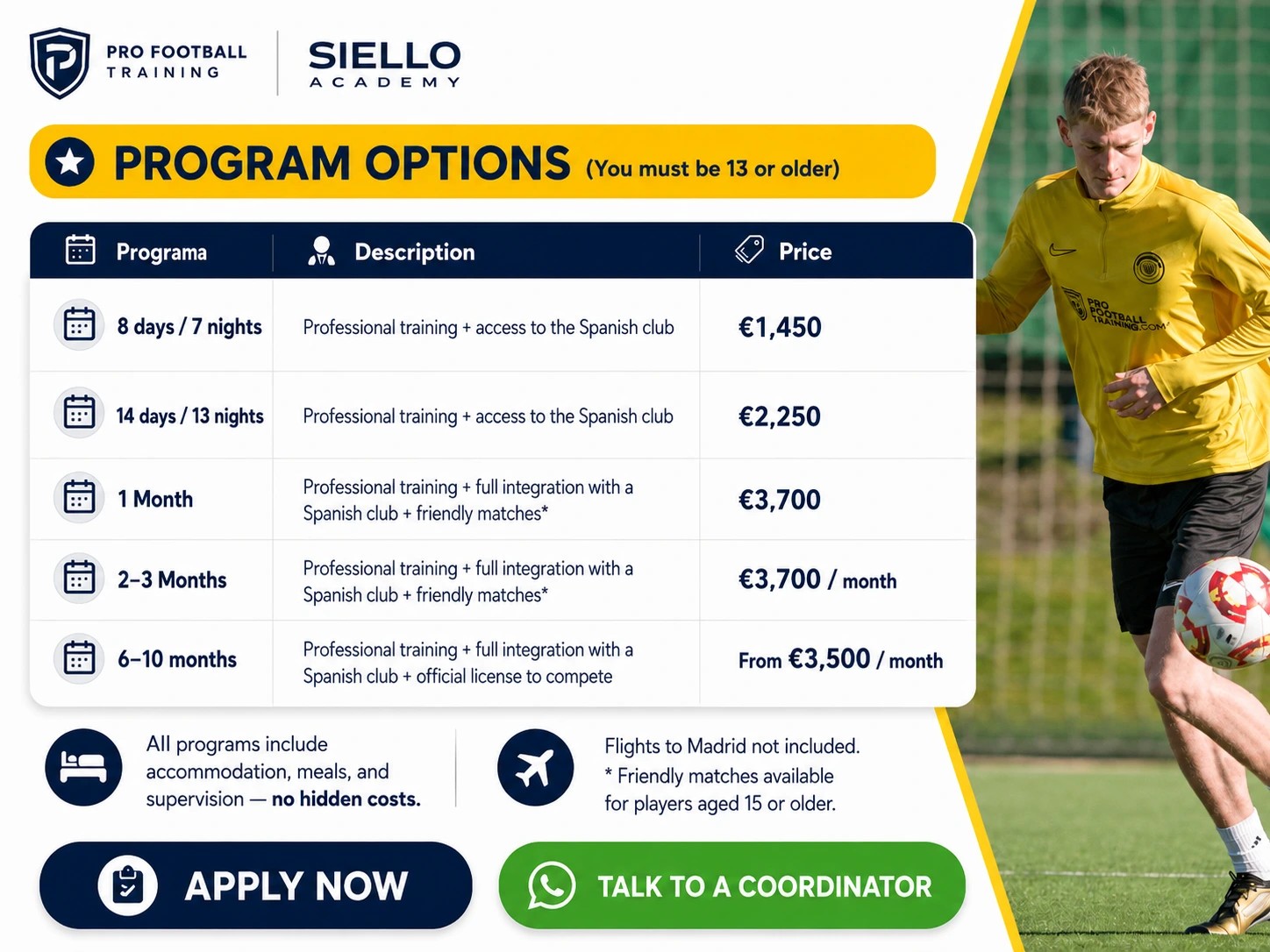
Pro Football Training offers programs in Madrid for international players who want to train within the Siello Academy environment. In longer programs, continuity makes it easier to observe how the player reads the game, adapts to the tempo and responds to more consistent technical and tactical demands.
Participation in short programs does not guarantee integration into Siello FC, playing time, professional representation or a professional contract. Certain players may be assessed for further stages depending on level, performance, age, category, eligibility, documentation, availability and the technical staff’s criteria.
Frequently Asked Questions About Game Vision in Football
Is Game Vision Innate, or Can It Be Trained?
It can be trained. There are individual differences, but abilities such as scanning, anticipation, pattern recognition and decision-making can improve through experience, representative training and feedback.
What Does Scanning Mean in Football?
It means deliberately looking away from the ball to gather information about teammates, opponents, spaces and possible actions.
How Many Times Should You Scan Before Receiving?
There is no universal number. The timing and usefulness of the information matter more than the number of head movements.
How Can You Improve Football Intelligence?
Small-sided games, video analysis, observing players in the same position and tasks that require decisions under pressure can all help.
Does Body Orientation Improve Game Vision?
Yes, because it can widen the field of view and keep more options open, although the right body position always depends on the context.
Does Playing One- or Two-Touch Mean Making Better Decisions?
Not necessarily. Sometimes it does; at other times it is better to protect the ball, wait or use an extra touch. The quality of the decision depends on the situation.
Does Watching Matches Help?
Yes, especially if you watch with a clear objective and follow a player in your position instead of focusing only on the ball.
Does Technique Affect Decision-Making?
A great deal. A player usually chooses from the solutions they feel capable of executing. The more technical tools they have, the more real options they can use.
Playing Before You Receive
Improving game vision is not simply about getting your head up. It is about getting to the information earlier and turning it into a useful action.
A player needs to observe, interpret, anticipate, orient the body and decide. Afterwards, they need to review what happened to keep refining their reading of the game. That process does not automatically turn anyone into an elite player, but it does improve something important: the ability to recognise the problem earlier and keep more options available to solve it.
In football, the player who makes the most spectacular play is not always the one making the best decision. Often, it is the player who understands what is happening earlier.
Do You Want to Work on Your Game Reading in a Different Football Environment?
Explore the programs offered by Pro Football Training and Siello Academy in Spain. The initial assessment takes into account the player’s age, experience, position and goals before an option is recommended.
