
Before a football match, the most practical option is usually a familiar, easy-to-digest meal with a clear source of carbohydrates, eaten with enough time before playing.
As a general guide, the main meal can be eaten around three to four hours before kick-off. If there is less time, it makes more sense to reduce the portion size and, if hunger appears, have a simple snack rather than trying to fit in a large meal.
That is the short answer.
The answer that actually works for the player depends on several factors: what time the match starts, how long they normally take to digest food, which foods they tolerate, how well hydrated they are, the temperature and how much nerves affect their appetite.
There is no perfect pre-match menu for everyone.
Pre-match nutrition cannot compensate for a week of poor sleep, insufficient food or inadequate hydration either. The goal is much more specific: to reach the warm-up with energy available, without feeling hungry and without feeling excessively full.
Important: this guide provides general information. It does not replace an individual assessment by a sports dietitian, paediatrician, doctor or other qualified healthcare professional. Minors and players with allergies, diabetes, digestive disorders or other medical conditions need recommendations adapted to their situation.
Why are carbohydrates important before playing?
Football combines continuous running with accelerations, changes of pace, jumps, duels, decelerations and decisions that need to be made quickly. To meet those demands, the body uses different energy sources. One of them is glycogen, stored mainly in the muscles and liver.
Carbohydrates help keep those stores available. That is why familiar foods such as rice, pasta, potatoes, bread, oats, corn tortillas or fruit often appear in pre-match meals.
UEFA’s expert statement on nutrition in football uses a carbohydrate-rich meal around three to four hours before competition as a general reference and emphasises two points that are particularly important here: the strategy should be adapted to the player, and digestive comfort matters as much as following a nutritional formula on paper.
That does not mean eating only carbohydrates.
A pre-match meal can also include a moderate amount of protein, fluids and other familiar foods. What changes as kick-off approaches is the volume: the less time there is to digest, the less sense a heavy meal makes.

Nutritional preparation does not start with the final meal
Focusing only on what you eat three hours before the match can lead to a fairly disorganised approach.
If a player reaches matchday after eating too little, restricting food, sleeping poorly or drinking too little, a large plate of pasta will not automatically solve the problem.
- The day before, it is better to maintain a normal and sufficient food intake.
There is no need to invent a “footballer’s dinner”. A familiar combination of rice, pasta, potatoes, bread or tortillas with a protein the player tolerates, usual vegetables, water and some fruit or yoghurt can fulfil that role perfectly well.
It is also not the right time to start a diet, skip meals to feel lighter or use extreme carbohydrate-loading strategies without professional supervision.
This is even more important for adolescents. Young players do not eat only to compete: their nutrition also needs to support growth, development, school, daily life, training and recovery. Recent literature on youth sports nutrition stresses the importance of individualising needs and avoiding treating an adolescent as a smaller version of an adult athlete.
¿Cuánto tiempo antes de un partido hay que comer?
Timing is probably the easiest way to organise the decision.
| Time before kickoff | Main priority | Practical examples |
| 3–4 hours | Familiar, balanced main meal | Rice with chicken, pasta with a mild sauce, potatoes with eggs, tortillas with chicken |
| 1–2 hours | Simple snack if the player is hungry | Yogurt with fruit, bread with fresh cheese, banana, soft oatmeal |
| Less than 1 hour | Small, easy-to-tolerate option only if needed | Ripe fruit, white bread, applesauce, or a familiar drink |
| Final minutes | Avoid large meals and excessive drinking | Small sips of water according to need |
These timings are guidelines, not universal rules.
One player may feel perfectly comfortable three hours after a meal that still feels heavy for another. That is why a pre-match strategy should be tested first in training or lower-stakes matches, rather than introduced for the first time at an important trial.

Three to four hours before the match:
This is usually the most comfortable window for the main meal. The base can be rice, pasta, potatoes, bread, oats or tortillas. It can be accompanied by chicken, fish, eggs, yoghurt, fresh cheese, tofu or another familiar protein in an amount the player digests well.
- There is no need to fill the plate with “sports” ingredients.
A simple chicken-and-rice meal can work well. So can pasta with a light sauce, tortillas with chicken, potatoes with eggs or, if it is breakfast, oats with fruit and another familiar accompaniment.
The player should finish satisfied, not excessively full.
One to two hours before
If the main meal was planned well, there may be no need to eat again.
If hunger returns, a small and familiar option is usually enough: a banana, yoghurt with fruit, some bread, fruit purée or a small sandwich, for example. At this point, tolerance matters more than trying to find “the best snack”.
When there is less than an hour to go
The closer you are to the warm-up, the less time there is to digest a full meal.
If you are not hungry, there is no need to eat simply because you feel you should. If the player needs something, a small option they already know is more sensible.
The aim is not to add energy at any cost. It is to avoid going onto the pitch hungry without creating a new digestive problem.
What should a good pre-match meal include?
Instead of memorising an endless list of foods, it is easier to think in terms of three questions.
Is there a clear source of carbohydrates?
Rice, pasta, bread, oats, potatoes, tortillas or fruit can fulfil that role depending on the timing and the player’s usual habits.
Is the meal a volume and composition that I normally tolerate?
A small amount of protein can be part of the meal. What you want to avoid is turning it into a huge serving of meat, fat or other foods that are very difficult to digest.
Have I eaten this before training or competing?
This last point may be the most important of all.
Matchday is not a laboratory. A food can look nutritionally perfect on paper and still be a poor choice if it causes reflux, gas, nausea or a feeling of heaviness.
What should you eat if the match is in the morning, afternoon or evening?
The schedule changes the organisation far more than the foods themselves.
- If you play early
Preparation starts the night before. A sufficient evening meal means breakfast does not need to become a huge meal first thing in the morning.
For someone with little appetite in the morning, a small and familiar breakfast —for example oats, bread, fruit or yoghurt— may be more comfortable than forcing down a plate they can barely tolerate.
- If you play around midday
Breakfast will probably be the main pre-match meal.
The typical mistake here is not only eating “poorly”, but eating too little at breakfast and becoming hungry an hour before the match, when there is little time left to fix it.
- If you play in the afternoon
There is time to have a normal breakfast and an early lunch.
That extra time does not mean lunch should be enormous. A simple meal based on rice, pasta or potatoes, with a moderate amount of protein and familiar foods, usually makes more sense than something heavy.
- If you play in the evening
You do not need to go hungry all day to “save room”.
Breakfast and lunch are still part of the day. The pre-match meal can then be organised during the afternoon and, if necessary, followed by a small snack.
It is also worth planning what happens after the match. Finishing late should not mean forgetting to eat and rehydrate altogether.
How should you hydrate before playing football?
Hydration works better when fluids are spread across the hours before the match rather than trying to fix everything at once.
Drinking very large amounts immediately before the warm-up can cause heaviness, nausea and frequent trips to the bathroom. A more sensible strategy is to reach matchday well hydrated and continue drinking progressively before playing.
Needs vary with body size, temperature, humidity, intensity, sweat rate and activity duration. In football, current research and expert guidance also recommend planning hydration around the context and individual fluid losses rather than relying on one identical number for everyone.
For young players, this individualisation is especially important.
Water, sports drinks and energy drinks are not the same thing
In many situations, water will be enough. A sports drink usually contains water, carbohydrates and electrolytes and may have a specific role during prolonged activity, very hot conditions, high sweat losses or days with multiple training or competition demands.
An energy drink is different. It usually contains caffeine and other stimulants and should not be treated as the same thing as a sports hydration drink.
The American Academy of Pediatrics explicitly distinguishes between these products and considers stimulant-containing energy drinks inappropriate for children and adolescents; sports drinks also have a much more limited role for young people than the marketing around these products may suggest.
What should you avoid before playing?
The aim is not to divide foods into “good” and “bad”. It is to avoid decisions that unnecessarily increase the risk of discomfort when there is little time left before competition.
A very large meal, fried foods, unusually high amounts of fat or fibre, very spicy dishes, heavy sauces or foods that have caused discomfort before are usually poor choices close to kick-off.
- It is also sensible to avoid alcohol, energy drinks and any new supplement or product.
That does not mean removing vegetables, fats or fibre from the daily diet. The issue is timing, quantity and individual tolerance.
It is also not a good idea to copy exactly what a professional footballer eats on social media. That photo does not show their body size, training load, digestive history, schedule, weekly plan or whether they are working with a sports nutrition professional.
What if nerves reduce your appetite?
Pre-match nerves can make a normal meal feel much bigger than usual. In that situation, forcing the player to finish the plate is rarely helpful.
It may be more practical to eat earlier, reduce the portion size, split the intake into two moments or choose a lighter option the player has already used before. The important thing is not to turn eating into another source of pressure.
And if nerves are the main issue, food should not be the only place you look for a solution. Routine, rest and mental preparation also matter. That is why this article should link directly to our guide on how to manage nerves before a football match or trial.
Is it a good idea to play fasted?
For most players, arriving at a demanding match after many hours without eating is not a strategy we should encourage as a general rule.
This is particularly important for young footballers. Playing fasted should not be used as a way to control weight, look leaner or try to feel “faster”. Concerns about weight, body composition or a problematic relationship with food require a different kind of professional support.
If the match is very early and the player has little appetite, the answer does not have to be a huge breakfast either: it may be more useful to organise the night before better and find a small option the player can comfortably tolerate.
Coffee, supplements and “pre-workout” products
They should not be the starting point. A footballer does not need a powder, capsule, gel or pre-workout product to prove that they are preparing seriously.
- UEFA’s expert statement itself promotes a food-first approach: nutrition, hydration, recovery and organisation come first; if there is a genuine need after that, any supplement should be assessed individually.
The same principle applies to caffeine: an important match is not the time to experiment. For minors, coffee, caffeinated drinks or stimulant products should not be used as a performance strategy without professional assessment.
Supplements also introduce an anti-doping issue. WADA continues to include supplement-related risk in athlete education and identifies contamination or inaccurate labelling as possible sources of unintended exposure to prohibited substances.
For a player subject to anti-doping controls, “my teammate takes it” or “I saw it on TikTok” are not safety criteria.
A simple check before leaving
You do not need a twenty-point checklist. Before heading to the pitch, simply check that you have eaten something familiar, allowed enough time to digest, included a clear source of carbohydrates, do not feel excessively full, have hydrated during the previous hours and have not introduced any new product.
That is usually more useful than searching for a supposed miracle food.
Learning how to eat is also part of learning how to compete
Nutrition does not replace technical, tactical, physical or mental training. It is part of a player’s ability to sustain that training.
When an international footballer arrives in Madrid, adaptation does not happen only on the pitch. The player also needs to learn how to organise schedules, rest, recovery, meals, travel and daily preparation within a more demanding environment.
Pro Football Training, a platform within Siello Academy, is part of Siello Football Group, an ecosystem dedicated to the long-term development of footballers in Europe.
Within that structure, Siello Academy is responsible for training, methodology and the demands of daily development. We are not saying that the programme includes an individual nutrition service: the relevant point here is that player development depends on habits that can sustain the process, not only on what happens during the 90 minutes.
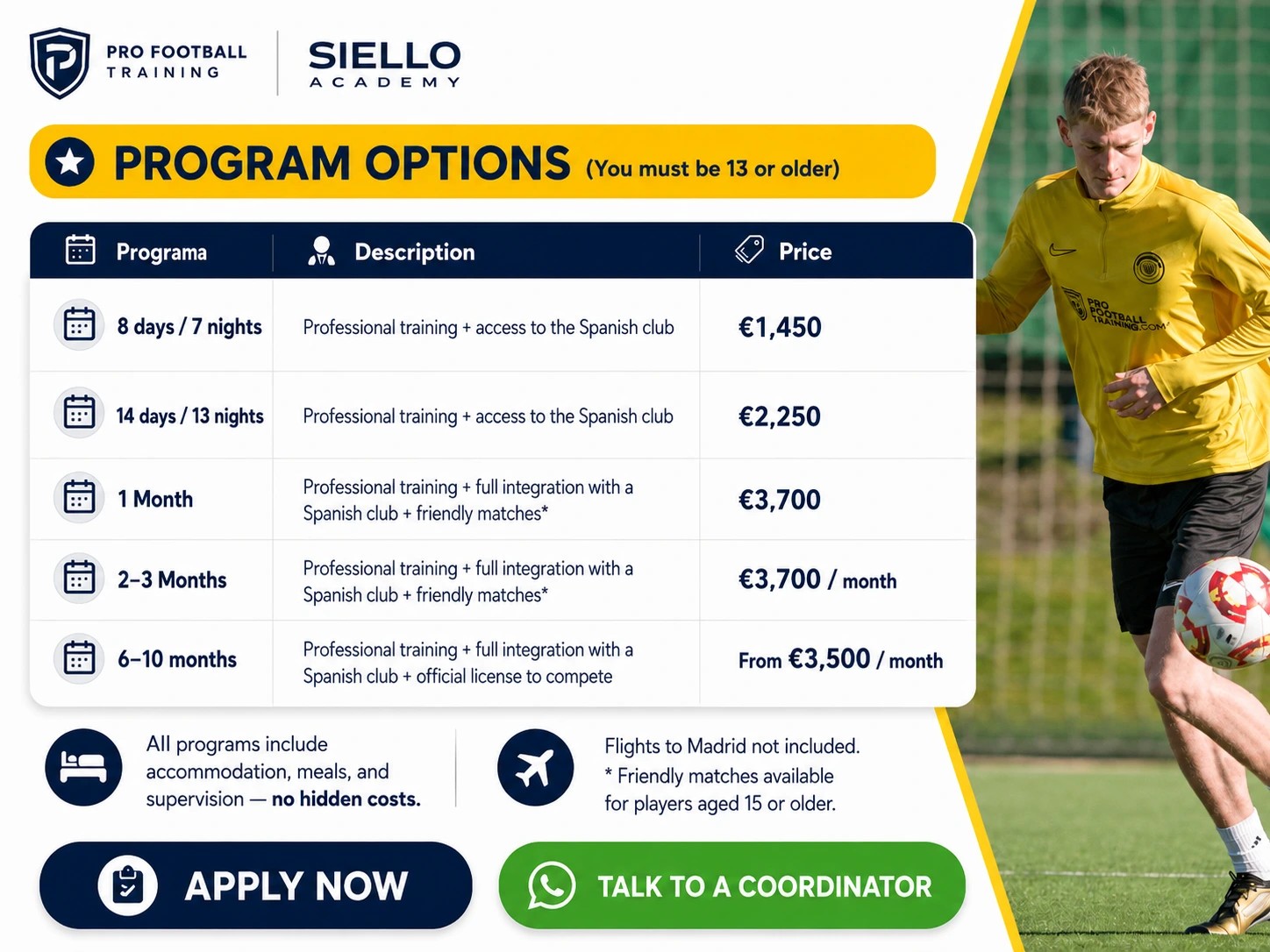
If you are considering training in Spain, the logical next step is not to search for a “professional” diet, but to understand what type of environment and programme duration fit your current stage as a player.
Explore which Pro Football Training programme fits your level, age and goals.
Frequently asked questions about what to eat before a football match
What should you eat three hours before a football match?
A familiar meal with a clear source of carbohydrates —for example rice, pasta, potatoes, bread or tortillas— can be accompanied by a moderate amount of protein and fluids. The important thing is that the portion feels comfortable and that the player already knows they tolerate it well.
What should you eat for breakfast before a morning match?
It depends on how much time there is before the match. Oats, bread, fruit, yoghurt, eggs or other familiar foods can be part of breakfast. When the match is very early, the evening meal the day before becomes more important.
Is a banana good before playing football?
It can be a practical option because it provides carbohydrates and is easy to carry, but it does not have a special or “magical” effect. It is useful if the player tolerates it and it fits the timing of the meal.
How long before a match should you eat?
As a general guide, the main meal often works well around three to four hours beforehand. A simple snack can be used one to two hours before if hunger appears. With less time available, the portion should be much smaller.
Is it better to play fasted?
It is not generally a strategy we would recommend for a demanding match, especially for young players. If a footballer finds it difficult to eat early, it is better to work on timing and identify options they tolerate well.
Is it good to drink coffee before a match?
There is no universal recommendation. It depends on age, habitual intake, individual sensitivity and medical context. Matchday is not the time to experiment with caffeine and, for minors, any caffeine-based performance strategy should be professionally assessed.
Water or a sports drink?
Water is sufficient in many situations. A sports drink can have a specific role when activity is prolonged, conditions are very hot or sweat losses are high. An energy drink containing stimulants is a different product and should not be used as a hydration drink.
What can a player eat if nerves reduce their appetite?
Eating earlier, reducing the portion size or using a light option that has already been tested can help. A player should not be forced to eat a large meal if nerves are making digestion difficult.
What foods should you avoid before playing?
Above all, avoid foods the player is unfamiliar with or that have caused discomfort before, as well as excessively large or heavy meals close to kick-off. Energy drinks and new products or supplements are also best avoided.
Does eating correctly guarantee that you will play better?
No. Nutrition can help a player arrive with enough energy and reduce avoidable problems, but performance also depends on training, rest, health, tactical context, decision-making and many individual variables.