
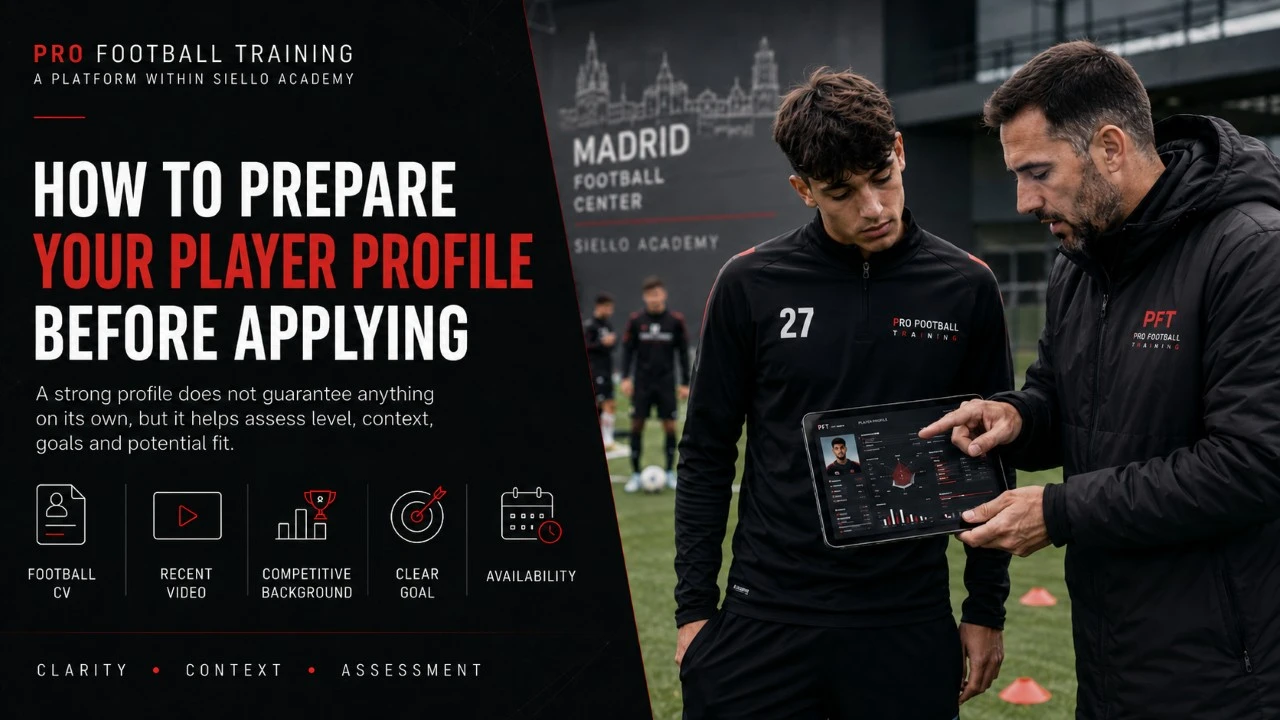
Many players want to apply to a football academy in Europe, but not all of them have a profile that allows their level to be assessed seriously. Some send only a video. Others send a short message with age and position. Others send a football CV that is too long, unclear or full of information that does not help explain how they actually play.
Before applying, the first step is not trying to impress. It is presenting clear information.
A player profile for a football academy should include basic personal data, age, position, height, dominant foot, current club, competitive background, recent video, goals, availability and player context. A strong profile does not guarantee acceptance, but it helps assess level, timing and possible fit with the program.
Pro Football Training and Siello Academy, are part of Siello Football Group, an ecosystem dedicated to the long-term development of footballers in Europe. We use this information to understand the player’s profile before recommending a format or duration. Not every player needs the same pathway. And no profile, no matter how well prepared, should be presented as a guarantee of a signing, contract or sporting success.
What is a player profile and what is it for?
A player profile is the package of information that helps an academy understand who you are as a footballer before seeing you train in person. It is not only a CV. It is not only a video. It is not only a list of achievements. It is an organized presentation of your football context.
It helps answer basic questions:
- who you are;
- how old you are;
- what position you play;
- where you currently compete;
- what your real level may be;
- what experience you have;
- how you look on video;
- what your objective is;
- when you are available to travel;
- what type of program may make sense.
For a European academy, this information supports an initial reading. It does not define your full ability, but it helps organize the first assessment.
FIFA’s talent identification framework explains that player profiles can include technical, tactical, physical, psychological and social attributes, using both objective and subjective measures to understand whether a player fits a specific context.
That matters because a serious academy should not evaluate only one action or one statement. It should try to understand the full profile.
Basic information that should not be missing
An incomplete profile forces people to guess. And when an academy has to guess, the evaluation becomes less precise.
Basic information should include:
- full name;
- date of birth;
- nationality;
- country and city of residence;
- primary position;
- secondary positions;
- dominant foot;
- positional height;
- weight, when relevant;
- current club, academy or team;
- current category or league;
- years of competitive experience;
- languages spoken;
- approximate availability to travel;
- football objective;
- player or family contact, depending on age.
This information does not need to be decorated. It needs to be clear.
A common mistake is writing too much about motivation and too little about useful information. Phrases such as “I want to make my dream happen” or “I am willing to do anything” do not help as much as a precise profile, recent video and honest explanation of the competitive context.
Motivation matters, but it does not replace data.

Football CV: what to include and what to avoid
The football CV is one part of the profile. Its role is to organize your background so the person evaluating you can understand your pathway quickly.
A good football CV should include:
- basic player data;
- position and football profile;
- previous clubs or academies;
- current club or academy;
- category;
- leagues or tournaments played;
- relevant achievements;
- real and verifiable statistics, if available;
- coach references, if they exist;
- video link;
- availability and objective.
What to avoid:
- exaggerated statements;
- achievements without context;
- information that cannot be verified;
- overloaded design;
- long paragraphs;
- promises about your future;
- comparing yourself to professional players;
- unnecessary personal information;
- exaggerating your level, category or experience.
A football CV should not try to sell a fantasy. It should help explain your trajectory.
Highlight video: what to show and what not to exaggerate
Video is one of the most useful tools for a first assessment, especially when the player is in another country. But a poorly prepared video can create an incomplete reading.
A good video should show:
- recent actions;
- the player’s real position;
- actions on the ball;
- off-ball movement;
- defensive actions, when relevant;
- decision-making;
- intensity;
- match context;
- level of the opponent, when possible;
- reasonable duration;
- clear image quality;
- identification of the player in each action.
What the video should not do:
- show only goals;
- use too many effects;
- hide the context;
- cut every action before the decision is complete;
- mix very old clips with current ones without clarifying dates;
- exaggerate the level of the tournament;
- use music or editing that distracts;
- show only actions where everything goes well.
A highlight video does not guarantee acceptance. It also does not replace an on-pitch evaluation. It starts the assessment.
FIFA includes video scouting and player observation as part of structured identification systems, alongside data analysis and broader scouting processes. That confirms video can help, but it should not be the only basis for the decision.
Competitive history and player context
Competitive history helps explain where the player has developed and what level he competes against. Not every club, league or tournament has the same demands. That is why saying “I play for a club” is not enough. The context should be explained.
Useful details include:
- current club or academy name;
- category;
- league or tournament;
- training frequency;
- match frequency;
- whether the player starts regularly or rotates;
- usual position;
- approximate competition level;
- relevant club changes;
- previous international experience, if any;
- recent injuries if they affect the process.
This is not about inflating the background. It is about making it understandable.
A player competing in a local league may still have a serious profile if he shows habits, level and adaptability. A player from a more recognized club still needs to show performance, discipline and response capacity.
Context does not replace performance, but it helps interpret it.
Objective, availability and possible duration
A player profile should also explain what the player is looking for. Applying for a first immersion is not the same as applying for a full-season program.
The objective may be:
- training in Europe for the first time;
- assessing adaptation;
- improving level;
- experiencing a football immersion;
- preparing for a longer pathway;
- seeking stronger exposure;
- evaluating whether a Spain-based academy makes sense;
- moving toward a deeper competitive stage.
Availability matters too. A player who can travel only for 8 or 14 days should not expect the same process as a player who can stay 1 month, 3 months or a full season.
Duration is not only a calendar issue. It defines what can be assessed seriously. A short stay can show initial adaptation. A medium stay can show more continuity. A full-season program may allow for a deeper process, always depending on age, documents, level and performance.
Documents and sensitive data: what to clarify and what not to publish
When an international player applies to an academy in Europe, it can be useful to clarify nationality, country of residence and general document availability. But that does not mean the player should publish sensitive information in an open profile, message or form.
At the first stage, it may be enough to indicate:
- nationality;
- country of residence;
- whether the player has a valid passport;
- whether the player has a European passport, only if relevant;
- approximate availability to travel;
- whether the player is a minor and would travel with family authorization;
- possible duration of stay.
There is no need to publish passport numbers, private documents, full addresses or sensitive personal data in an open profile. That information should only be shared through secure channels and when it is genuinely necessary.
Players should also avoid a wrong expectation: having documents ready may help with logistics, but it does not guarantee sporting acceptance, official competition, visa approval or signing.
Strong profile vs incomplete profile
| Element | Strong player profile | Incomplete profile |
| Basic data | Age, nationality, residence, height, foot, position | Only name and age |
| Position | Clear main and secondary positions | “I play everywhere” without precision |
| Background | Current club, category, league and experience | “I have played for several teams” |
| Video | Recent clips, context and player clearly identified | No date, no position, only goals |
| CV | Organized and verifiable pathway | Long, unclear or exaggerated text |
| Objective | Explains what the player is looking for and why Europe | Only “I want to become a pro” |
| Availability | Approximate dates or duration | No timing information |
| Documents | Nationality and general document context | Unnecessary sensitive data or no context |
| Tone | Clear, serious and honest | Exaggerated, emotional or vague |
This table does not mean you need a perfect profile to apply. It means that the clearer the information, the better the initial assessment can be.
Common mistakes when applying to European academies
Many players make mistakes that can be avoided before sending their profile.
The most common ones are:
- sending only a WhatsApp message without data;
- sending a video without age or position;
- using an over-edited highlight reel;
- exagerar categoría o logros;
- exaggerating category or achievements;
- not explaining the current club;
- not indicating availability;
- asking for “a trial” without context;
- confusing academy, club, agency and signing;
- promising to “give everything” without showing concrete information;
- sharing sensitive personal data too early;
- assuming that a good video guarantees a positive response.
A serious profile does not need to sound grand. It needs to be useful.
If an academy has to ask too many basic questions before understanding who you are, the profile is not ready yet.
How we use this information for a profile assessment
At Pro Football Training and Siello Academy, ,we use the player’s information to understand whether there may be a fit between profile, age, objective, duration and structure.
We look at details such as:
- age;
- position;
- competitive level;
- background;
- video;
- maturity;
- availability;
- objective;
- possible duration;
- family context;
- ability to adapt.
This assessment does not guarantee acceptance or sporting outcomes. It does not guarantee a club, contract, representation or playing minutes. It helps identify which step may make more sense.
For some players, that may be a short stay. For others, a medium duration. For others, a longer season. And for some, the best recommendation may be to prepare the profile better before travelling.
The structure creates a training, integration and assessment environment. The player must respond with performance, discipline and adaptation.
Checklist before sending your player profile
Before sending your profile, check whether you have:
- basic personal data;
- main and secondary positions;
- height and dominant foot;
- current club or academy;
- category and league;
- competitive background;
- updated football CV;
- recent video;
- clear football objective;
- availability to travel;
- possible duration;
- nationality and country of residence;
- general document situation;
- correct contact information;
- realistic expectations about the process.
This checklist may look simple, but it makes a difference. A player who presents information clearly makes assessment easier. A player who presents information in a disorganized way forces others to rebuild the profile from zero.

Conclusion: a strong profile does not guarantee, but it organizes the process
Preparing your player profile before applying to a football academy in Europe is not a minor step. It is the first filter that allows a structure to understand who you are, where you are, what you are looking for and what type of program may make sense.
A strong profile does not guarantee a positive response, acceptance, club or contract. But it helps reduce confusion, organize expectations and start the conversation more seriously.
If you want to understand the right next step for your case, start by preparing your information clearly.
Discover the right next step for your case
Request a profile assessment.
FAQs
What should a player profile include?
It should include basic data, age, nationality, position, height, dominant foot, current club, category, competitive background, recent video, football CV, objective, availability and general player context.
Do I need a football CV to apply to an academy in Europe?
Yes, it is recommended. A football CV helps organize your trajectory, clubs, category, experience and key data. It does not replace video or evaluation, but it supports an initial profile reading.
What should a highlight video show?
It should show recent actions, real position, on-ball and off-ball actions, decision-making, intensity, defensive actions when relevant and enough context to understand the level of the match.
Can I apply only with a video?
You can start a conversation with video, but it is better to include basic data, position, age, current club, competitive history, objective and availability. A video without context may not be enough.
Does sending my profile guarantee a response or acceptance?
No. Sending a profile does not guarantee acceptance, a positive response, signing or contract. It helps begin an assessment and understand whether there may be a fit between your profile, objective and the type of program.