

In Spain, youth football is organised by age categories, usually based on the player’s year of birth and the sporting season. For an international footballer, understanding this structure helps set realistic expectations: training, joining a club environment, playing friendly matches and competing officially are not the same thing. The right pathway depends on the player’s age, level, programme duration, documentation and ability to adapt to the Spanish football environment.
From that perspective, age matters, but it does not explain everything. The player’s actual level, maturity, position, adaptability, available time and the family’s objective also play an important role.
Why Spanish youth football age groups matter for international players
Many international families think in terms of U15, U17 or U19. In Spain, those references can help, but the system commonly uses categories such as infantil, cadete, juvenil and aficionado/senior.
That difference matters.
A player may be a certain age in his home country and still need to be evaluated in Spain according to year of birth, sporting season, federation category and type of registration. Before thinking about official competition, the first step is to understand where the player fits and what can realistically be expected at that stage.
For families, this is not only about knowing which team a player might train with. It is about understanding whether the player is in a development stage, an adaptation stage, an advanced youth competition stage or a transition toward adult football.
Pro Football Training y Siello Academy At Pro Football Training, and Siello Academy, we work with international players through a process-based approach inside the Siello Football Group ecosystem. Age matters, but it does not explain everything. Level, maturity, program duration, adaptation and eligibility to compete when applicable also matter.
How youth football in Spain is structured by age
Spanish youth football is generally structured through age categories that group players by development stage. There may be variations depending on the season, regional federation, year of birth, competition rules and registration context, but the general structure helps families understand the player’s position.
Football base and development stages
The early categories, such as debutante, prebenjamín, benjamín, alevín and infantil, are part of the development base. These stages build technical habits, game understanding, coordination, relationship with the ball, decision-making and first collective behaviors.
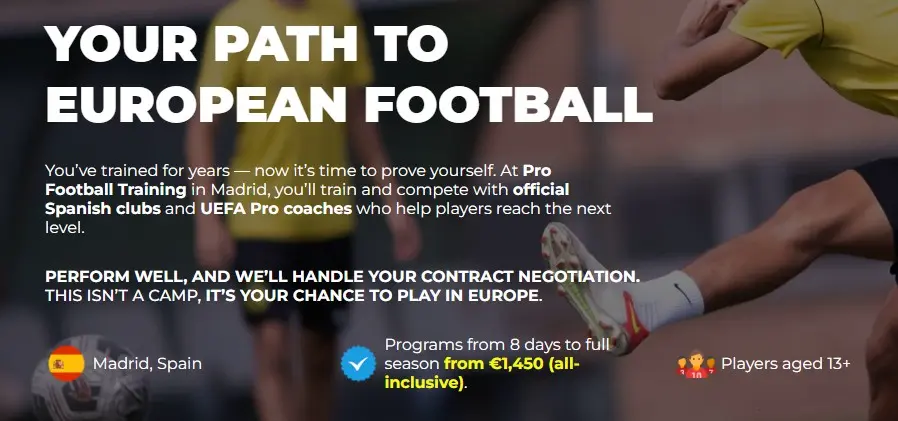
For Siello Academy, the visible program entry point is for players over 13 years old. In practical terms, many international players evaluating a football training program in Madrid enter from the infantil, cadete or juvenil stages.
At infantil level, the player starts to face clearer tactical, physical and behavioral demands. It is no longer only about technical ability. Players must begin to understand space, roles, tempo, intensity and corrections within a collective structure.
Cadete category
Cadete is usually a key stage for players around 15 and 16, although the exact reference should always be checked according to the season. At this point, football requires more continuity, discipline, adaptation and the ability to sustain tempo.
For an international player, this stage can be useful to understand how he responds outside his usual environment. The football language, ball speed, pressure after loss, tactical reading and training intensity may be different from what he knows.
In certain formats, and when applicable, friendly matches may make more sense for players over 15. Still, they should not be assumed automatically. They depend on the program, context, calendar, player level and applicable conditions.
Juvenil category
Juvenil is the stage before adult or senior football. It is much more demanding because the player is no longer evaluated only through potential. Performance, game reading, competitive maturity, position, regularity and emotional response to the environment become more important.
For an international player at juvenil age, coming to Spain should not be treated as a single isolated trial. Timing matters. A short-stay program can help observe level and initial adaptation, but a deeper pathway may require continuity, structure and a more precise conversation around documentation, competition and goals.
Orientation table: Spanish youth football categories
This table should be read as a general guide, not as definitive federation advice. The exact category may vary depending on the season, federation, year of birth, modality, applicable rules and type of registration.
| Spanish category | General age reference | Practical meaning for international families |
| Debutante | 5–6 | First football initiation stage |
| Prebenjamín | 7–8 | Early football base |
| Benjamín | 9–10 | Initial technical development |
| Alevín | 11–12 | Transition toward a more structured collective game |
| Infantil | 13–14 | Beginning of clearer tactical, physical and habit-based demands |
| Cadete | 15–16 | Key competitive development and adaptation stage |
| Juvenil | Pre-senior youth stage | High-demand stage before adult football |
The table helps organize the conversation, but it does not replace an individual case review. Two players of the same age may need different routes depending on level, position, maturity, competitive background and available time.
What changes when a player comes from another country
An international player does not only enter another age group. He enters another football language, another training rhythm, another correction culture and another way of competing.
Age and year of birth
Age is not interpreted only by the player’s birthday on the day of arrival. In Spain, the reference may be linked to the year of birth and the sporting season. A family should not assume the category without checking the player’s birth year and the applicable calendar.
This becomes especially important when the player is close to a transition: from infantil to cadete, from cadete to juvenil or from juvenil to adult football.
Competitive rhythm
Rhythm does not only mean running more. In Spanish football, rhythm appears in decision speed, pressure, body orientation, use of fewer touches, reading of space and the ability to stay focused throughout the session.
A player who stands out in his country may still need time to adapt if he comes from a context where the game is interpreted differently. That does not mean he lacks level. It means he must learn to respond in a different environment.
Tactical adaptation
Tactical adaptation is often one of the most important filters. In Spain, many training environments work on space occupation, support, shifting, pressure, build-up play, transitions and decision-making in reduced spaces.
The international player must understand that individual talent is not enough. He needs to show that he can learn, correct, interpret instructions and sustain performance within a collective structure.
Documentation and the possibility of official competition
Training in Spain is not the same as competing officially. Official competition may involve federation, documentation, immigration and authorization requirements, especially when the player is an international minor.
This does not mean an international player cannot experience a serious immersion, train, integrate into a Spanish club environment or receive a real assessment. It means official competition should never be presented as automatic.
Why age matters for training, friendlies and official competition
Age matters because not every experience has the same scope. A player can train, adapt and go through a football immersion experience without that necessarily meaning official competition. However, one of the most common mistakes is to treat these ideas as if they were equivalent.
- Training in a club environment means experiencing methodology, rhythm, teammates, corrections, demands and collective dynamics. It is a central part of the immersion, but it is not the same as having an official competition license.
- Playing friendlies means participating in matches that are not necessarily official. Friendlies can help observe adaptation, competitive rhythm and decision-making when the format, age and conditions allow it.
- Competing officially is another layer: registration, license, category, club, calendar, regulations and applicable documentation. Long-stay programs may provide more space to work on this dimension, but it should never be presented as a universal promise.
This distinction protects both the player and the family. If a family expects official matches during a short-stay program, the expectation may be misaligned. If the goal is to understand the player’s level and adaptation capacity, an initial immersion can make sense.
Program length also matters. A short stay may help the player train, adapt and understand the rhythm. A one-to-three-month stay may provide more continuity and a deeper reading of the player. A full-season program may create a broader environment for integration and competition, always within the applicable conditions.
En In our programs, friendlies must be communicated carefully: they may be available when applicable, and the age factor matters, especially for players over 15 in certain formats. Not every player and not every program involves friendlies or official matches.
The rule is clear: official competition should not be promised across all formats. Competition depends on the case.
What International Players Can Expect at Different Ages
An international player should not expect the same thing at 13, 15, 17 or after 18. Each stage has a different logic.
- A 13- or 14-year-old player is usually in a phase where adaptation, habits, tactical understanding and maturity are as important as immediate performance. For this profile, a Spain-based experience may help observe how the player responds outside the usual environment.
- A 15- or 16-year-old enters a more competitive stage. Rhythm, intensity, discipline and the ability to sustain corrections begin to matter more. In some cases, a longer stay may make more sense if the family wants a more serious assessment.
- A youth player approaching the senior stage requires an even more precise assessment. At that point, it is no longer only about learning or having a first experience abroad. Performance, position, adaptation to the pace of play, maturity and timing start to carry much more weight.
A player over 18 should not evaluate an academy as if he were still in early youth football. He can still develop, but the pathway must become more strategic: competition, exposure, appropriate duration and clarity around club, agency, representation and signing.
What an international player can expect depending on program length
Program length changes the scope of the experience. Eight days, several months and a full-season pathway should not be evaluated as the same process with different durations.
Short-stay programs
Short-stay formats can provide a serious first immersion: training, understanding the rhythm, observing initial adaptation and seeing how the player responds outside his usual environment.
Their value is not to promise official competition. Their value is to create context and provide an initial reading of the player’s profile.
For some players, a short stay may be enough to confirm whether the environment makes sense. For others, it may become the first step before evaluating a longer pathway.
1 to 3-month programs
One to three-month programs provide more continuity. The player has more time to receive corrections, adapt to the rhythm, build habits, show evolution and understand the level of the environment.
In certain cases, friendlies may be part of the process when applicable, especially for players over 15 and depending on the specific format. Still, they should not be confused with official competition or guaranteed exposure.
This duration can make sense for families looking for a deeper assessment without committing immediately to a full-season program.
Full-season or long-stay program
A long-stay or full-season program, usually from six to ten months, allows a deeper integration. It can open a more serious conversation around competitive continuity, official competition licensing when conditions allow and sustained development within the ecosystem.
Even then, the right limits must remain clear. A deeper structure does not mean a guaranteed signing, a guaranteed professional contract or an automatic career outcome. The program creates a stronger environment; performance still depends on the player.
Common mistakes when reading the Spanish youth football system
The first mistake is thinking that category explains everything. Age organizes the starting point, but it does not define the right pathway by itself.
The second mistake is assuming that training with a club means competing officially. A player can train in a real environment and gain meaningful value without being registered for official competition.
The third mistake is comparing a short stay with a full-season program as if they were the same product in different lengths. The goal, depth, integration and observation capacity are different.
The fourth mistake is treating Spain as a one-session trial. In a serious process, assessment is not based on one training day. It depends on how the player sustains rhythm, corrections, discipline and performance over time.
The fifth mistake is looking for a promise before looking for an assessment. A family should not only ask, “Will he play?” A better question is: “Which pathway makes sense for his age, level, documentation, maturity and goals?”
How to evaluate which pathway fits the player
The best decision does not start with choosing a category. It starts with understanding the profile. Una familia debería revisar:
| Question | Why it matters |
| What is the player’s year of birth? | It helps define the age category for the season |
| What is his real competitive level? | It avoids inflated or overly conservative expectations |
| What position does he play? | Some positions require more specific tactical adaptation |
| How long can he stay in Spain? | Program length changes the scope of the process |
| Is the goal adaptation, assessment or competition? | Not every objective requires the same format |
| What documentation does he have? | It may affect stay, registration or official competition |
| Does the family understand what is not guaranteed? | It protects both expectations and investment |
At Siello Academy, this evaluation considers the complete profile: age, level, position, experience, maturity, available duration, documentation and family objectives.
Not every player needs the same pathway. Some may start with a short stay to understand the environment. Others need more continuity. Some may need to prepare their profile better before traveling. And some, depending on age and goals, may need a more serious conversation around a full-season pathway.
What an official competition license means
Having an official competition license means the player is registered through the federation to compete in a specific category and club.
For international families, this often creates confusion. A license is not the same as training. It is not the same as a football immersion. And it should not be presented as available in every program or for every player.
An official license may depend on:
- age;
- nationality;
- residence or documentation status;
- season;
- club;
- category;
- federation rules;
- program duration;
- authorization when the player is a foreign minor;
- the sporting conditions of the case.
In our programs, an official competition license belongs to a deeper layer of the process, especially connected to longer formats when the applicable conditions allow it. It should not be assumed as part of a short stay.
So, when a family asks, “Will my child play official matches?”, the responsible answer is not a generic yes. The correct answer is: it depends on age, duration, documents, category, club and performance.
Questions families should ask before travelling
Before travelling to Spain, families should clarify several questions:
- What category would my child fall into according to birth year?
- Is the experience based on training, immersion, friendlies or official competition?
- What duration makes sense for age and objective?
- What documents should be reviewed according to nationality and stay?
- Is the player travelling to adapt, be assessed or compete?
- Is there residence, supervision and support?
- What depends on age?
- What depends on performance?
- What depends on federation rules?
- What is not guaranteed?
Families should also review entry or stay conditions in Spain according to nationality. Spain’s Ministry of Foreign Affairs states that a Schengen visa allows stays of up to 90 days in any 180-day period for specific purposes, but also clarifies that it does not imply an automatic right of entry into the Schengen area.
This should be handled carefully. This article does not replace a case-specific document review. If the stay is long or if the player needs to compete officially, the family should verify the situation through official sources and the relevant team.

How to evaluate the program according to age and objective
The best decision does not start with the category. It starts by understanding the objective.
If the player is 13 or 14, the main goal may be adaptation, development and level assessment. If the player is 15 or 16, competition, rhythm and intensity may become more relevant. If the player is in the juvenil stage, sporting timing becomes more important. If he is already over 18, the pathway must be evaluated with more competitive criteria.
- At Pro Football Training and Siello Academy, we assess the full profile: age, level, position, experience, maturity, possible duration, documents and family objective.
Not every player needs the same pathway. Some may start with a short stay to understand the environment. Others need more continuity. Some may need to prepare their profile better before traveling. And some, depending on age and goals, may need a more serious conversation around a full-season pathway.
The value of a serious process is not in promising that every player will compete officially. It is in explaining what each player can realistically expect according to the case.
Understanding categories helps families decide better
Youth football in Spain has a structure of categories, ages and licenses that may be new for many international families. Understanding that structure helps avoid unrealistic expectations.
A player can come to Spain to train, adapt and experience a serious immersion in Madrid without that automatically meaning official competition. Official competition depends on age, duration, documents, license, federation rules, club and performance.
If you are evaluating a program in Spain, the first step should not be assuming that all categories work the same way. The first step should be reviewing the player’s profile and understanding which type of program fits his age, level and objective.
Explore which type of program makes sense for your age, level and timing.
Request a profile assessment.
FAQs
What are the main youth football age groups in Spain?
Spain commonly uses categories such as debutante, prebenjamín, benjamín, alevín, infantil, cadete and juvenil before amateur or senior football. The RFEF defines these licenses by natural years within each season, so the exact category depends on the player’s birth year and the season.
Can all international players compete officially in Spain?
No. Training or joining a club environment is not the same as competing officially. Official competition may require a federation license, documents, authorization, an appropriate duration, a club, category and regulatory compliance. For foreign minors, FIFA/RFEF rules also apply.
What changes according to age and program duration?
Age affects category and the type of experience that makes sense. Duration affects depth: a short stay may support initial adaptation; one to three months allows more continuity; a full-season program can create deeper integration, without guaranteeing automatic outcomes.
What does an official competition license mean?
It means the player is registered through the federation to compete in a specific category and club. It is not the same as training, friendlies or an immersion program. It depends on sporting, federation and documentation requirements.
From what age can a player join a program in Madrid?
In our programs, we work with players aged 13 and older. From that point, the right format depends on level, maturity, autonomy, available duration and family objective.
What age is considered youth football in Spain?
Youth football in Spain is organized by season and year of birth. The juvenil stage is the final youth stage before adult or senior football, but the exact category should always be checked according to the applicable season and federation rules.
Is training at an academy the same as playing for a Spanish club?
No. Training at an academy or within a Spanish club environment allows the player to experience methodology, rhythm, corrections and demands. Playing for a Spanish club in official competition involves another layer: registration, licensing, calendar, category and regulation.Through our full-season programmes, Siello Academy, as part of Siello Football Group, gives players access to both pathways.
Which Spanish age group would I belong to as an international player?
It depends on your year of birth, the sporting season and the applicable federation rules. A general table can guide the conversation, but the exact category should be reviewed before making decisions about program length or competition expectations.
How long does it take to adapt to Spanish youth football?
It depends on age, level, position, maturity and previous experience. Some players adapt quickly to the training rhythm. Others need several weeks to understand the football language, intensity, decision speed and tactical structure.