Choosing a soccer academy in Spain should not start with a highlight video, a polished social feed, or a word like “elite.” It should start with a much more useful question: what kind of process does the player actually need, and what kind of structure is behind the offer?
Because not every academy is selling the same thing, even when the language sounds similar.
Some are selling a short experience. Others offer deeper integration. Some provide serious training but very little competitive clarity. Others talk about clubs, exposure, or opportunities without explaining what depends on the program, what depends on age, and what still depends on the player’s performance.
That is one of the first real filters: a serious academy does not blur its own offer.
Do not look for the academy that promises the most.
Look for the one that explains the most clearly.
When families start evaluating options in Spain, they usually focus first on three things: the city, the level of training, and the possibility of future opportunities. All of that matters. But it is not enough.
A serious academy or program should also be able to answer questions like these with precision:
- What actually changes between a short stay and a full-season pathway?
- What is really included?
- Which part of the process happens at the academy level, the club level, the residential level, or within the wider ecosystem?
- Which parts are real opportunities, and which parts should never be presented as guarantees?
- What role does the player still have in the outcome?
If a brand cannot separate these layers clearly, the issue is not just commercial. It is structural.
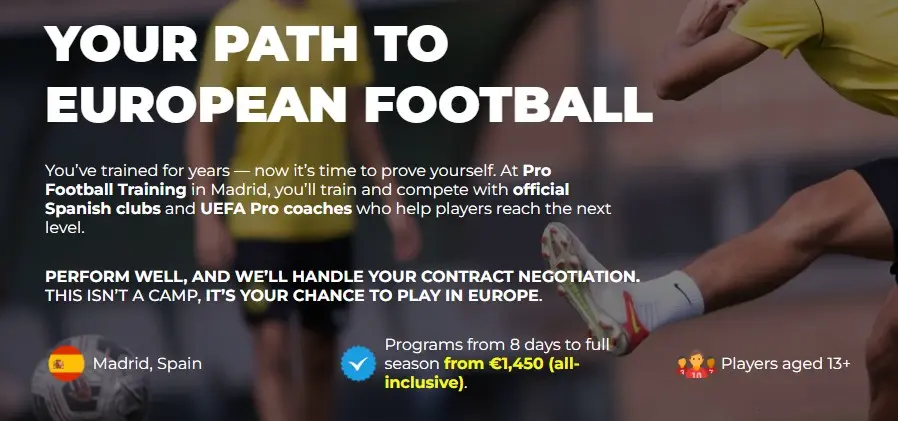
At Pro Football Training, that distinction is central to the way the offer is positioned: the goal is not to sell “Europe” as a fantasy, but to offer a serious pathway of immersion, training, adaptation, and exposure within a real football structure.
Pro Football Training, a platform within Siello Academy, is part of Siello Football Group, an ecosystem dedicated to the long-term development of footballers in Europe.
First sign of quality:
The length of the program should meaningfully change what the player is buying
One of the most common mistakes in this market is presenting every program as if it offered almost the same thing, just with more or fewer days attached to it. That is not how this works.
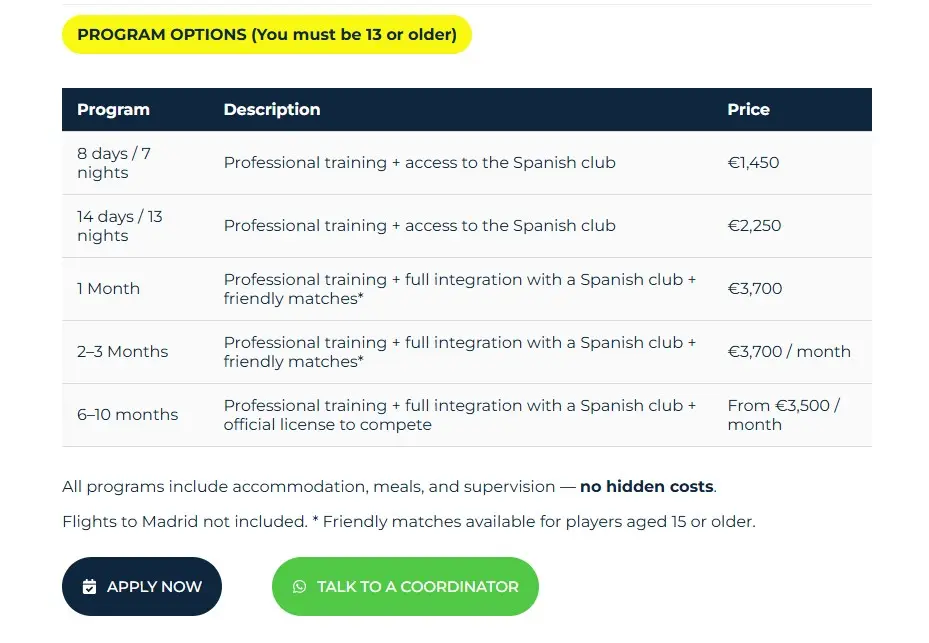
An 8-day or 14-day format can serve as a serious first immersion: training, contact with the environment, an initial level read, and early adaptation to the tempo and demands of Spanish football. But it should never be presented as equivalent to a medium-term stay or a full-season structure.
As the duration increases, the depth of the process changes too:
- the level of club integration
- the continuity of the competitive environment
- the possibility of friendlies or official competition where applicable
- the degree of real exposure within the ecosystem
- the time available to evaluate adaptation, consistency, and performance
That is why a serious academy does not just publish durations. It explains what actually changes between them.
In Pro Football Training’s that distinction is clear: there are short, medium, and long formats; they do not all promise the same thing; and some layers of the process depend on duration, age, or performance. That kind of precision matters, because it prevents false expectations from the start.
Second sign:
It should clearly separate training, competing, exposure, and signing
A lot of confusion in this market starts here. everything gets blended together to sound more attractive. But these are not the same thing.
- Training means working inside a real coaching and performance structure.
- Competing means entering an actual match environment with real demands.
- Exposure means being in a context where your level can be seen and evaluated.
- Signing with an agency or a club belongs to a completely different layer.
A serious brand does not mix these ideas to make the offer sound bigger than it is. In fact, one of the most useful principles for families and international players is this: exposure is not representation, and representation is not a club signing.
That is not a semantic detail. It is a sign of commercial honesty. If an academy promises too early what in reality depends on the player’s performance, the length of the process, and the competitive context, it is not simplifying the decision. It is distorting it.
Pro Football Training is explicit about this difference: the ecosystem may open real opportunities for exposure, integration, and progression, but it should never imply automatic professionalization or identical outcomes for every player.
Third sign:
The daily experience should be structurally solid, not just well marketed
Sometimes an academy looks serious because of its visual identity, its pitch, or the names around it, but the day-to-day reality for the player remains vague. That is where another layer matters: the operational structure.
It is not enough to say “high performance.” A family needs to understand whether there is:
- real accommodation in Madrid
- full board
- airport pickup
- local transportation
- daily training
- club integration
- 24/7 supervision and support
- local logistics and day-to-day guidance
None of that automatically makes a program the right fit for every player. But it does mark an important difference between an improvised offer and a serious structure.
This is usually where families can tell whether they are looking at a polished brochure or an actual system. When the process is well built, the conversation is not limited to the field. It also includes adaptation, supervision, rhythm, and context. That matters even more when the player is traveling from another country and the family is not evaluating a recreational experience, but a serious football and development decision.
Fourth sign:
It should not invent benefits or hide conditions
This is another useful filter: how clearly does the academy communicate what is included and what should not be assumed?
A trustworthy academy does not leave families assuming:
- that every program includes matches
- that official competition applies to every format
- that representation is automatically included
- that every player will receive the same level of integration
- that club access automatically means a contract is close
It should also be transparent about public conditions tied to age or duration. For example, if certain friendlies only apply to players above a certain age, that should be stated. If deeper competitive integration only becomes realistic in longer formats, that should be stated too. Commercial transparency does not weaken an offer. It strengthens it.
In a market full of inflated language, a brand builds authority when it explains what it can offer and what no serious program should guarantee in advance. That is one of the clearest signs of a structured project: it does not need to hide conditions in order to sound attractive.
Fifth sign:
It should have real structure and track record, not just a good story
Then come the proof points. Not as spectacle. Not as empty aspiration. But as evidence that there is more behind the offer than a well-designed page.
The signals that do help evaluate seriousness include:
- institutional track record
- a real club network
- public reviews with consistency
- the existence of an academy, agency, and club inside a wider ecosystem
- well-contextualized experience cases and development cases
- clarity around what each entity actually does
In the case of Pro Football Training and the Siello ecosystem, we can communicate signals such as a 4.8/5 Google rating based on 33 reviews, 15+ years connecting players and clubs, 25+ represented players, and access to 15+ clubs through the ecosystem. This kind of evidence helps reinforce structure, scale, and credibility. It should not be used as a promise that every player will follow the same path.
So how do you bring the decision down to your actual case?
The best academy for a player is not automatically the one with the biggest name or the loudest message. It is the one that best fits five real variables:
- Age. Not every pathway makes sense at 13, 16, or 19.
- Current level. Desire alone means very little if the chosen structure does not match the player’s real starting point.
- Objective. A first serious immersion is not the same thing as a long-term pathway with deeper competitive integration.
- Time available. The duration of the stay affects the type of experience and the depth of the process.
- The family’s ability to support the decision. Because this is not sports tourism. It is a serious investment in structure, logistics, and football development.
That is why, before comparing academies only by city, price, or branding, it makes more sense to ask a much more grounded question: what does this player actually need right now, and which format fits that moment best?
That approach reduces mistakes, lowers the risk of unrealistic expectations, and usually leads to a much better decision.
Choosing well does not start with excitement. It starts with criteria.
Spain can absolutely be a valuable environment for an international player. But not because there is some magic route to a career. It can be valuable because, inside the right structure, it becomes a serious environment for training, adaptation, competition, and exposure. That difference changes everything.
What families should look for is not the academy that sounds the biggest. They should look for a program that:
- clearly differentiates what it offers
- does not inflate what still depends on performance
- explains the process with precision
- has a real structure behind it
- treats the player as a profile that must be evaluated, not as a fantasy that needs to be sold “Europe”
If you want to bring this decision down to your real case, the next step is not to compare slogans. It is to understand which program fits your level, your goals, and your timing.