
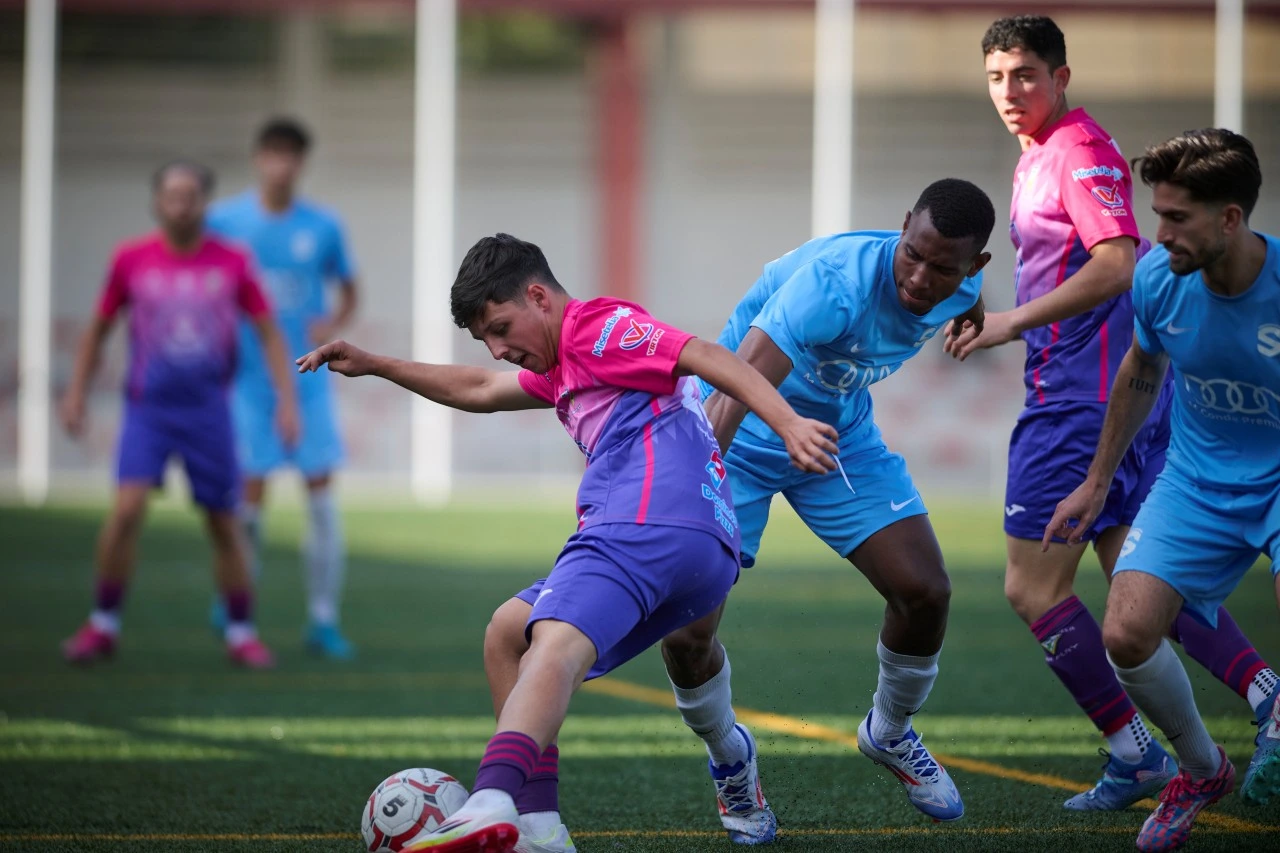
A football tryout in Spain is a structured evaluation to understand your real level and fit: technical execution at speed, tactical understanding and decision-making, physical base, and mindset (coachability, resilience, adaptability). Most coordinators will ask for a video, a player CV, and your basics (age, position, country). It’s not a magic shortcut or a guaranteed contract—it's a clear process to place you honestly and help you take the next step.
For many international players, a tryout in Spain looks like a direct door to an opportunity. But in a serious competitive environment, a trial does not work as a shortcut. It helps coaches observe the player in a specific context, and its value depends on preparation, adaptation, real level and the ability to sustain performance beyond one day.
The essentials in 30 seconds
- Tryouts are decided by repeatable behaviours, not one highlight.
- Many youth environments use a “four-corner” lens: technical, physical, psychological, social
- You’ll usually need: video + CV + basic player data.
- Apply with realistic filters: programs from €1,450 and minimum age 13+.
- The best preparation is 14 days of rhythm, habits, and clarity.
A tryout in Spain can help an international player be assessed in a more competitive environment, but it should not be understood as a guaranteed signing. Tactical adaptation, physical condition, age, program length, preparation and player performance all influence what that assessment can generate within a serious process.
Siello Academy, is part of Siello Football Group, an ecosystem dedicated to the long-term development of footballers in Europe. From that perspective, a trial can be useful, but it does not replace a complete profile assessment or a real adaptation process to the Spanish football environment.
¿What a tryout is (and what it is not)?
A tryout is an evaluation that helps staff decide:
- where your current level fits,
- what you should improve next,
- and what environment matches your profile.
What a tryout is NOT
- Not a guaranteed contract.
- Not a “highlight contest.”
- Not purely technical—your behaviour and adaptability matter.
International programs focused on Spain commonly assess your level and place you accordingly.
¿What it means to attend a tryout in Spain?
Attending a tryout in Spain means taking part in an assessment opportunity inside a Spanish football environment or in a context linked to clubs, coaches, academies or scouts who observe the player’s level.
It is not only about “playing well one day.” A trial may include training, small-sided games, a full match, position-specific observation, technical evaluation, tactical reading, competitive behaviour and prior review of materials such as video or a player CV..
The key is to understand that Spain is not just a destination. It is a competitive football context with rhythm, structure, correction, tactical demands and evaluation standards that may be different from the player’s home country.
¿Why a trial in Spain should not be seen as a shortcut?
The most common mistake is thinking that a tryout works like an automatic door: the player travels, gets seen, stands out and gets a club. That reading is too simple for serious football.
A trial can open an observation. It can provide an initial reading of level. It can show technical, physical and competitive qualities. But it does not guarantee a club signing, contract, representation agreement, official competition license or continuity within a club.
There is also a football reason: one isolated trial shows part of the player, not the whole profile. It may show how he performs in one session, but not necessarily how he sustains habits, corrects, adapts to rhythm, lives with daily demands or competes when he is no longer in “showcase mode.”
That is why a trial in Spain becomes more valuable when it is part of an organized assessment. The goal should not be chasing any opportunity. It should be understanding whether the player is prepared to show himself in an environment that will likely demand decision speed, tactical discipline, intensity and adaptation.

What coaches and clubs evaluate during a tryout
A coach does not only assess whether the player has talent. He assesses how that talent appears inside the game. In Spain, as in many competitive European environments, observation usually looks at the player in an integrated way: technique, tactics, physical rhythm, mindset, response to mistakes, communication and adaptation.
A practical and widely used framework is the FA “4 Corner Model”: technical, physical, psychological, and social. In tryouts, these corners show up together in every action.
Technical
Technique is observed in context. It is not enough to control the ball well without pressure. What matters is whether the player can execute at speed, with the right body orientation and with a previous reading of the play.
A coach may look at how the player receives, plays one or two touch, passes under pressure, protects the ball, orients the first touch, finishes and uses his technical resources without breaking the team structure.
What they typically look for (by position):
- first touch and oriented control under pressure,
- short/medium pass with both feet,
- clean execution at speed.
- finishing (if applicable),
- body orientation to receive and play quickly.
Key indicator: Does your technique hold up when the pace picks up?
A flashy action may attract attention. But reliable, repeatable and game-useful technique often matters more than one isolated play.
Tactical
Tactical reading often creates a clear difference. In a Spanish environment, a player may be assessed by his off-ball positioning, ability to offer passing lanes, positional discipline, coordinated pressure, reaction in transition and understanding of his role.
A winger is not assessed only by dribbling. A midfielder is not assessed only by passing. A centre-back is not assessed only by winning duels. Each position has specific decisions, and the coach observes whether the player understands his role within the team.
This is where the "European" focus is serious: decision and reading of the game.
- Do you scan before receiving?
- occupying spaces,
- when to accelerate and when to pause,
- understanding your role in phases (defence/attack/transitions),
In many cases, talent is seen more in repeated correct decisions than in one spectacular action.
Tactics also appear when the player receives a correction. If he understands quickly and adjusts, that leaves a positive signal. If he repeats the same mistake without processing the instruction, that also communicates something.
Physical
Physical rhythm is not only speed. It includes the ability to repeat efforts, sustain intensity, compete in duels, press, recover, change direction and maintain concentration under fatigue.
For an international player, this can be a sensitive point. He may come from an environment where he has more time to decide or faces less pressure after losing the ball. In Spain, he may encounter more dynamic sessions, less mental pause and higher transition demands.
It's not about "being the strongest," but about:
- coordination and agility,
- capacity to repeat efforts,
- changes of pace,
- aerobic base to sustain intensity.
Important: A "just enough" physical level can be compensated with intelligence and habits; a dominant physique without tactics often drops when the level increases.
The body matters, but so does the ability to play with clarity when rhythm increases.
Mindset & adaptation
For an international player, adaptation does not only mean speaking the language. It means understanding the training rhythm, correction style, dressing-room codes, daily intensity, way of competing and type of leadership expected.
Spain may demand a faster reading of space, a different relationship with the ball and stronger tactical discipline. This does not mean Spanish football is “better” in absolute terms. It means the context changes, and the player must show he can learn inside that context.
This part is often decisive for international players:
- how you respond to mistakes,
- response to coaching feedback,
- body language,
- discipline (punctuality, respect, daily work),
- team responsibility.
The evaluation of the "psychological" and "social" aspects is explicit in youth football development frameworks, because the player is not just performance: they are a person and a context.

What they’ll ask you for
Video (what works)
The video should not be only a collection of spectacular plays with music. Good material should help coaches understand the real player profile.
Ideally, it should show repeatable actions: oriented first touches, decisions under pressure, passing, duels, off-ball movement, finishing when relevant, transitions and participation in real-game situations. If full-match clips or longer sequences are available, they may provide more context than an over-edited highlight reel.
A useful video is not a 3-minute montage with music. The ideal:
- 1–2 short clips of repeatable actions (receiving, passing, decision-making),
- 1 real game segment (if you have one),
- clarity: position, jersey number, date and competition/environment.
If you don't have a match, show drills performed at game speed: first touch, one-touch passing, and finishing (depending on your position). The goal of the video is to start a conversation; it does not replace an on-field evaluation.
Player CV (simple and credible)
The player CV should be simple, credible and useful. It should quickly answer who the player is, his age, country, position, current club or recent background, competitive level and objective.
A player CV should not exaggerate achievements or use empty phrases. If the player has experience in tournaments, clubs, regional teams, academies or relevant competitions, it should be presented clearly.
It also makes sense to include practical details: date of birth, dominant foot, main position, secondary positions, height if relevant, nationality, country of residence, contact information and video link.
Your CV should answer quickly:
- data (age, height if applicable, dominant foot),
- position and role,
- current and previous clubs,
- competitive level (leagues/tournaments),
- verifiable achievements (without exaggeration),
- objective: what you are looking for in Spain and within what timeframe.
Basic player data (age, country, position)
Typical application forms request at least: birthdate, position, and country, in addition to name/email.
- Minimum age 13+..
- Investment reference: programs from €1,450 (depending on duration).
What changes when the player comes from another country
For an international player, a trial in Spain can be more complex than a trial at home. The football language changes. So do rhythm, coaching style, category, calendar, documentation, logistics and family pressure.
The way performance is interpreted also changes. A player may have level but need time to adapt. He may arrive with strong physical qualities but not yet understand the tactical rhythm. He may have technique but not be used to making decisions with less time.
This matters especially for families investing in the process. The expectation should not be “we travel and everything is decided in one trial.” A more serious reading would be: “we need to understand whether the player can adapt, sustain rhythm and show his profile in a more demanding context.”
Adaptation is not an excuse. It is part of the assessment.
How to train in football in Spain: Requirements, levels, and steps for international youth players
Whether you live in Latin America or the United States, the process of applying to a Spanish academy can feel challenging at first, but with the right information, everything starts to fall into place.
How to prepare for a tryout (14-day checklist)
The best preparation for a tryout is not to "kill yourself" training. It is to arrive with:
- competitive rhythm
- solid habits,
- and a clear head.
14-day checklist (practical)
Days 1–4: base and cleaning
- 2 technical sessions at pace (first touch + passing + body orientation)
- 2 mobility/preventive strength sessions (core, hip, ankle)
- 1 self video review: 10 actions (what you repeat well / what challenges you)
Days 5–9: decision under pressure
- 2 sessions with real pressure (rondos, small-sided games, 1–2 touches)
- 1 match or conditioned game (if possible)
- 2 short aerobic blocks (intervals) to sustain intensity
- practice "reset" after a mistake: breathe + next action (without frustration)
Days 10–12: tryout simulation
- 1 "profiling" session: warm-up + technical tasks + mini-match
- 1 tactical session: role by position (what I do in transition)
- get good sleep 2 nights in a row (this weighs more than you think)
Days 13–14: taper and arrive fresh
- light technical, mobility, activation
- review your video and CV (make sure they are ready)
- prepare gear, hydration, and schedule
What adds invisible points
- Arriving punctual and presentable
- Listening and executing instructions quickly
- Being a good teammate (communication and respect)
- Maintaining effort even if you don't succeed the first time
How an immersion in Madrid can help before an assessment
A football immersion in Madrid can help when the player needs context before being assessed. Instead of arriving directly into an isolated trial, he can train, adapt to the rhythm, receive corrections, understand the environment and show a more realistic version of his profile.
Pro Football Training offers programs in Madrid where the player trains, integrates into the Spanish club environment and experiences an immersion within the Siello ecosystem. Depending on the length of the program and the player’s performance, that experience can open real opportunities for exposure, competition and progression within the process.
The key is not to confuse structure with guarantee. The program can create a more serious environment to train, adapt and be observed. Performance still depends on the player.
If you are evaluating a trial in Spain, do not start by chasing any opportunity. First, review whether your age, level, position, preparation and timing fit a serious assessment process.
Common mistakes (and how to avoid them)
- Going with unrealistic expectations: thinking that a tryout = immediate contract.: pensar que un tryout = contrato inmediato.
- Confusing video: it is not clear who you are or there are only isolated plays.: no se entiende quién eres o solo hay jugadas aisladas.
- Overtraining in the last days: you arrive tired and "slow."
- Not knowing your role: wanting to do everything and losing identity.
- Defensive attitude to corrections: the staff is looking for learning, not perfection.
Steps to apply (straightforward)
- Define your objective: desired duration and context (age/role).
- Prepare: video + CV + basics.
- Send your profile via WhatsApp or form and ask for an initial evaluation.
- If you fit, reserve a date and confirm logistics (no promises: with clarity).
** Programs from €1,450 and minimum age 13+.
FAQs
Do I need professional level to attend?
Not necessarily. The key is honest placement and growth potential.
Minimum age?
Reference: 13+.
What should I send first?
Video + player CV + basics (age, position, country)
How much does it start from?
Depends on duration; there are options from €1,450 (all-inclusive depending on the program).
Do I need to speak Spanish?
International programs usually have English support; always confirm with the coordinator.
Can I be evaluated only by video?
Video helps as a first filter, but the real evaluation is strengthened with training/playing in context.
What happens if I am not selected?
A good process is not «pass/fail»: it gives you clarity on what to improve and what objective level to pursue.
What is valued more: technique or attitude?
Both. Technique opens doors, but coachable attitude and adaptability usually sustain opportunities.
If you want a no-obligation initial evaluation, send via WhatsApp
- Basic player data (age, country, position)
- 2–3 lines of your experience
- your video link
and we will reply with clear guidance on next steps.
Programs starting at €1,450; minimum age 13+.