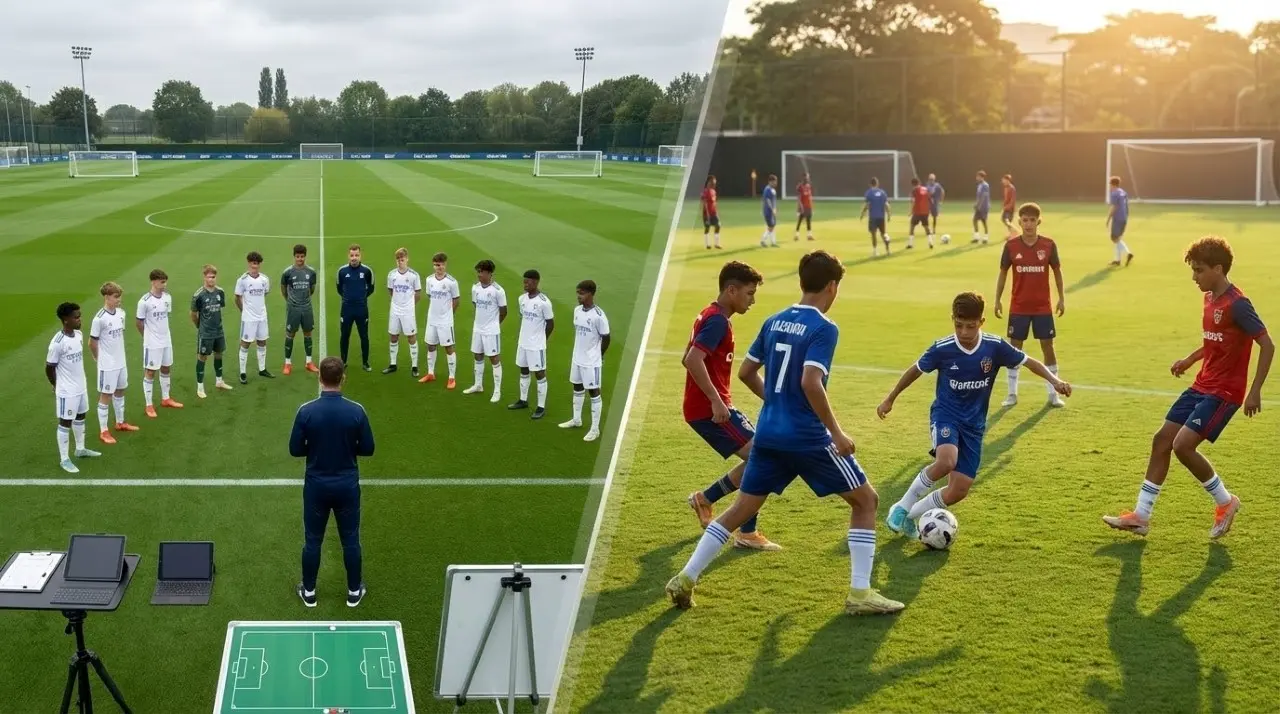
For years, the debate surrounding football training has had a silent protagonist: the method. Europe and Latin America train, feel, and understand football in different ways, and these differences shape players from a very young age.
Neither is better by definition, but each leaves a particular imprint on a young athlete's technique, tactics, character, and evolution.
This article does not seek to choose a winner. It seeks to understand, with honesty and depth, what these differences are and how they influence the development of a growing footballer.
How to train in football in Spain: Requirements, levels, and steps for international youth players
Whether you live in Latin America or the United States, the process of applying to a Spanish academy can feel challenging at first, but with the right information, everything starts to fall into place.
Why Compare Methodologies
In recent years, many young Latin Americans have begun training or trying out in Europe. This movement sparked a question among coaches and families: What does each system contribute, and how can they complement each other?
Youth football has been transformed. The demands have increased, performance analyses have become common, and comprehensive development—technical, physical, emotional, and cognitive—has taken center stage. Today, "playing well" is not enough: players must understand the game, adapt quickly, and sustain intense rhythms.
This is why this comparison matters. Not to define a "better place," but to understand what kind of environment can maximize the characteristics of a young footballer based on their personality, maturity, and style of play.
How is Training Done in Europe?
Europe has built a system that prioritizes structure and coherence in the developmental process. This is reflected in three elements: planning, clarity of roles, and methodological continuity
Most youth programs work with defined progressions: what is taught at each age, how it is evaluated, what skills are developed first, and how they are integrated as the player grows. This structure does not seek to limit talent but to organize it for sustained progress.
A central aspect is decision-making. European training organizes situations where the player must constantly think, read the game, anticipate, correct, and adapt. Technique is not practiced in the abstract: it is trained under pressure, in scenarios that simulate the reality of the match.
Another distinctive element is the professionalization of the coaching staff. Many coaches hold formative licenses recognized by bodies like UEFA, ensuring consistent teaching standards. It is not just about teaching football but about understanding the player's cognitive, physical, and emotional stages.
The use of technological tools is also visible: video analysis, physical load metrics, and monitoring of progress and setbacks. Technology does not replace the coach's intuition but complements it.
In general, Europe offers a highly ordered environment where the player learns to think fast, position themselves well, and respond to complex tactical systems.
Living and training in football in Spain:
Real costs, adaptation and key factors for young international players
How is Training Done in Latin America?
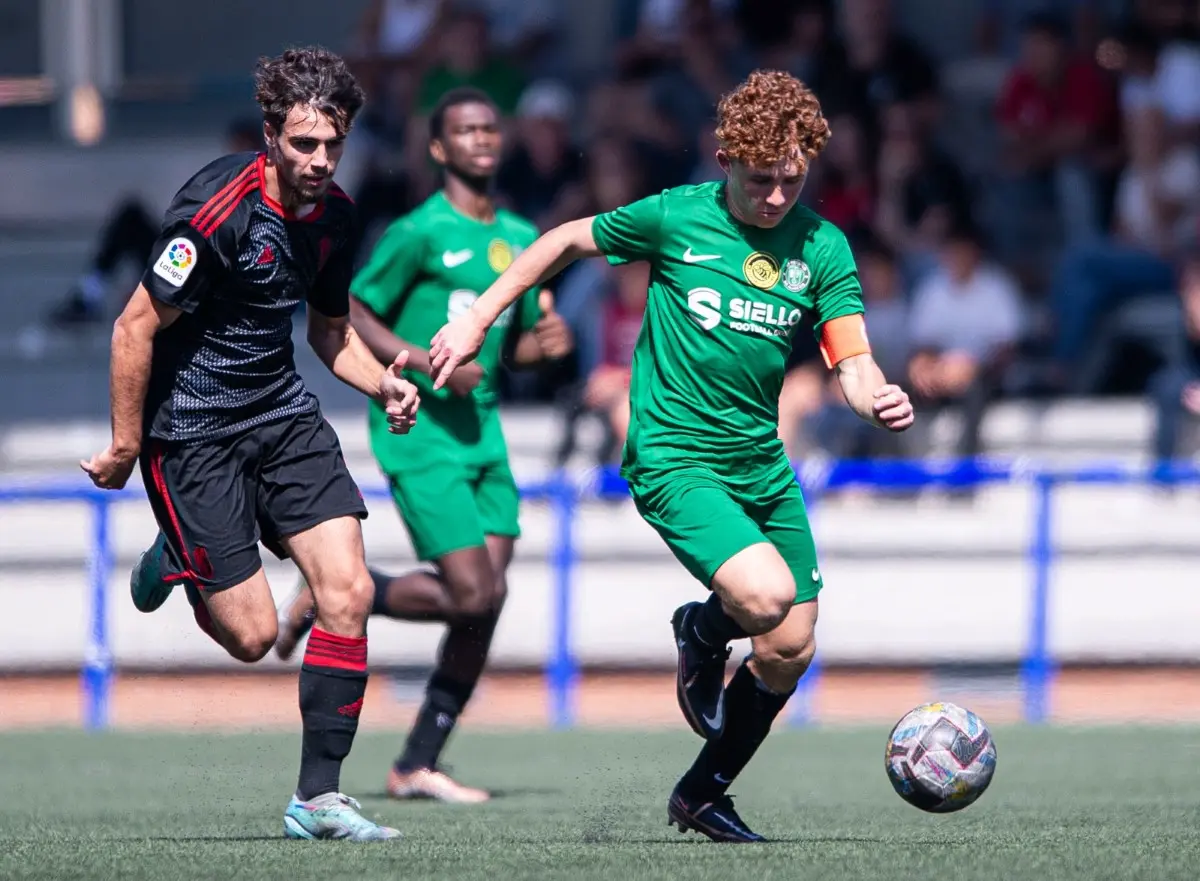
Latin American football has its own identity: creativity, improvisation, courage, and technical flair. Many players grow up in environments where they must solve unexpected situations, with little space, under pressure, and without time to hesitate. It is a style of football learned by playing, competing, and facing difficulties early on.
Latin American development relies on the individual capacity to unbalance the opponent, expressive technical skill, and spontaneous talent. The player learns to trust their intuition, overcome obstacles with ingenuity, and maintain their emotional intensity in critical moments.
Training sessions can be less standardized and more dependent on the coach's style and the context of the club or training school. This variability—though challenging—produces resilient players, capable of adapting to adverse circumstances and maintaining a very strong natural competitiveness.
In Latin America, football is also experienced emotionally. The player grows up with a deep emotional connection to the sport, which pushes them to strive even in difficult conditions. This emotional energy becomes part of their identity on the field.
How These Differences Impact Player Development
The European methodology usually strengthens game understanding, tactical discipline, and the cognitive ability to make quick decisions. The player learns to navigate complex collective systems and sustain stable performance.
The Latin American methodology usually strengthens creativity, boldness, and the ability to solve unplanned situations. The player learns to improvise, read emotions, and be courageous with the ball.
Both form different, yet complementary, talents. The European player may need more spontaneity; the Latin American player, more structure. When a player manages to integrate both dimensions, their growth is remarkable.
Differences also exist in physical preparation. Europe works with more controlled loads and well-organized training cycles, which favors injury prevention and sustained performance. In Latin America, emotional and competitive intensity can accelerate endurance capacity, but sometimes without the same level of monitoring and control.
Emotionally, the Latin player is often accustomed to dealing with pressure and expectations early on. The European player tends to develop in more balanced and less volatile environments. Again, these are distinct styles that leave different imprints.

Is There a Better System? An Honest Answer
No. There is no universal method that works for everyone.
Europe offers structure, clarity, and a solid methodological approach. Latin America offers formative passion, creativity, and a natural competitiveness that is difficult to replicate.
A young footballer should not choose a system to be like others, but to enhance their own profile. It depends on their personality, maturity, style of play, response to discipline, and ability to adapt to different rhythms.
What is clear is that many Latin American players grow tremendously when exposed to the European structure, without losing their original identity. It is a powerful combination: creativity + organization.
Which Methodology is Best Suited for Your Child or Your Profile as a Player?
This is the question that truly matters. Not all young people respond equally to the same stimuli: some need order to grow; others need freedom; others need both at different times.
Parents can observe key signals: how they handle frustration, how they organize themselves, how they interact, how they respond to correction, how they relate to teammates, and how they sustain effort when things do not go well.
The choice of the training environment will influence the player's trajectory, but also their personal development. That is why it is so important to make the decision calmly, with information, and with perspective.
Europe and Latin America train differently because they view football from different angles. And this diversity is a richness, not a conflict.
When a player understands how both worlds work, they discover new ways of thinking, feeling, and playing. When a family understands these differences, they make more conscious and less impulsive decisions. And when both cultures meet, young footballers grow from the best of each.