

Before a minor travels to Spain for soccer training, the family should confirm four areas: travel documents and entry requirements, travel authorizations based on the country of departure and airline, accommodation and responsible contacts in Madrid, and the actual sporting scope of the program. Requirements vary according to nationality, residence, itinerary, length of stay, age and family circumstances.
A trip like this does not begin when the player boards the plane. Before booking flights or setting dates, families should confirm whether the documentation fits the specific case, who will coordinate the arrival, where the player will live, how communication with the family will work and what the selected program actually includes.
At Pro Football Training, we work with international players aged 13 and older. When the participant is a minor, the family is part of the planning process from the beginning. Training, residence life and the daily routine take place within the Siello Academy environment, with a structure designed to support the player’s adaptation in Madrid.
That support does not replace decisions made by immigration authorities, consulates or airlines, nor does it replace the legal responsibilities that apply to each family.
What This Guide Covers — and What You Need to Verify Separately
This guide organizes the checks a family should complete before a minor travels.
It does not replace legal, immigration or custody advice. There is also no single document checklist that applies to every family: requirements may vary according to nationality, residence, country of departure, transit countries, length and purpose of stay, family circumstances and airline rules.
For a deeper look at visas and stay routes, see our guide to visa requirements for soccer training in Spain.
The practical rule is simple: first identify which situation applies to the player; then verify the exact requirements with the competent authority; and only after that commit to flights or other significant non-refundable expenses.
Before Moving Forward: Training, Competing and Signing Are Not the Same Thing
An important part of planning is understanding exactly what the family is booking.
Training at an academy, integrating into a club environment, playing in official competition, obtaining a federation license, receiving representation, entering contract negotiations and signing with a club are different processes.
Within our programs:
- training and football immersion are part of the process;
- integration refers to access and participation within a Spanish club environment, not an automatic club signing;
- friendly matches or competition depend on the program format, player age and applicable conditions;
- an official competition license applies only to formats in which it is expressly included;
- representation would require a separate relationship with Siello Football Agency;
- contract negotiations or a potential club signing depend on performance, context and later decisions by the relevant entities.
The structure can provide a real environment for development, adaptation and exposure. It does not turn those processes into guaranteed outcomes.
Family Checklist Before Booking Flights
1. Passport, Itinerary and Entry Requirements
The first area is documentation. Before booking, the family should review:
- a valid passport or travel document;
- the player’s nationality and country of residence;
- the planned length of stay;
- the complete itinerary, including transit countries;
- whether a visa is needed;
- documents that may be required to support the purpose and conditions of the stay;
- financial or additional requirements that may apply to the specific case;
- and secure copies of key documents and contact details.
Spain’s Ministry of the Interior states that foreign nationals entering Spain must have valid travel documentation and, where applicable, a visa. They may also be required to justify the purpose and conditions of the stay and demonstrate sufficient financial means.
That does not mean every family must submit exactly the same documents. Another player’s documentation should never be used as the definitive template for your own case.
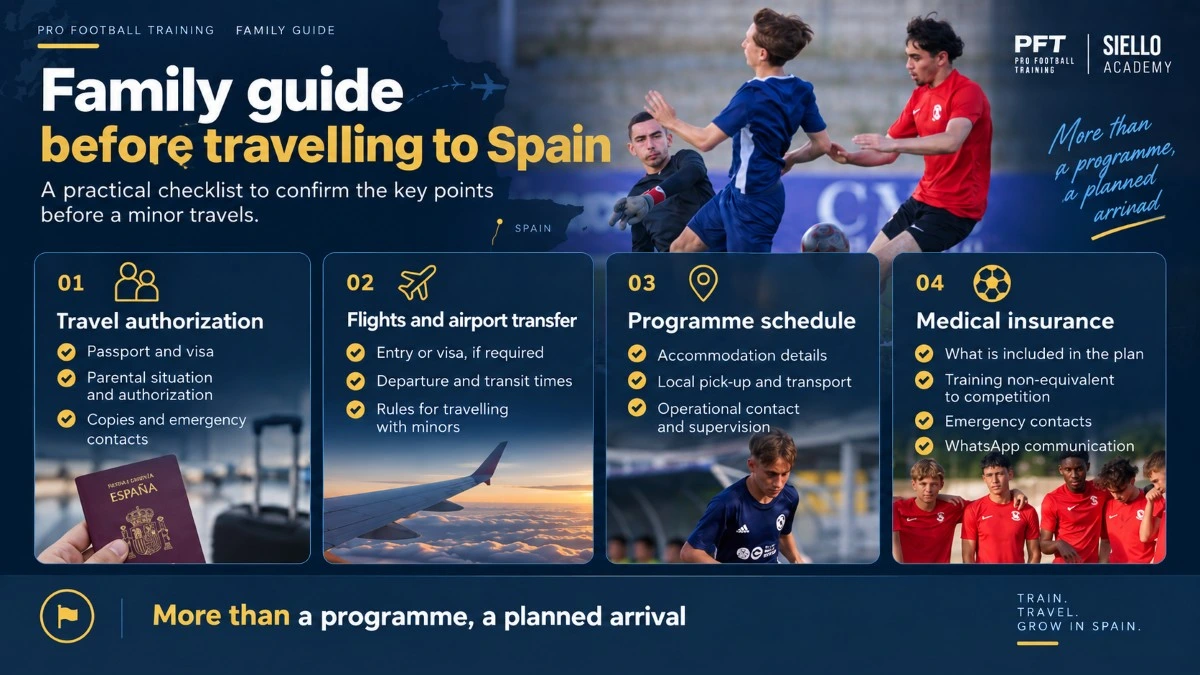
2. Travel Authorization for a Minor
A minor traveling alone, with an adult who is not a legal guardian, or with only one parent may need additional documentation authorizing the trip.
There is no universal authorization that applies in every country. The European Commission notes that each country sets its own rules and that transit-country requirements should also be checked. Airlines may also require their own forms or procedures.
That is why the right question is not simply: “Does the player need parental consent?”
Instead, ask: “What documentation is required by the country of departure, transit countries, Spain and the airline for this specific minor and itinerary?”
If the Player Is Departing From Mexico
For Mexico, it is important to avoid a common oversimplification.
The Minor Departure Form (SAM) is one of the mechanisms used by Mexico’s National Immigration Institute for certain minors leaving the country, particularly when they travel alone or with an adult third party. Mexican rules also provide for other authorized mechanisms, so the SAM should not be presented as automatically being the only document that applies to every minor or every trip.
If the player will depart from Mexico, the family should verify the specific situation directly with the National Immigration Institute before travel.
If the Player Is Departing From Argentina
Argentina’s immigration authority reported in July 2026 that departure authorization applies when a minor travels alone, with only one parent or guardian, or accompanied by a third party.
When the minor travels with both parents, documentation proving the family relationship must be presented.
The exact conditions, required documents and procedure should be verified directly with Argentina’s immigration authority before travel.
What if the Family Is Departing From the United States or Another Country?
Mexican or Argentine rules should not be automatically applied to families departing from other countries.
The family should verify the requirements of the country from which the minor is actually departing, as well as any transit-country requirements and airline rules.
3. If the Stay Will Be Longer
A stay of several weeks and a long-term program should not be treated as if they necessarily follow the same documentation route.
Before assuming that a particular visa or authorization applies, families need to identify which activity, duration and immigration situation actually apply to the player.
For certain Spanish authorizations linked to studies or training activities, foreign public documents may require a sworn translation, legalization or apostille depending on the case. These rules apply to specific procedures and should not be generalized to every sports program.
Our program can provide visa support, but that support does not equal visa approval and does not replace the competent authority. Visa support is part of the program’s validated general inclusions.
What Should You Confirm With Our Team Before Travel?
Before organizing the arrival, the family should have a clear understanding of the structure of the stay.
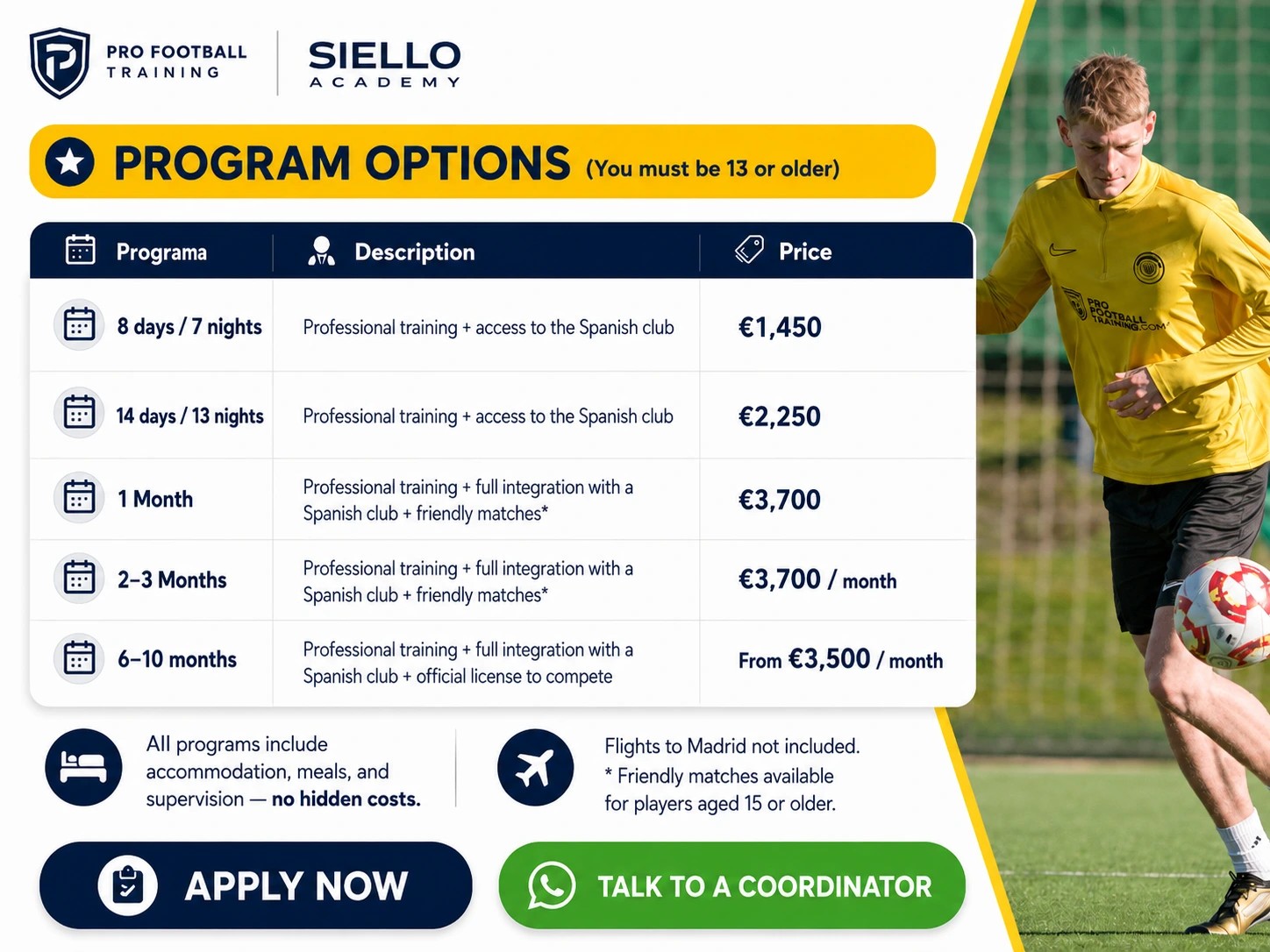
Pro Football Training programs generally include accommodation in Madrid, full board, airport pickup, local transportation, daily training, integration into a Spanish club environment, 24/7 supervision and support, visa support and local logistics.
When the player is a minor, families should also confirm how those elements will work for the specific stay.
Before traveling, confirm the following with our team:
- the accommodation format and applicable conditions;
- the arrival contact person or communication channel;
- the airport pickup procedure;
- transportation connected to the program routine;
- communication channels for parents or guardians;
- the procedure if an incident occurs;
- the documentation we need to receive to organize the stay;
- conditions that may change depending on age, duration or program format;
- and what sporting integration means in the selected program format.
Families should not assume that the program includes legal guardianship, guaranteed schooling, comprehensive medical insurance, clinical services, full legal support or parental representation, because these services are not part of the program’s validated general inclusions.
Before Travel, on Arrival and During the Stay
| Stage | What to review | What should be confirmed |
| Before travel | Passport, visa if applicable, authorizations and transit requirements | That the requirements match the player’s actual nationality, residence, age, itinerary and length of stay |
| Before travel | Program, residence and arrival | Accommodation, contact person, inclusions, pickup and transportation |
| On arrival | Pickup, settling in and communication | Who the player contacts and how the family receives confirmation of arrival |
| During the stay | Routine and incidents | Which situations should be reported, to whom and through which channel |
| During the stay | Sporting scope | The difference between training, integration, friendly matches, official competition, licensing and registration |
9 Questions Families Should Ask Before Confirming
- Which documents does our child need to travel, and which requirements must we verify with the authorities?
- Which documents does Pro Football Training need to organize the stay?
- Where will the player stay, and how will the arrival in Madrid work?
- Who will be our operational contact during the stay?
- How do transportation and family communication work?
- What exactly is included in the program format we are considering?
- What does integration into a club environment mean within this program?
- Does the format include training, friendly matches or official competition, and what conditions apply to each?
- Which parts of the process depend on performance and cannot be determined before the player arrives?
These questions are more useful than simply asking whether the program “includes a club” or whether the player “will have opportunities.” They turn broad concepts into specific conditions that can actually be confirmed.
Maturity, Independence and Communication
Having every document in order does not automatically mean that the timing is right for the player to travel.
The family should also assess whether the player can:
- follow a routine without constant family supervision;
- living with other players;
- respect rules and schedules;
- organize personal belongings;
- communicate a problem before it escalates;
- ask for help when needed;
- and respond to changes within a demanding environment.
The residence and supervision provide structure, but they do not guarantee automatic adaptation.
To explore this decision in more detail, see how to tell whether your child is ready for a soccer academy in Spain and our parent guide to safety, accommodation and support for young players.
If the documentation is already clear and you want to understand daily life, you can also read living in Madrid while training: routine, residence and adaptation.
What Should a Family Not Assume About the Sporting Process?
A minor can travel correctly, complete a program and train within a club environment without automatically becoming registered as a player for that club.
FIFA maintains specific protections for minors: international transfers of players under 18 are prohibited except in limited circumstances, and certain first registrations of foreign minors are also subject to specific procedures. FIFA published an updated edition of its guide to minor applications in February 2026.
That is why families should always distinguish between:
training → sporting integration → competition → licensing or registration → representation → contract negotiations → club signing.
Not all of these stages are part of every program, and none should be interpreted as an automatic consequence of traveling to train.
The Decision Starts Before the Flight
Organizing a minor player’s trip to Spain requires more than buying a ticket and packing a bag.
Serious planning reduces uncertainty before departure: documents, travel authorizations, residence arrangements, arrival, contacts, communication, sporting scope and family expectations.
The clearer each point is before travel, the fewer decisions the family and player will need to improvise once the player is in Madrid.
If your family is already evaluating dates and program length, speak with an advisor about your child’s case to review which program may make sense based on age, goals and current stage of development.
You can also review the different soccer academy formats available in Europe and what families can expect.

Official Sources to Check Before Travel
- Spain’s Ministry of the Interior: entry requirements and conditions.
- Your Europe — Comisión Europea: documentos y autorizaciones para menores que viajan.
- Your Europe — European Commission: travel documents and authorizations for minors.
- Mexico’s National Immigration Institute: Minor Departure Form (SAM).
- Argentina’s National Directorate of Migration: departure authorization for minors.
- Spain’s Ministry of Inclusion, Social Security and Migration: stay authorizations and foreign documentation.
FAQs
Can a Minor Travel Alone to Spain for Soccer Training?
It may be possible, but it depends on nationality, country of departure, itinerary, applicable authorizations and airline rules. The family should verify the requirements for the specific trip before booking flights.
Does a Minor Need Authorization When Traveling With Only One Parent?
Possibly. Rules vary by country of departure, transit and destination, as well as family circumstances. There is no single authorization that applies to every minor.
Are the Requirements the Same for Mexico, Argentina and the United States?
No. Each country sets its own departure requirements. Mexico has specific procedures such as the SAM in certain situations; Argentina requires authorization for certain trips involving minors; and requirements for the United States should be checked separately based on the case and itinerary.
Does Training With an Academy Mean the Player Is Registered With a Spanish Club?
No. Training, integration into a club environment, official competition, licensing, registration, representation and club signing are separate processes.
Who Confirms Whether the Player Needs a Visa?
The competent consular, immigration or administrative authority. Our team can provide documentation and visa support within the scope of the program, but it does not decide or guarantee approval.
What Should a Family Confirm With Pro Football Training Before Travel?
The family should confirm the program format, accommodation, arrival arrangements, transportation, communication channels, operational contact, inclusions, required documentation and any conditions that depend on the player’s age, program length or individual circumstances.