
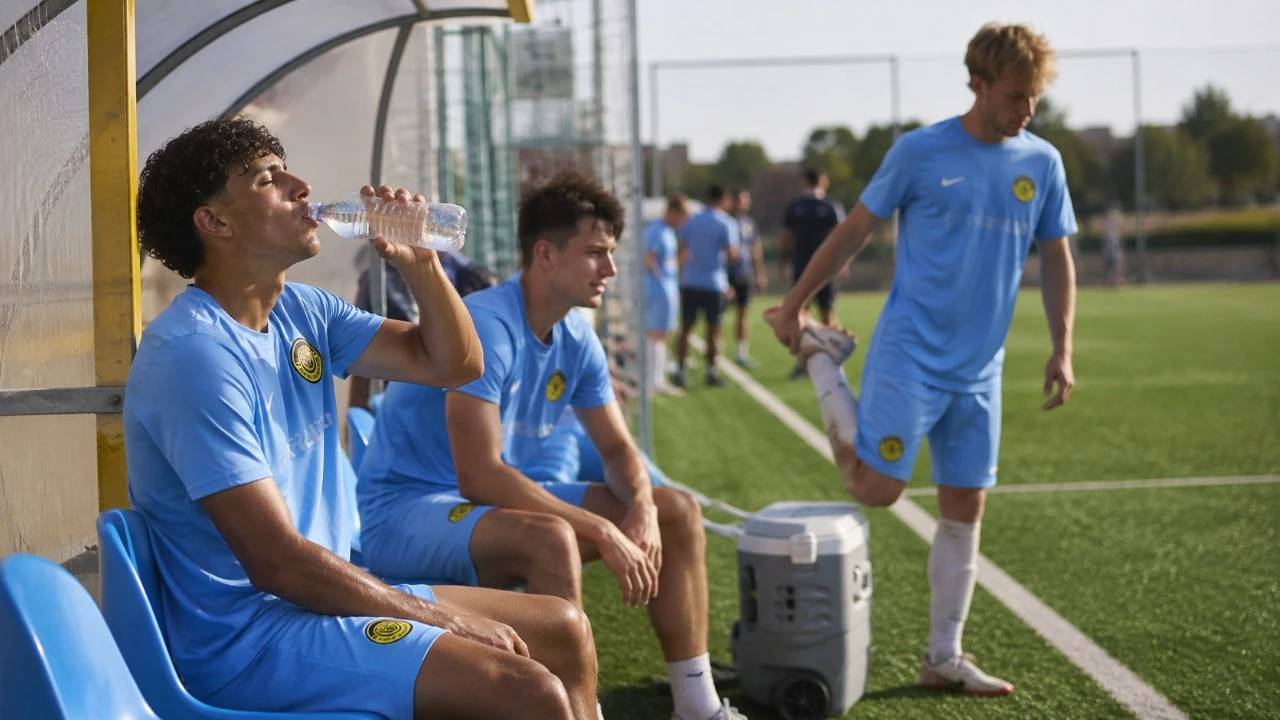
To recover after a football match, the priorities are far less sophisticated than they often look on social media: check that there is no injury that needs attention, replace fluids and energy, sleep, and adjust the training load over the following hours.
Ice baths, stretching, massage and foam rolling can be useful in certain contexts, but they are secondary tools. None of them replaces sufficient nutrition, hydration, sleep or good management of the next training load. There is also no fixed number of hours that guarantees a footballer is fully recovered.
The actual match load, minutes played, position, fitness level, prior rest, impacts, weather, travel and time until the next fixture all influence the individual response.
- A recent systematic review in professional football found that some variables could still be impaired 72 hours later, even though others had already returned to levels similar to those measured before the match.
That is why good recovery is not about using every technique available; it is about making the right decisions at the right time and observing how the player responds.
Important:
This guide provides general information and does not replace assessment by a doctor, physiotherapist, sports dietitian or other qualified healthcare professional. If there is severe pain, loss of function, difficulty bearing weight, symptoms after a blow to the head or another concerning sign, the priority is to obtain an appropriate assessment.
What Happens After a Football Match?
A football match produces several types of fatigue at the same time. The player has run, accelerated, decelerated, jumped, competed in duels and repeated high-intensity actions. By the end, there may be a combination of reduced glycogen availability, fluid loss, muscular and neuromuscular fatigue, stiffness, discomfort from contact and mental fatigue.
- That is part of the normal response to competition.
The problem is treating every discomfort as simple fatigue or, at the other extreme, assuming that heavy legs automatically mean an injury. Not everything recovers at the same rate, and feeling better does not necessarily mean that every physical capacity has fully recovered.
Recovery Plan for the First 24–48 Hours
This timeline is a practical reference, not a rigid protocol or a series of “magic windows”.
| Time after the game | Main priorities |
| First 15–30 minutes | Check symptoms, cool down, and begin rehydrating |
| First 2 hours | Eat, replace fluids, change clothes, and report pain or impact |
| That evening | Eat a sufficient meal, reduce stimulation, and sleep |
| The following morning | Review pain, mobility, energy, and response to movement |
| Between 24 and 48 hours | Adjust training load according to recovery and the next fixture |
The value of the table lies precisely in the order: safety and basic needs first; complementary recovery tools afterwards.
The First 30 Minutes: Before You “Recover”, Check How You Finished
If there is no concerning discomfort, there is no need to turn the end of the match into another training session.
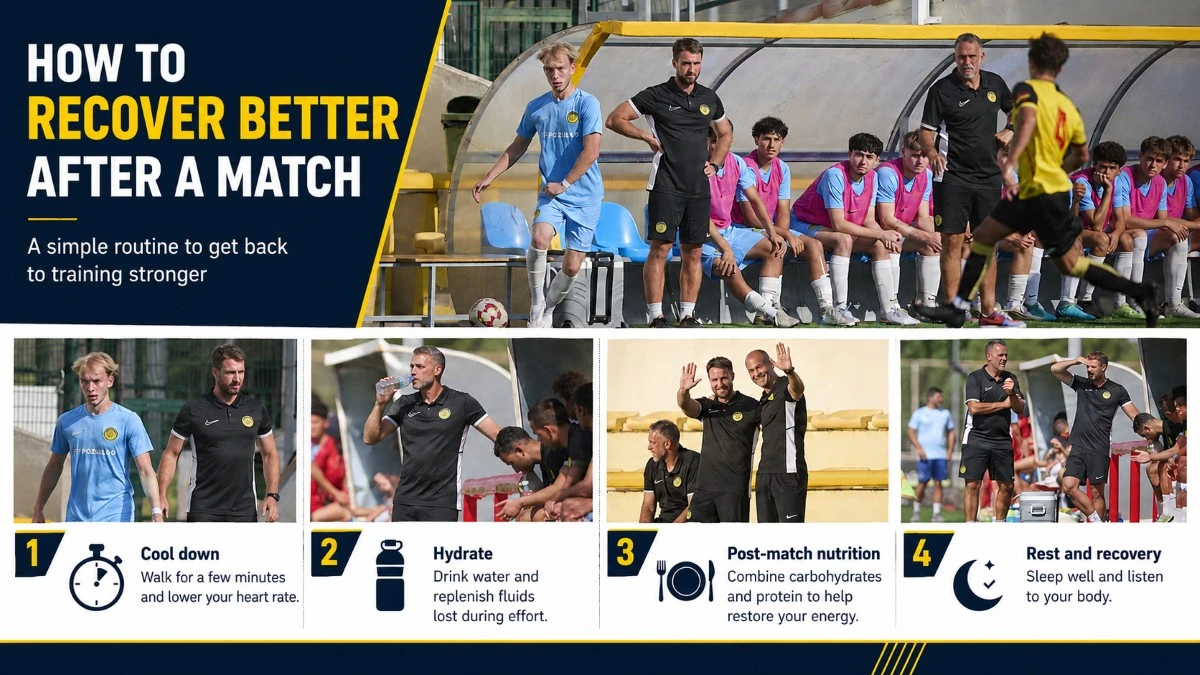
Walking for a few minutes, allowing your breathing to return gradually to normal, doing some comfortable mobility work, drinking and changing out of wet clothes may be enough as a transition. You do not need to stretch aggressively to “clear lactic acid” or force a position that hurts.
If there is sudden, localized pain, significant swelling, instability, difficulty bearing weight, dizziness or another symptom that does not match the player’s usual feeling of fatigue, trying to fix it with a generic recovery routine does not make sense.
If There Was a Blow to the Head
This requires a different approach. A concussion can occur without loss of consciousness, and symptoms do not always appear immediately.
- FIFA and the WHO’s Suspect and Protect campaign warns that symptoms may appear up to 72 hours after the impact. If concussion is suspected, the player should leave the activity and receive a medical assessment; they should not decide on their own to return to play.
Headache or pressure in the head, dizziness, nausea, balance problems, visual changes, confusion, memory problems, unusual drowsiness or clear changes in behaviour after an impact should not be treated as a normal part of post-match fatigue.
The First Few Hours: Eat and Rehydrate Without Overcomplicating It
Post-match nutrition should help replace the energy used, provide nutrients for repair processes and gradually restore lost fluids. You do not need to start with a supplement.
- A regular meal that combines carbohydrates, a source of protein and fluids can do the job perfectly well: rice with chicken, pasta with egg or fish, potatoes with a protein source, tortillas with chicken or beans, a sandwich with fruit, or yoghurt with oats and banana are all possible examples, provided they are foods the player tolerates well.
UEFA’s expert statement on nutrition in football includes carbohydrates, fluids and protein as part of post-match recovery and also follows a food-first philosophy: start with real food and adapt the strategy to the player’s context. Rapid replenishment becomes more important when there is little time before the next training or competition load.
This does not mean there is an exact deadline after which “eating no longer helps”. If the player has little appetite immediately after the match, they can start with something small and have a more complete meal once they feel better. The important thing is not to go several hours without eating and then expect one shake to solve the entire recovery process.
How Much Should You Drink?
There is no identical amount for everyone. Fluid loss depends on the weather, minutes played, body size, sweat rate, intensity and opportunities to drink during the match. After the game, it makes more sense to rehydrate progressively than to drink very large amounts within a few minutes.
In many situations, water and food will be enough. When sweat losses have been substantial, the weather is very hot or another activity is coming soon, fluids, carbohydrates and electrolytes may require more specific planning.
Energy drinks are not hydration drinks. Alcohol is not a recovery strategy either because, among other effects, it can interfere with processes that matter for rehydration, rest and recovery.
If you also want to organize your nutrition before competition, complement this guide with our article on what to eat before a football match.
The Night After the Match: Eat, Wind Down and Sleep
Sleep is one of the foundations of recovery and, paradoxically, sleeping well can be difficult after an evening match. Travel, competitive arousal, bright lights, screens, a late meal or caffeine can all delay sleep.
The strategy does not need to become a perfect routine. It makes sense to eat dinner even if the timing is different from usual, continue hydrating without drinking huge amounts immediately before bed, gradually reduce stimulation and create a comfortable environment for sleep.
I would not use one universal number of hours as the criterion for deciding whether a player is recovered either. Consensus guidance on sleep in athletes specifically warns that a one-size-fits-all approach does not reflect differences in age, load, schedule, sleep quality and individual needs.
For young players, sleep also has to fit around school, training, travel and other commitments. Recovering well requires that the whole context is part of the planning.
What to Check the Morning After a Match
The day after a match should not begin with only one question: “Do my legs hurt?” What matters is identifying what kind of sensation is present and how it is changing.
| More consistent with post-match fatigue | Needs professional assessment |
| General or bilateral heaviness | Sudden, highly localized pain |
| Moderate stiffness | Significant swelling |
| Diffuse muscle soreness | Inability or major difficulty bearing weight |
| General feeling of fatigue | Clear loss of strength |
| Muscle soreness that develops gradually | Instability or deformity |
| Symptoms that begin to improve | Pain that worsens or does not improve as expected |
| — | Persistent dizziness or symptoms after a blow to the head |
Chest pain, difficulty breathing, loss of consciousness or other severe symptoms require urgent medical attention.
This table is not designed for self-diagnosis either. Its purpose is to avoid two mistakes: ignoring a possible injury because “it is normal to be sore” or treating any stiffness after a match as an injury.
Should You Train the Next Day?
It depends. If there are no signs of injury and the player tolerates movement well, walking, mobility work or very light activity can be part of the following day. However, active recovery does not mean adding another demanding session.
- The goal is to maintain comfortable movement, not to prove commitment or “sweat out the fatigue”.
When a footballer is part of a team, the training load should be coordinated with the coaching staff. Minutes played, actual effort and the next fixture are more useful for decision-making than a rule such as “the day after a match is always a rest day” or “the day after a match is always a training day”.
If there is another match the following day, the fundamentals become even more important: enough food, hydration, sleep, less unnecessary physical activity and honest communication about any symptoms.
Having little time between matches does not make every recovery technique mandatory.
Stretching, Ice, Foam Rolling and Massage: What Can They Really Do?
Once the foundations —nutrition, hydration, sleep and load management— are covered, other tools can be used to improve the player’s comfort during recovery.
The key is to understand what each tool may contribute without attributing effects that have not been demonstrated.
| Recovery tool | What it may provide | What it should not promise |
| Foam roller | Temporary improvement in mobility and perceived soreness | Repairing an injury |
| Massage | Relaxation and perceived relief | Instant muscle recovery |
| Compression garments | Comfort for some players | Guaranteed performance |
| Cold-water immersion | Reduced soreness in certain contexts | Replacing nutrition and sleep |
| Gentle mobility | Maintaining comfortable movement | Correcting every type of pain |
| Electrical stimulation | Context-dependent and variable effects | Removing all fatigue |
Stretching after a match is not something you need to avoid. If the stretches are gentle, do not cause pain and are part of a routine the player tolerates well, they can be used to relax or regain a sense of mobility.
What needs to be clarified is what stretching can actually do. Available evidence does not clearly show that post-exercise stretching reduces muscle soreness over the following days or speeds up strength recovery compared with rest. The available studies are also limited, so it would not be accurate to conclude that stretching “does not work”.
Foam rolling and massage follow a similar principle: a player may feel less stiff or more comfortable without that meaning every physical capacity has fully recovered. In professional football, reviews of post-match recovery strategies also find that some methods show clearer effects on perceived soreness or wellbeing than on objective measures of performance and physiological recovery.
What About Ice Baths?
Cold-water immersion has somewhat stronger evidence in certain scenarios, particularly during congested fixture schedules. Recent football research has found possible improvements in perceived soreness and some recovery variables, but the effects are not the same across every physical capacity or every player.
That is why an ice bath does not need to become compulsory after every match. It can be a context-dependent tool, but it does not replace food, hydration, sleep or good load management.
How Many Hours Does a Footballer Need to Recover?
There is no universal number. Some variables may return close to their usual levels within the first 24 to 48 hours, while others can remain altered at 72 hours. A recent systematic review in professional players found that although some capacities had recovered by 72 hours, deficits could still remain in other measures, including some related to jumping and hamstring strength.
So “I feel fine” is useful information, but it is not a complete measure of recovery. Decisions about the next training load should also consider minutes played, intensity, age, history, sleep, discomfort, travel and the competition schedule.
Recovery Is Also Part of Player Development
A footballer’s development does not happen only during training sessions or matches. It also depends on how the player manages the time between one load and the next.
Learning to hydrate, eat enough, organize rest, recognize when a problem needs attention and communicate how you feel are all habits that help sustain a more demanding training process.
For a player arriving in Spain from another country, this adaptation also happens off the pitch. Schedules, travel, climate, meals, living arrangements and the daily sporting routine all change. Learning to organize those variables is part of adapting to a more structured football environment.
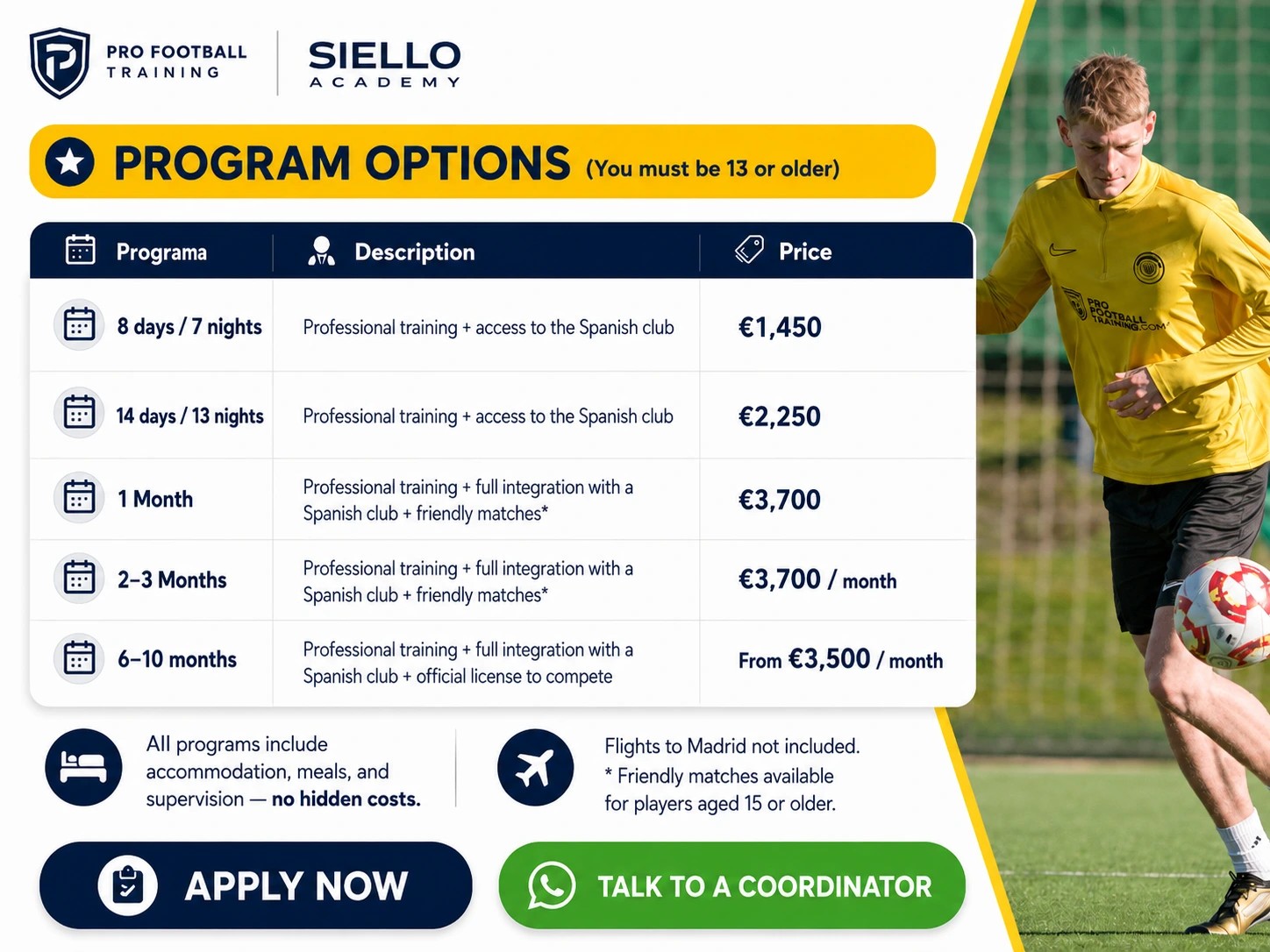
At Pro Football Training, the process is not simply about accumulating training sessions. The program gives players the opportunity to train in Madrid within an environment that requires them to adapt to new routines, training rhythms and football dynamics.
That is why, when assessing a program, it is not enough to look only at how many hours you train or how many days it lasts. It also matters to understand the level of immersion and continuity the player needs according to their age, experience and goals.
Explore Pro Football Training programs and find the format that best fits your current stage as a player.

Frequently Asked Questions About Recovery After a Football Match
What Should You Do Immediately After a Football Match?
First, check whether there has been any impact, pain or symptom that needs attention. If everything is fine, start drinking progressively, lower the intensity, change out of wet clothes and organize a meal or snack.
What Should You Eat After Playing Football?
A recovery meal can combine carbohydrates, a source of protein and fluids. Rice, pasta, potatoes, tortillas, fruit, yoghurt, eggs, chicken, fish or legumes can all be part of it depending on the player’s preferences and tolerance.
How Long Does It Take a Footballer to Recover?
It depends on the load and the player. Some capacities may recover within 24–48 hours, while others can remain altered for 72 hours or longer. There is no single number that applies to everyone.
Is It Good to Stretch After a Match?
Gentle stretching can be used if it feels comfortable, but there is no strong evidence that post-exercise stretching substantially reduces muscle soreness over the following days.
Do Ice Baths Help After a Match?
They may help some recovery indicators and reduce perceived soreness in certain contexts, especially during congested schedules. They are not essential and do not replace food, hydration or sleep.
Is It Good to Train the Next Day?
It depends on the minutes played, the match load, symptoms and the next fixture. Light activity may make sense, but another demanding session should be adjusted to the player’s actual condition.
How Can You Tell the Difference Between Fatigue and a Possible Injury?
Fatigue is more likely to feel like general heaviness or stiffness and should improve over time. Sudden localized pain, swelling, loss of strength, instability, difficulty bearing weight or symptoms after a blow to the head require professional assessment.