
When a family searches for soccer academies in Europe, it usually enters the market with a simple idea: find a good option, compare it with others, and decide. The problem is that the search itself starts from a misleading assumption. “Soccer academy in Europe” sounds like one single category, but in reality it covers very different types of offers.
That is one of the most common mistakes at the start of this process. Families compare formats that are not meant to do the same job, read promises as if they referred to the same kind of pathway, and end up making decisions with expectations that were never calibrated correctly.
That is why the first useful step is not ranking academies. It is understanding the map.
Before asking which academy is best, a family should understand what kind of program is actually in front of them. Because a showcase is not the same as a short-stay immersion. A camp is not the same as a structured development pathway. A medium-length program is not the same as a full-season environment. And training, competing, getting exposure, and moving into deeper layers of a football ecosystem are not the same thing either.
From the outside, the European market can look homogeneous. Many websites use similar words: elite, high performance, exposure, clubs, trials, Europe. But behind that language there are very different structures, with different levels of depth, demand, supervision, and continuity.
Some offers are built as a first point of contact. Others are meant to function as short, intensive experiences. Some are mainly designed to place the player in front of evaluators for a limited window. Others are designed to support routine, adaptation, and deeper club integration over time.
That is the first value of this article: it helps families read the market with more precision.
Because a family should not evaluate “soccer academies in Europe” as if it were comparing four versions of the same product. It should understand what models exist, what each one is meant to do, and what can reasonably be expected from each format.
Format 1: camps, campus-style offers, and short exposure experiences
In the European market, short formats often exist as camps, campus-style experiences, or condensed training environments. Sometimes they last only a few days; sometimes one or two weeks. In some cases, they are meant to provide a first immersion. In others, they are designed as an intensive block of sessions, group training, or brief exposure to a new environment.
There is nothing inherently wrong with this format. The problem begins when it is interpreted as if it were something else.
This kind of experience can be useful for getting to know an environment, testing a first response, stepping outside the player’s usual context, or getting an initial external read. It can also make sense for families that are not yet ready to commit to a longer pathway and want a more limited starting point.
What should not happen is overloading the format with expectations that do not belong to it. A short experience does not replace a long process. It should not be sold as if it automatically delivered competitive depth, structural continuity, or results that can only be evaluated over a much longer period of time.
Format 2: showcases, tryouts, and short evaluation windows
Another common category is the showcase or concentrated tryout model. .Here the focus is usually on observing the player during a limited window, whether in front of coaches, scouts, clubs, or evaluators. For some families, this model feels attractive because it seems to offer a fast answer. That is exactly why it requires careful reading.
For some families, this model feels attractive because it seems to offer a fast answer. That is exactly why it requires careful reading.
A short evaluation window can be useful for generating observation, feedback, or an initial reference point. What it cannot do on its own is replace a serious adaptation process. In football, a real reading of a player does not depend only on what happens in one isolated moment. It also depends on how the player handles rhythm, interprets the environment, adapts tactically, and responds to demand over time.
So when a family sees a showcase or tryout-based offer, the most useful question is not “Will they see me?” The more useful question is, “What part of the process can actually be measured in this format, and what part cannot?”
Format 3: short but structured immersion programs
Between very short experiences and long-term pathways, there is another category that tends to be much more useful for families looking for something serious without jumping straight into a full season: short but structured immersion programs.
Here the point is no longer just to train for a few days or attend a single trial. The point is to enter a process logic, even if only in an initial layer. These formats usually allow a more realistic read on how the player adapts to training, daily rhythm, demand, living structure, and the club environment.
That is where their value sits. They do not promise a complete transformation in a short window, but they also go beyond a superficial experience. They function as a serious first layer of immersion.
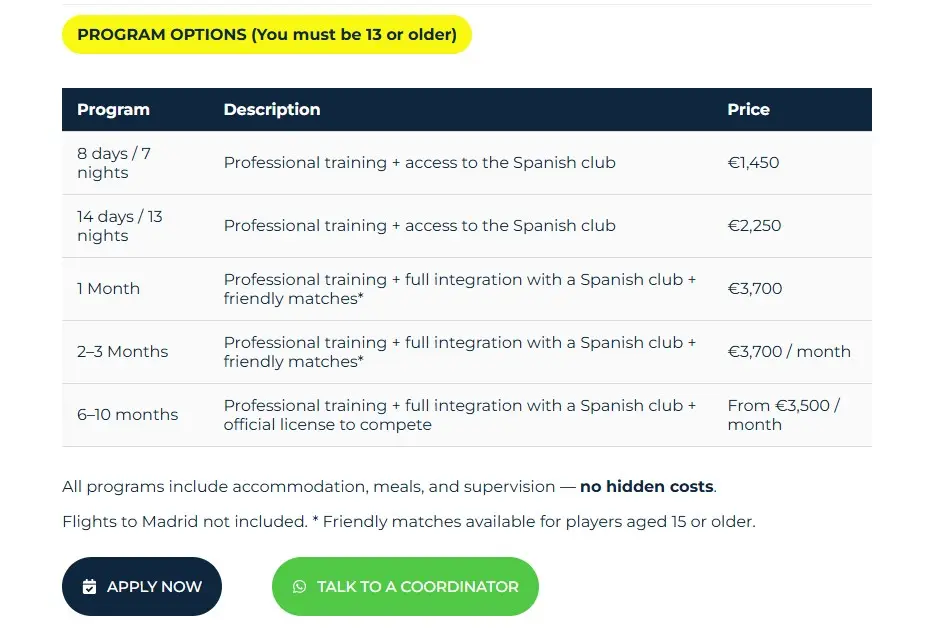
In the case of Siello Academy,the short programs are as a structured and demanding entry point into the process, with training, immersion, integration into the environment, and support, but without presenting the experience as if it were equivalent to a full-season pathway or an automatic route to later outcomes.

Format 4: medium-length integration and adaptation programs
Then come flonger formats, usually from one to three months, which make it possible to observe a different level of response.
At this stage, the player is not only getting a first impression of the environment. The player is beginning to sustain a routine, absorb the structure more fully, live with stable demands, and show whether adaptation can move from something temporary to something competitive.
For many families, this is one of the most valuable ranges . Not because it “guarantees” anything, but because it creates more room for realistic evaluation. A player can look promising for a few days. Holding the process for weeks is a different test.
This is also where another common confusion needs to be avoided: more time does not automatically mean representation, signing, or a career outcome. What a medium-length format can often provide is a stronger base for reading fit, discipline, tactical response, continuity, and the player’s capacity to sustain immersion.
Format 5: long-stay or full-season pathways
The deepest category in the European market is the long-stay or full-season pathway. This is where the conversation moves beyond short experience and into real continuity, much more robust integration, and a process that simply cannot be compared with brief formats.
This kind of option can make a lot of sense for profiles that already need a complete structure for development, competition, and adaptation. But it is also the format that should stay farthest away from empty aspirational language. Precisely because it is more serious, it needs more clarity.
A long-stay pathway should not be sold as automatic access. It should be explained for what it is: a deeper structure, with more time to compete, adapt, sustain rhythm, and be evaluated inside a serious football process.
In Siello Academy this principle is clear. The long-stay pathway is presented as the strongest option for integration, continuity, and competitive structure within the ecosystem, but not as a synonym for guaranteed success.
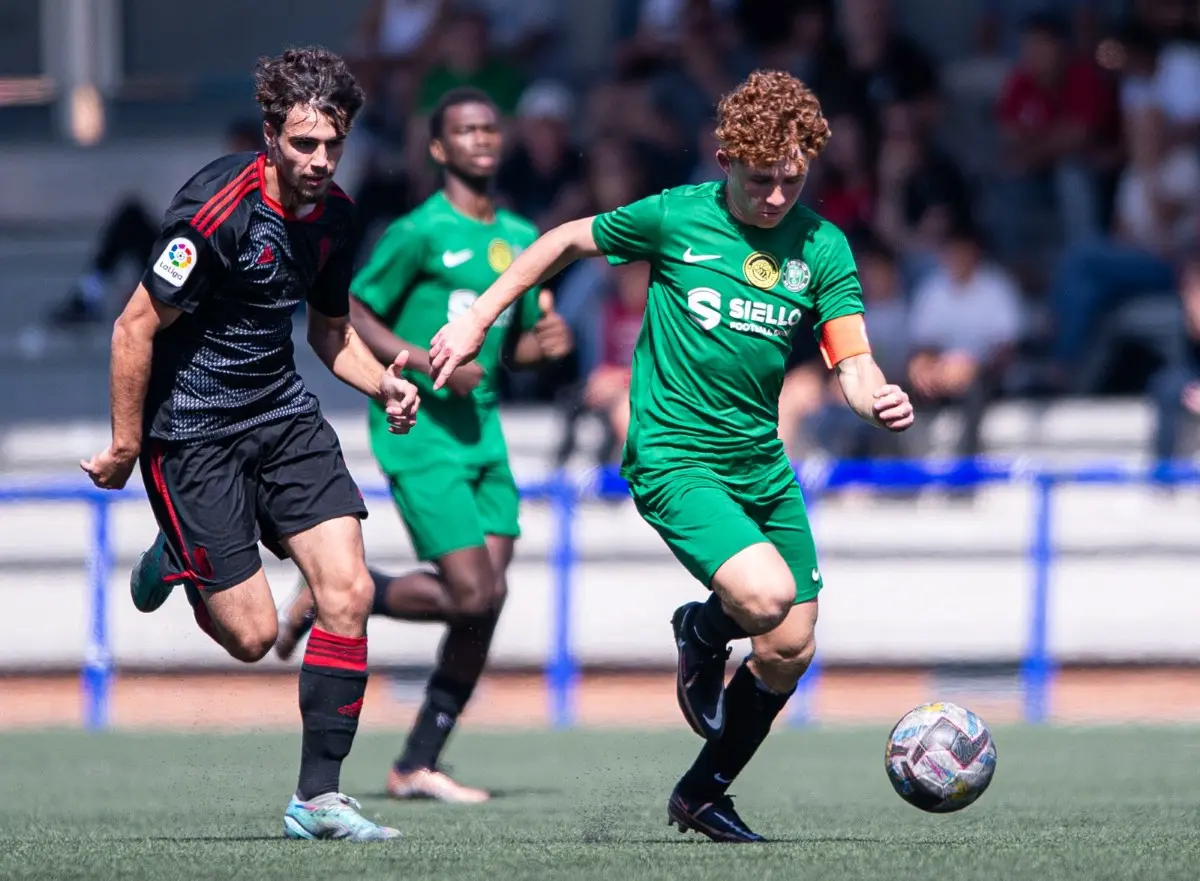
Living and training in football in Spain:
Real costs, adaptation and key factors for young international players
What a family can reasonably expect
Once these formats are understood, the whole conversation improves. The family stops comparing names and starts comparing functions. That shift improves expectations in a healthy way.
- A short experience may offer a serious first read, not a solved career.
- A showcase may offer observation, not structural depth.
- A short but organized immersion may offer a real entry into the process, not the equivalent of a long-stay pathway.
- A medium-length format may offer more adaptation and more context for evaluation.
- A long-stay structure may offer continuity and a much deeper framework, not magic.
That is, in the end, one of the most useful filters in the market: understanding what each format can actually do, and stopping the habit of asking one model to deliver what only another model can provide.
There is something even more important: even when a format looks serious, not everything should be assumed automatically.
- A family should not assume that every academy offers the same level of supervision.
- It should not assume that all programs include the same level of club integration.
- It should not assume that more time erases the role of age, level, or performance.
- And it should never assume that training means competing, or that competing means signing.
Families that enter the European market with these distinctions clear tend to make better decisions. Not because risk disappears — it never does — but because the process starts being read with more criteria.
So what should a family do with this information?
There is no need to start with the loudest academy, the biggest name, or the most dramatic language. It makes much more sense to start with something simpler: identify what kind of format the player actually needs.
That step organizes everything else. Because once the correct format is clear, it becomes much easier to compare programs, ask better questions, evaluate structure, and filter out empty promises.
Europe is not one single offer. It is a market made up of different models. And families that understand that arrive much better prepared when it is time to make a decision.
If you want to bring that reading down to your real case, the next logical step is not to read more slogans. It is to understand which type of program actually fits the player’s profile, goal, and current stage.