Choosing a soccer program in Spain should not start with a question like, “Which one is the best?” It should start with a much more useful one: which format makes sense for this player, at this stage, with this level and this objective?
That difference changes the whole decision.
In this market, many players and families compare formats as if the only thing that changes is the number of days. That is not how it works. Between a short stay, a deeper mid-length option, and a full-season pathway, what changes is not just the calendar.
What changes is the depth of the process, the type of adaptation that can realistically be observed, the level of competitive integration, and the room to evaluate how the player responds inside the ecosystem.
That is why it helps to stop looking at an 8-day, 14-day, 1-month, or full-season program as if they were all just different versions of the same product. They are not. Each one serves a different purpose, and the smarter decision is not the longest or the shortest by default. It is the one that fits the player’s real profile.
Not every format is meant to do the same job
One of the most common mistakes when evaluating soccer programs in Spain is assuming that every format offers essentially the same thing, just with more or less time attached to it.That is not the case.
A short program can work as a serious first immersion. A mid-length option can create a much deeper adaptation phase. A full-season structure can offer a level of continuity that simply does not exist in a brief stay. Each one answers a different need, and when people choose the wrong format, what usually fails is not the program itself. It is the expectation they brought into it.
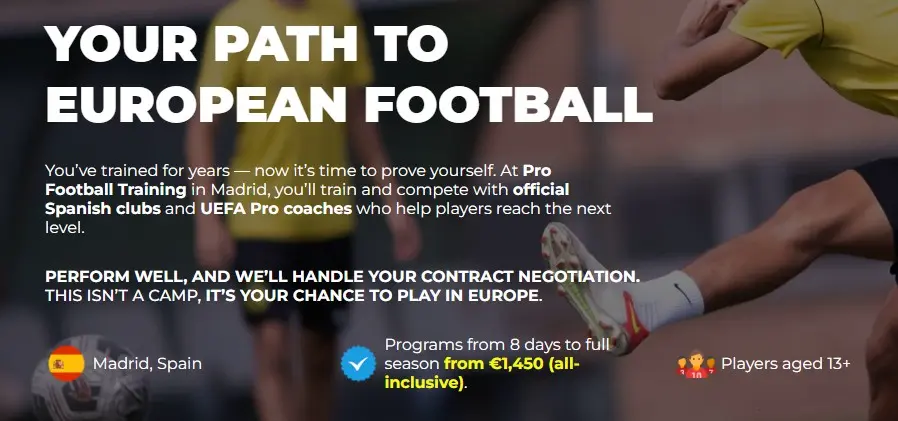
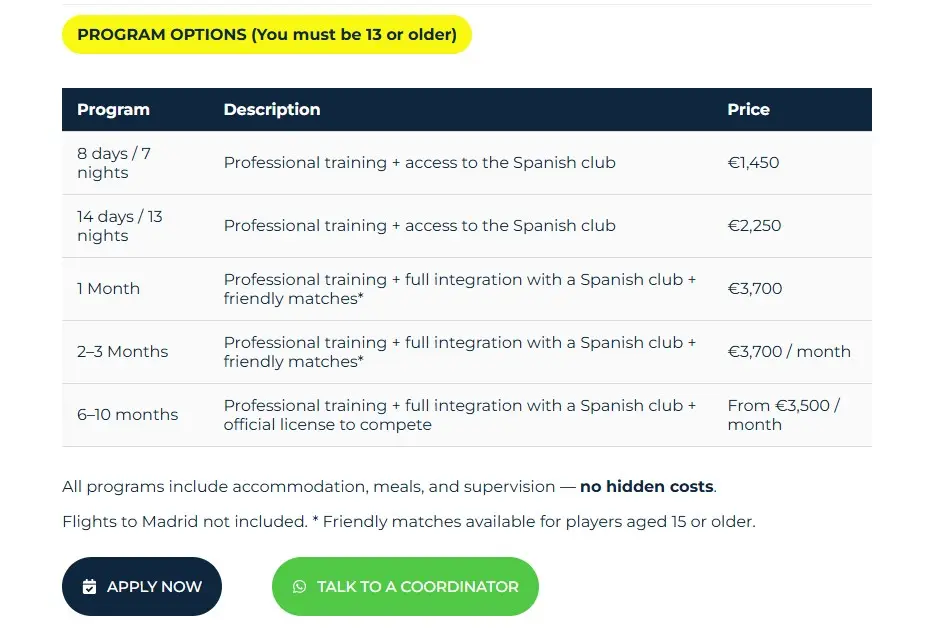
In Pro Football Training and Siello Academy that difference is explicit: there are short formats of 8 days / 7 nights and 14 days / 13 nights, medium formats of 1 month and 2–3 months, and a longer 6–10 month structure. The point is not to sell more time as if more time automatically solved everything. The point is to explain what actually changes when the duration changes.
The real question is not, “Which program sounds more complete?” It is “What does this player need right now for the process to make sense?”
What an 8-day or 14-day stay can actually give you
Short programs have a specific function, and they can be very valuable when they are understood correctly.
They work as a serious entry point into the process. Not as sports tourism, not as a recreational experience, and not as a fast promise of a career. Their value sits somewhere else: they allow a first immersion into the environment, a more realistic read on the player’s level, and an initial evaluation of how the player adapts to the demands, tempo, and structure of football in Spain.
That matters more than many families expect.
For international players, the first challenge is not always technical. Often, it is contextual. The pace changes. The decision-making speed changes. The training structure changes. The tactical rhythm changes. And the ability to hold a serious routine away from home becomes part of the picture too.
- A short program can make a lot of sense when the goal is to test that first response with real criteria.
It can also be useful for families who are not ready to commit to a deeper pathway yet, but who do want to move beyond fantasy and into a real environment that allows them to see the player in a different setting.
At the same time, that specific function should not be inflated. An 8-day or 14-day stay should not be presented as equivalent to a long-term pathway. Nor should families assume that short formats automatically include friendlies, official competition, representation, contract negotiations, or an official competition license. Those layers do not belong automatically to the short formats, and presenting them that way would create the wrong expectation from the start.
If what a family needs is a serious first immersion to evaluate adaptation, level, response, and fit, a short format may be the right starting point. If what they need is deeper competitive continuity, it probably will not be enough.
When a 1-month or 2–3-month program makes more sense
This is where the logic changes. Mid-length programs do more than introduce the player to the ecosystem. They create a much deeper adaptation stage. With more time, the player is not just training. He is beginning to hold a routine, absorb the environment more fully, integrate more consistently, and offer a far more realistic picture of how he responds inside the structure.
That makes evaluation much more meaningful.
When a player needs more than a first contact — but is not yet clearly at the point where a full-season pathway makes sense —a 1-month or 2–3-month format can be a very intelligent option. It gives real room to see whether the adaptation was not just emotional or temporary, but competitive and sustainable. It also allows coaches and families to observe more clearly things like discipline, consistency, tactical response, tolerance for demand, and the player’s ability to stay inside the process after the initial excitement wears off.
In these formats, club integration is deeper than in a short stay. There may also be friendlies where applicable, but with an important nuance that should never disappear from the communication: in the public offer, friendlies should be described with precision, and they are tied to specific conditions, including age. If the article mentions friendlies, it is important to preserve that public distinction instead of presenting them as a universal feature.
What should not happen here is exaggeration.
A 1-to-3-month program can provide a much more serious immersion, a more realistic level of competitive exposure, and more room for evaluation inside the environment. But that does not mean it automatically includes an official competition license, agency representation, guaranteed playing time, or a club contract. Duration alone does not justify those conclusions.
Put simply, the medium-length option can be the smartest step for many profiles precisely because it combines depth with realism. It does not promise what still does not belong to that stage, but it does allow much more to be observed than a short format ever could.
What actually changes in a full-season pathway
A full season is not simply “more time.” It is a different layer of the process.
When the conversation moves to a 6-to-10-month format, what comes into play is not just a longer stay, but competitive continuity, much deeper integration, an official competition license, and a more robust structure for training, adaptation, and exposure inside the ecosystem. That is why, when the player’s profile really justifies it, a long-stay pathway can offer a much more solid framework for long-term development.
Even here, though, the tone should stay grounded.
The fact that the full-season option is the strongest offer does not mean it is automatically the right one for everyone. It also does not mean it should be sold as if it were the same thing as a signing, a contract, or a guaranteed career path. The project’s claim system is very clear on this point: the program can open real opportunities for competition, visibility, and progression depending on the player’s duration and performance, but it should never be framed as an automatic success formula.
A full-season format makes sense when the player no longer needs only an initial read or a short adaptation phase, but a more complete structure where the process can develop with continuity. It is a serious option for players who need a deeper pathway, not for families looking for a comforting promise.
So how do you know which format fits your case?
The best decision does not come from comparing days. It comes from looking at five real variables together.
The first is age. The right approach is not the same at 13, 16, or 19. Public age conditions matter, and so does the type of process a player can realistically sustain at each stage.
The second is the player’s current level. Not his desire. Not the family’s hope. His actual starting point. A program can be too short for a profile that needs depth, but it can also be too long for someone who has not even tested how he responds in a more demanding structure.
The third is the objective. A first serious immersion is not the same as a longer pathway focused on deeper competitive integration. The format should match the objective, not the other way around.
The fourth is time available. Some families try to make a major decision too early. Others prolong the trial phase for too long. Neither helps much. Time should serve the process, not the anxiety to get an answer as quickly as possible.
The fifth is the player’s real capacity for adaptation. And that does not refer only to football. It also includes routine, discipline, intensity, coexistence, competitive context, and the ability to hold daily structure away from home.
When those five variables are evaluated together, the decision usually becomes much clearer.
Common mistakes when choosing program length
One of the most common mistakes is choosing a short format while expecting results that belong to a much longer process. Another is paying for a long stay without having enough clarity yet about the player’s profile, objective, or actual readiness to sustain it.
Families also make poor decisions when they choose only by price, as if the most accessible program were automatically the smartest one. Or when they choose only by emotion, as if the longest format automatically validated the seriousness of the pathway.
The right duration is not defined by impulse. It is defined by fit.
And in a market where many offers still try to resolve the conversation with oversized promises, that kind of criteria matters a lot.
Choosing well is not about buying more. It is about entering the right process.
The best decision is not always the longest one, the shortest one, or the one that looks most ambitious from the outside. It is the one that best matches the player’s current stage, level, objective, and adaptation needs.
An 8-day or 14-day program can be a very useful first immersion when what the player needs is a real read on response and context. A 1-to-3-month format can be the right next step when deeper adaptation is the real priority. A full-season pathway can make sense when the profile already calls for competitive continuity and a much more complete structure.
What matters is not buying time as a symbol. It is choosing duration as a tool.
If you want to bring that decision down to your real case, the next step is not to compare formats by instinct. It is to understand which one fits your profile, level, and objective most clearly.
FAQs about Soccer Programs in Spain
Which soccer program in Spain makes sense as a serious first step?
A short program can work well as a first serious immersion when the goal is to evaluate adaptation, level, and response inside a new environment without assuming the depth of a long-term pathway.
What changes between a 14-day program and a 1-month program?
The difference is not just time. A 1-month stay allows much deeper adaptation, more consistent integration, and a much more meaningful evaluation of how the player responds inside the process.
Is the full-season option always the best one?
No. It is the deepest structure, but not automatically the right fit for every player. The best choice depends on age, level, objective, timing, and adaptation capacity.
Do all formats include matches and official competition?
No. Not every format includes the same level of competitive integration, and some elements depend on duration, age, and context.
How do I know whether I need a short stay or a longer pathway?
The best way is to evaluate the player’s current profile, real objective, stage of development, and how much depth the process actually requires.